Have you ever looked at a calendar, counted a few weeks ahead, and then wondered whether you had landed on the correct date? It happens more often than we admit.
Maybe you are planning a family celebration, waiting for an important appointment, preparing for a holiday, or simply trying to picture where you will be two months from now. Whatever the reason, knowing What Date Is 8 Weeks From Today can make planning feel a little less confusing and a lot more manageable.
Today’s date is October 10, 2026, and eight weeks from today will be Saturday, December 5, 2026. That means the date is 56 days into the future, giving you a useful reference point for personal goals, work deadlines, travel plans, and special occasions.
It may sound like a small calculation, but having the right date can prevent missed appointments and last-minute rushing, which nobody particularly enjoys.
In this guide, we will explore the exact answer, explain how to calculate the date yourself, break down the time conversion, and show you how to use a calendar or date calculator for better planning.
We will also look at related dates, common calculation mistakes, and practical ways to make an eight-week timeline work for your everyday life.
What Date Is 8 Weeks From Today? Quick Reference Table
| Item | Details |
|---|---|
| Title | What Date Is 8 Weeks From Today? Exact Date, Calendar Calculation, and Planning Guide |
| 8 Weeks Equals | 56 Days |
| Today’s Date | October 11, 2026 |
| Date 8 Weeks From Today | December 6, 2026 |
| Day of the Week | Sunday |
| Calendar Weeks | 8 Complete Weeks |
| Hours | 1,344 Hours |
| Minutes | 80,640 Minutes |
| Seconds | 4,838,400 Seconds |
| Crosses Month Boundary? | Yes (October November December) |
| Crosses Year Boundary? | No |
| Common Uses | Project planning, appointments, pregnancy milestones, travel planning, study schedules, event countdowns |
| Calculation Formula | Start Date + (8 × 7 Days) = Future Date inchcalculator.com |
What Date Is 8 Weeks From Today?
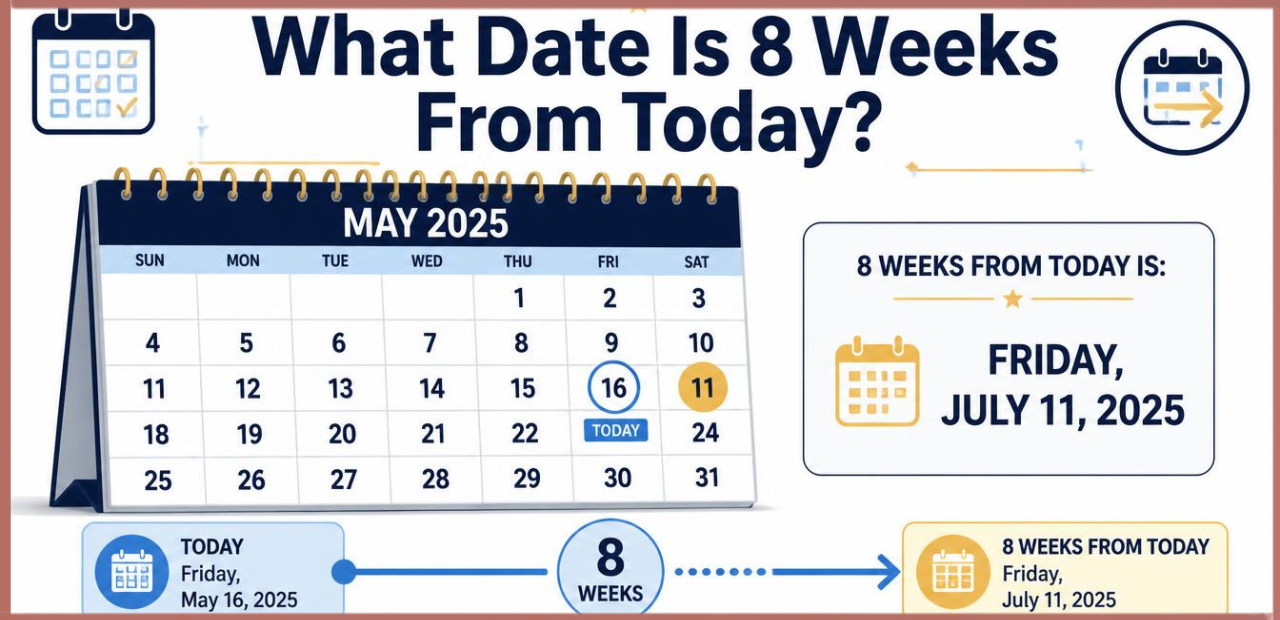
The direct answer is Saturday, December 5, 2026. Starting from October 10, 2026, you simply move forward by eight complete weeks on the calendar. Since every standard week contains seven days, eight weeks equal 56 days.
Here is the essential information at a glance:
- Today’s Date: October 10, 2026
- Start Date: October 10, 2026
- Duration: 8 weeks
- Total Days: 56 days
- Future Date: December 5, 2026
- Day of Week: Saturday
- Calendar System: Gregorian calendar
This Date in 8 Weeks is particularly helpful when you need an exact date rather than a rough estimate. Saying “about two months from now” can be convenient in conversation, but two calendar months do not always contain the same number of days. Eight weeks, on the other hand, always represents 56 days when measured as a standard elapsed period.
Imagine writing the date on a sticky note and placing it beside your computer. Suddenly, a distant deadline becomes something you can work toward, one week at a time. That’s the nice thing about turning an abstract duration into an actual calendar date.
How to Calculate 8 Weeks From Today
You do not need an advanced mathematical formula or a complicated application to perform this calculation. A simple calendar and a little patience will usually do the job. Still, understanding the process is useful when you need to calculate other future dates without depending on a tool every time.
Start With Today’s Date
The first step in any Date Calculation is identifying the correct starting point. For this example, the Start Date is October 10, 2026.
Make sure you are using the current date in the relevant time zone, especially if you are scheduling an international meeting, an online appointment, or a deadline for someone in another country. A difference of one day can sometimes create unnecessary confusion, and it is easier to check at the beginning than fix later.
Convert Weeks Into Days
The next step is a basic Time Calculation:
- One week equals 7 days.
- Four weeks equal 28 days.
- Eight weeks equal 56 days.
The calculation is straightforward:
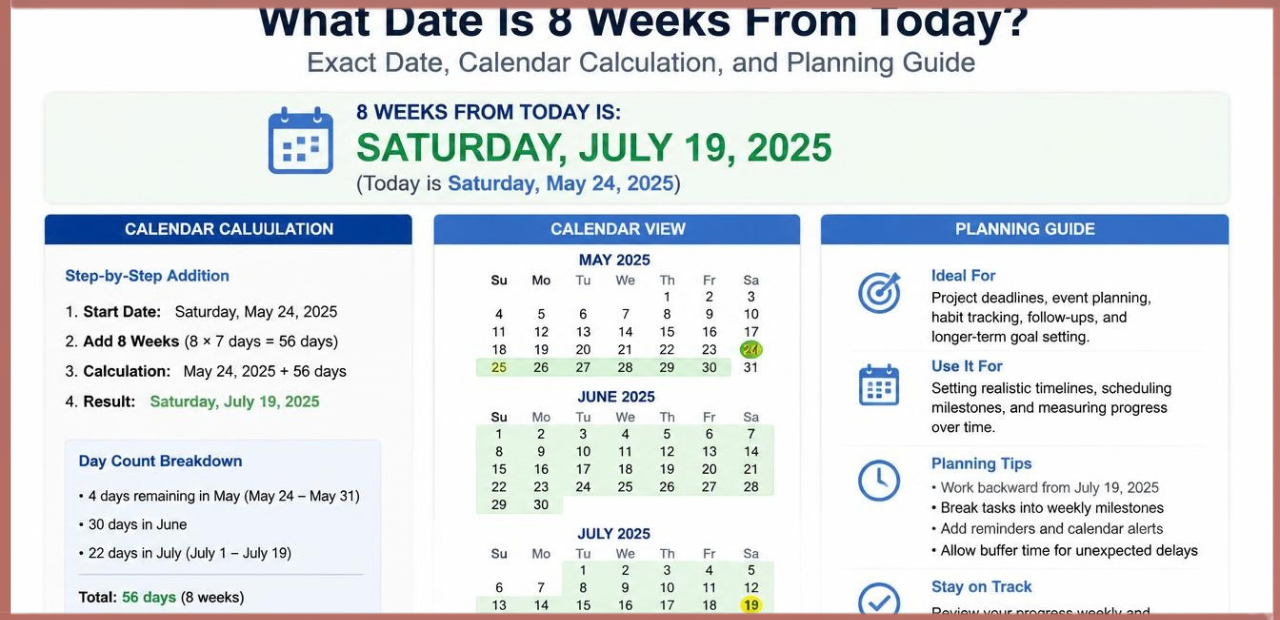
8 weeks × 7 days = 56 days
This conversion is the foundation of a reliable Week Calculation. Once you know that the interval contains 56 days, you can use a paper calendar, a digital calendar, or a date calculator to determine the final date.
Move Forward by 56 Days
Now take October 10 and count forward 56 days without counting the starting date as day one.
There are 21 days from October 10 to October 31 when calculating the elapsed interval from the starting date to the end of October. After that, November contributes another 30 days, bringing the total to 51 days. Five more days take you into December, landing on December 5.
The result is Saturday, December 5, 2026.
This method is sometimes called calendar arithmetic or adding a date offset. It works for other durations too, whether you want to find a date 14 days ahead, 35 days ahead, or several weeks into the future. The main thing is to count elapsed days correctly rather than accidentally including the starting date as an extra day.
Verify the Result
A final check is always worthwhile. Eight weeks should move the date forward by exactly eight seven-day intervals, and the weekday should remain the same.
October 10, 2026, is a Saturday. Eight weeks later is also a Saturday, December 5, 2026. That simple weekday check offers a useful confirmation that your Calendar Date is consistent with the requested duration.
8 Weeks From Today in Days, Hours, Minutes, and Seconds
Sometimes, knowing the date is enough. Other times, you may need a complete Time Duration Calculator breakdown for a countdown, a project timeline, or an online date tool. Converting weeks into smaller units makes the length of the interval easier to visualize.
Here is the conversion for eight standard weeks:
- 8 weeks: 8 complete weekly periods
- 56 days: 8 multiplied by 7 days
- 1,344 hours: 56 multiplied by 24 hours
- 80,640 minutes: 1,344 multiplied by 60 minutes
- 4,838,400 seconds: 80,640 multiplied by 60 seconds
These figures describe a standard interval of 56 full days. They are useful for general planning, but they do not necessarily describe the exact number of seconds between two local clock readings across a daylight-saving-time change. Some locations adjust their clocks seasonally, which can make the elapsed number of hours differ from a simple 56-day multiplication.
For everyday purposes, however, the conversion is more than sufficient. If you’re creating a Countdown to December 5, you can describe the milestone as eight weeks away or 56 days away, depending on which wording feels more natural.
How Time Conversion Helps With Planning
A Time Interval becomes easier to understand when it is expressed in a unit that fits the task. Days are helpful for travel planning, hours work well for shift schedules, and minutes or seconds may be useful in technical applications.
For example, a team managing a software launch may use 56 days as the overall project duration, divide the schedule into weekly milestones, and reserve the final few days for testing. Someone preparing for a family gathering may prefer to think in weekends rather than individual days.
The underlying calculation stays the same. Only the way you use the information changes, which is why a simple Time Calculation can be useful in so many different situations.Writing
Date in 8 Weeks: A Calendar Breakdown
A calendar is more than a collection of numbered squares. It is a practical way to turn future plans into something visible, and an eight-week period gives you enough space to organize several important activities without feeling as if everything is happening tomorrow.
Starting from October 10, 2026, the following dates show how the eight-week period progresses.
| Time interval | Calendar date |
|---|---|
| Starting point | Saturday, October 10, 2026 |
| One week later | Saturday, October 17, 2026 |
| Two weeks later | Saturday, October 24, 2026 |
| Three weeks later | Saturday, October 31, 2026 |
| Four weeks later | Saturday, November 7, 2026 |
| Five weeks later | Saturday, November 14, 2026 |
| Six weeks later | Saturday, November 21, 2026 |
| Seven weeks later | Saturday, November 28, 2026 |
| Eight weeks later | Saturday, December 5, 2026 |
Notice how every date falls on a Saturday. That happens because a full week contains seven days, so adding seven days preserves the weekday. This is a useful little trick when doing Week Counting without a calculator.
You can also mark each Saturday on a wall calendar and use it as a weekly checkpoint. Maybe the first Saturday is for setting goals, the fourth for reviewing progress, and the eighth for celebrating what you have accomplished. A small habit like this can make a distant Future Date feel surprisingly achievable.
How a Date Calculator Makes the Process Easier

A Date Calculator is a convenient option when you need a quick answer or want to compare several possible dates. Rather than manually counting squares on a calendar, you enter the starting date, choose the number of weeks, and let the tool calculate the result.
A typical Weeks Calculator works with three basic inputs: the start date, the duration, and the direction of the calculation. You can add weeks to find a future date or subtract weeks to discover a date in the past.
For the current example, the process is simple:
- Enter October 10, 2026, as the starting date.
- Select the option to add time.
- Enter eight weeks.
- Check the result: December 5, 2026.
A future date calculator is especially useful when you are dealing with multiple deadlines, repeating appointments, or a long list of events. It can reduce counting mistakes and help you keep your schedule consistent.
When to Use a Weeks From Today Calculator
An online weeks from today calculator can help in several everyday situations:
- Planning a birthday party, anniversary, or family reunion.
- Working out when a course or training program will finish.
- Estimating the date of a project milestone.
- Organizing travel reservations and accommodation.
- Setting reminders for renewals, submissions, or follow-up appointments.
- Building a personal fitness or learning schedule.
A Time Duration Calculator may offer additional options, such as calculating the difference between two dates or converting days into weeks. If you are planning something important, always check whether the tool calculates calendar dates or working days, because those are different things.
For official appointments and contractual deadlines, verify the final date against the relevant organization’s rules. Some deadlines exclude weekends or public holidays, and a standard calendar calculation will not automatically account for those exceptions.
Common Date Calculation Mistakes to Avoid
Date arithmetic seems easy until one small assumption throws everything off. Fortunately, most mistakes are avoidable if you understand how weeks and dates work.
Confusing Eight Weeks With Two Calendar Months
Eight weeks equals 56 days, but two calendar months may contain 59, 60, 61, or 62 days, depending on the months involved. For that reason, eight weeks from today and two months from today are not interchangeable expressions.
If someone asks for a date eight weeks after October 10, the correct calculation gives December 5, 2026. If they ask for a date two calendar months later, the answer would be December 10, 2026.
The difference matters when you are scheduling an event, calculating a project deadline, or following instructions that specify an exact duration.
Counting the Starting Date Twice
Another common mistake is treating the starting date as day one when adding a duration. In ordinary date arithmetic, adding 56 days to October 10 means moving forward by 56 days, resulting in December 5.
Some processes use inclusive counting, particularly when counting a series of calendar days for administrative or legal purposes. In those situations, the applicable rules may produce a different deadline. Always follow the counting convention specified by the organization or authority involved.
Forgetting Time Zones and Clock Changes
A calendar date is not always the same thing as an exact elapsed number of hours. If you are scheduling a meeting across time zones or calculating a deadline around a daylight-saving transition, check both the local date and the relevant clock time.
For an ordinary eight-week calendar calculation, December 5 is the correct result. For technical systems that measure elapsed seconds, additional time-zone details may be necessary.
Using the Wrong Starting Date
Sometimes the problem isn’t the arithmetic at all; it is the date you started with. A mistaken entry of October 9 instead of October 10 changes the final result by one day.
Before relying on a Calendar Calculation, confirm the current date, the intended time zone, and whether the instructions refer to calendar weeks or working weeks. It sounds obvious, but a few seconds of verification can save an awful lot of hassle.
Related Date Questions: What About Other Weeks?
Once you know how to calculate eight weeks ahead, you can apply the same principle to almost any weekly interval. The formula is simply the number of weeks multiplied by seven days, followed by a calendar calculation from your chosen starting date.
Here are a few useful related searches:
- What was 8 weeks ago? Subtract 56 days from the starting date instead of adding them.
- 9 weeks from today: Add 63 days.
- 10 weeks from today: Add 70 days.
- 11 weeks from today: Add 77 days.
- 12 weeks from today: Add 84 days.
- 56 days from today: This is equivalent to eight weeks from today.
- 2 months from today: Add two calendar months rather than assuming 56 days.
These examples demonstrate how a Date Finder or Calendar Calculator can support a wide range of planning needs. Once you understand the relationship between weeks and days, you can calculate dates in either direction without starting from scratch each time.
If you are comparing multiple future dates, write down the starting date and the requested interval beside each result. This creates a clear date reference and makes it much easier to catch inconsistencies before they become scheduling problems.
Making an Eight-Week Timeline Work for You
Eight weeks is a useful amount of time because it is long enough for meaningful progress but short enough to keep a goal within sight. Rather than focusing entirely on the final date, try dividing the period into smaller stages.
Set a Clear Goal
Start by deciding what you want to accomplish by December 5, 2026. Perhaps you want to finish a writing project, prepare for a family celebration, learn a new skill, or organize a holiday trip.
A clearly defined goal gives the Future Date a purpose. Without one, a countdown is just a collection of numbers quietly disappearing from the calendar.
Break the Time Into Weekly Milestones
Create a basic weekly schedule with one achievable objective for each week. For a project, the first week might involve research, the second planning, and the following weeks execution and review.
For a personal goal, you could dedicate a little time each week to practice, preparation, or reflection. The point isn’t to fill every hour with activity; it is to make steady progress without turning your life into one enormous to-do list.
Add Reminders and Review Your Progress
Use a digital calendar or paper planner to create reminders at useful intervals. A reminder after four weeks can help you assess whether you are on track, while another in the seventh week can give you time to address anything unfinished.
This kind of Reminder Planning makes an eight-week period more manageable. You do not need to remember every detail in your head, and you can adjust your plans when circumstances change.
Leave Room for Real Life
Plans are helpful, but life occasionally has other ideas. An unexpected family commitment, a busy workweek, or a delayed delivery can affect even the most carefully organized schedule.
Leave a little flexibility wherever possible. A realistic plan is usually more effective than one that assumes every day will go perfectly, which, if we’re honest, rarely happens.
Frequently Asked Questions About 8 Weeks From Today
What date will it be 8 weeks from today?
Starting from October 10, 2026, the date eight weeks later is Saturday, December 5, 2026. This calculation adds 56 days to the starting date.
How many days are in eight weeks?
Eight weeks contain 56 days because each standard week contains seven days. The calculation is 8 × 7 = 56.
Is eight weeks the same as two months?
Not exactly. Eight weeks is always 56 days, while two calendar months can have different lengths. The two periods may end on different dates.
What day will it be in eight weeks?
It will be Saturday, December 5, 2026. Adding a whole number of seven-day weeks preserves the day of the week.
How can I calculate eight weeks from any date?
Enter your chosen starting date into a calendar or date calculator, then add 56 days. Alternatively, count forward eight complete weekly intervals, checking the final date before using it for an important deadline.
Can I calculate eight weeks backward?
Yes. To find a date eight weeks ago, subtract 56 days from your starting date. This is the reverse of adding eight weeks to find a future date.
Is a date calculator accurate for official deadlines?
A date calculator can accurately add a standard duration to a date, but official deadlines may follow special rules involving working days, holidays, time zones, or inclusive counting. Always verify those requirements when they apply.
Frequently Asked Question
| what is 8 weeks from today | 8 weeks from today is the date that falls exactly 56 days after today’s date. You can use a weeks calculator to find the exact calendar date instantly. |
| 8 weeks from now | 8 weeks from now means moving forward by eight full weeks from the current date. It is the same as adding 56 days. |
| how long is 8 weeks | 8 weeks is equal to 56 days, 1,344 hours, 80,640 minutes, or 4,838,400 seconds. |
| eight weeks from today | Eight weeks from today refers to the calendar date that comes after eight complete weeks. It is commonly used for planning future events and schedules. |
| what day is 8 weeks from today | The day 8 weeks from today depends on the starting date. A date calculator can quickly show the exact day and date. |
Read this blog https://avenzorixy.com/sizes-of-envelopes/
Conclusion: Make the Most of the Next Eight Weeks
So, What Date Is 8 Weeks From Today? With October 10, 2026, as the starting date, the answer is Saturday, December 5, 2026. Eight weeks represent 56 days, or 1,344 hours under a standard 24-hour-day calculation, and the date can be found with a simple calendar or an online date calculator.
More importantly, knowing the date gives you a starting point for making plans that might otherwise feel a little too far away. You can organize a special occasion, set achievable goals, prepare for a deadline, or simply create a gentle reminder to check in with yourself as the weeks pass.
Write the date down, add a reminder if you need one, and break larger plans into manageable steps. A little forward planning doesn’t guarantee that everything will go as expected, but it does give you more room to respond thoughtfully when life gets busy.
And here’s one last thought: the calendar will keep moving whether you plan for it or not, so you might as well give those eight weeks a purpose.
What are you hoping to accomplish by December 5? Share your plans, favorite date-calculation tips, or experiences with planning ahead in the comments. Your idea might be exactly the inspiration someone else needs to make their next eight weeks count.