An envelope may look like a small piece of paper folded into a pocket, but it carries much more than a letter. It can hold a wedding invitation, protect an important business document, deliver a handwritten thank-you note, or present a gift card in a way that feels thoughtful. Sometimes, the envelope is the first thing a person sees, and its appearance quietly sets expectations for what is inside.
Choosing the right envelope isn’t always as simple as picking one from a stationery shelf. There are different envelope styles and sizes, from everyday commercial envelopes to elegant announcement envelopes and sturdy catalog mailers.
Each type has its own purpose, dimensions, and design features. A little knowledge can save you from choosing an envelope that’s too small, paying for unnecessary postage, or sending a document that arrives with folded corners.
Whether you’re preparing business correspondence, mailing invitations, or organizing personal stationery, this guide explains the most common envelope types, standard dimensions, and practical ways to select the best option for your needs.
| Envelope Type | Common Use |
|---|---|
| Commercial | Business letters, invoices, checks |
| Announcement | Invitations, greeting cards |
| Baronial | Formal invitations and stationery |
| Booklet | Brochures, reports, documents |
| Catalog | Magazines, large documents |
| Window | Bills, invoices, business mail |
| Open-End | Large documents inserted from the short side |
| Open-Side | Letters inserted from the long side |
| Metal Clasp | Reusable document storage and mailing |
| Coin Envelope | Coins, stamps, small items |
Envelope Styles and Sizes: Understanding the Basics
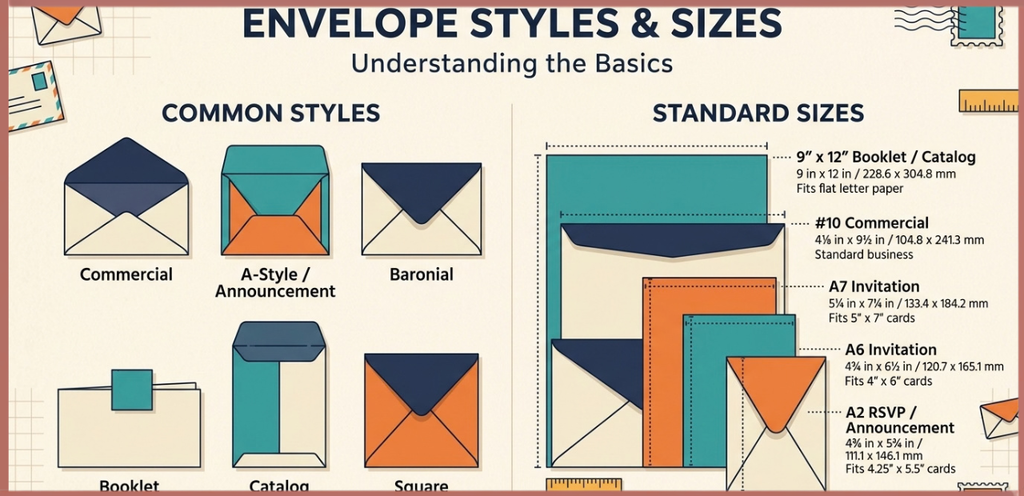
Before buying envelopes, it’s helpful to understand how their construction, dimensions, and intended uses work together. Two envelopes may appear almost identical but have different openings, flap shapes, or internal capacities. And yes, these small differences can matter quite a bit.
Envelope sizes generally refer to the length and width of an envelope when it is closed and laid flat. Measurements are commonly provided in inches or millimeters, depending on the country and manufacturer. Envelope styles, meanwhile, describe the shape, opening, flap design, and overall construction.
For example, a standard business envelope is usually designed for letters and invoices, while a booklet envelope is more suitable for inserting documents without folding them.
Here are a few important terms to know:
- Envelope dimensions: The physical measurements of the envelope.
- Envelope construction: How the paper is folded, sealed, and assembled.
- Envelope flap styles: The shapes and positions of the flaps used to close an envelope.
- Envelope size chart: A reference that compares envelope dimensions and common uses.
- Mailing envelopes: Envelopes designed to transport letters, documents, cards, or other flat items.
- Standard envelope sizes: Commonly available dimensions used for personal, commercial, and international mailing.
Understanding these basics makes it easier to compare products and select an envelope that looks appropriate while protecting its contents.
Different Types of Envelopes and Their Uses
Not all envelopes are made for the same job. Some are designed for formal occasions, while others prioritize efficiency, document protection, or automated mail processing. The following different types of envelopes cover many everyday situations.
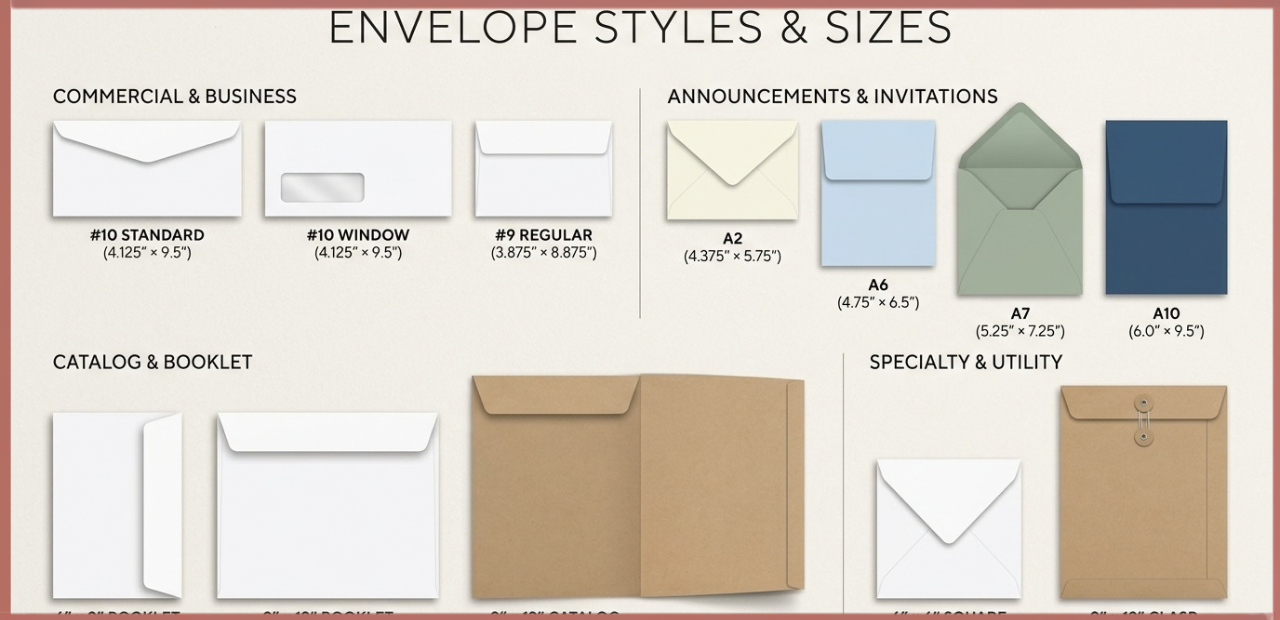
Commercial Envelopes
Commercial envelopes are among the most familiar types used in offices, schools, and homes. They are commonly associated with business letters, invoices, checks, statements, and everyday correspondence.
Their design usually features a rectangular shape and a flap that closes along the long edge or another configuration appropriate to the product. Many commercial envelopes are made from lightweight paper to keep mailing costs manageable.
Common examples include No. 10 and No. 9 envelopes. The No. 10 envelope is especially popular for business letters in the United States because it can hold a standard letter-sized sheet folded into thirds.
These envelopes are practical when you need to send documents regularly without spending too much on elaborate packaging.
Announcement Envelopes
Announcement envelopes are designed for special messages that deserve a little extra attention. They are often used for wedding invitations, birth announcements, graduation cards, party invitations, and personal greetings.
They may be square or rectangular, depending on the format of the card they hold. Premium paper, subtle textures, colored finishes, and decorative flaps are common features.
Imagine opening your mailbox and finding a beautifully designed envelope announcing a friend’s wedding. Even before reading the invitation, you can feel that something meaningful is waiting inside.
When selecting announcement envelopes, measure the actual invitation rather than relying only on its advertised card size. Thick cardstock, ribbon embellishments, and layered inserts can require additional room.
Baronial Envelopes
Baronial envelopes are traditionally associated with formal correspondence and invitations. Their defining feature is often a deep, pointed flap that creates a classic, refined appearance.
They are especially suitable for formal greeting cards, wedding stationery, announcements, and personalized notes. Some designs have a more delicate shape than ordinary commercial envelopes, making them appealing for occasions where presentation matters.
A baronial envelope can make even a simple handwritten message feel considered and special. Choose a size that accommodates the card comfortably, leaving enough room to insert it without bending the corners.
Booklet Envelopes
Booklet envelopes are designed to hold booklets, reports, brochures, folders, and other documents that are easier to insert through an opening along the long side.
Their construction makes inserting and removing materials convenient, particularly when the contents are relatively large or need to remain flat.
These envelopes are useful for corporate presentations, promotional materials, educational documents, and event programs. They can also be selected in heavier paper stocks when extra durability is needed.
When comparing booklet envelope dimensions, check the width, height, and thickness of the complete document package, not just the first sheet.
Catalog Envelopes
Catalog envelopes are generally intended for larger documents, catalogs, magazines, reports, and printed materials. Many feature an opening on the short side, making them convenient for inserting substantial stacks of paper.
They often use heavier paper than standard letter envelopes because the contents may be bulky or relatively heavy.
Catalog envelopes are a useful option when folded documents would look unprofessional or when a large stack of pages needs additional protection. For especially valuable or fragile contents, consider a padded mailer or rigid document envelope instead.
Window Envelopes
Window envelopes include a transparent panel that allows part of the enclosed document to remain visible. Instead of writing or printing the recipient’s address directly on the envelope, the sender positions the address on the document so it appears through the window.
A single-window envelope usually displays the recipient’s address. A double-window envelope can show both the recipient’s address and return information, depending on its design.
These envelopes are widely used for invoices, utility bills, statements, checks, and business correspondence.
Correct positioning matters. The address must remain visible within the window even when the document shifts slightly during handling. Follow the manufacturer’s layout recommendations, especially when printing large batches.
Open-End and Open-Side Envelopes
Open-end and open-side envelopes describe the location of the opening used to insert the contents.
- Open-end envelopes have an opening along the short side. They are frequently used for catalogs, larger documents, and materials that slide in vertically.
- Open-side envelopes have an opening along the long side. They are common for letters, booklets, and documents that are easier to insert horizontally.
The exact configuration varies by manufacturer, so inspect the product dimensions and flap position before ordering.
Other Useful Envelope Types
Several specialized envelopes are useful for particular tasks.
- Coin envelopes: Small envelopes for coins, jewelry components, labels, and other tiny items.
- Metal clasp envelopes: Reusable envelopes with a metal fastener, often used for internal office documents.
- Padded envelopes: Protective mailers with cushioning for items that need extra impact protection.
- Square envelopes: Decorative envelopes for greeting cards, invitations, and creative stationery.
- Recycled envelopes: Paper envelopes made partly or entirely from recovered paper fibers, depending on the product.
- Security envelopes: Envelopes with an interior pattern intended to reduce visibility of enclosed information.
The right choice depends on what you’re sending, how much protection it needs, and how you want it to look when it arrives.
Standard US Envelope Sizes
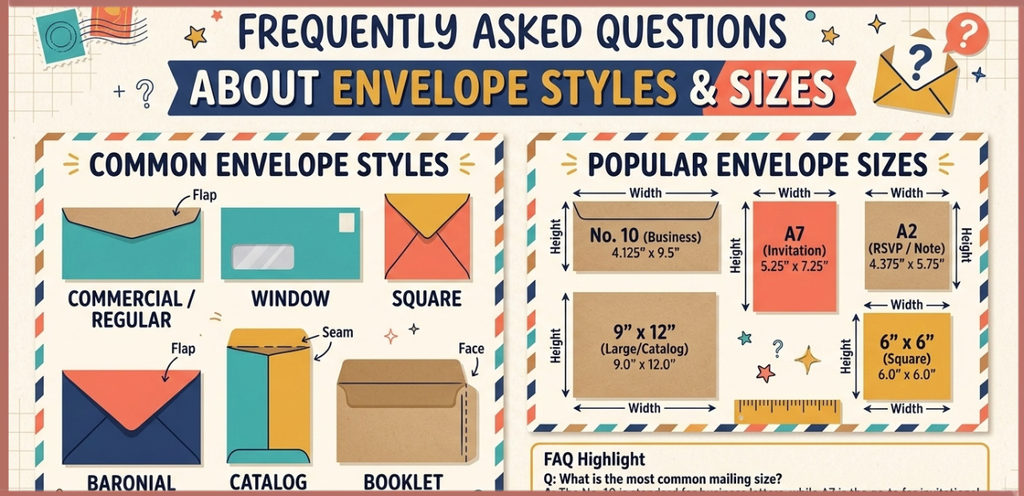
In the United States, envelopes are commonly identified by names such as No. 10, No. 9, A2, A7, and Monarch. Some are intended for business correspondence, while others are popular for greeting cards and invitations.
The following envelope sizes chart provides approximate dimensions for common US envelope formats. Always check the manufacturer’s specifications because products can vary slightly.
| Envelope type | Approx. dimensions (inches) | Common uses |
|---|---|---|
| No. 10 | 4.125 × 9.5 | Business letters and invoices |
| No. 9 | 3.875 × 8.875 | Return envelopes and business mail |
| Monarch | 3.875 × 7.5 | Personal and formal correspondence |
| A2 | 4.375 × 5.75 | Small greeting cards |
| A6 | 4.75 × 6.5 | Greeting cards and invitations |
| A7 | 5.25 × 7.25 | Invitations and larger greeting cards |
| A9 | 5.75 × 8.75 | Large invitations and cards |
| 6 × 9 | 6 × 9 | Small booklets and documents |
| 9 × 12 | 9 × 12 | Unfolded documents and reports |
| 10 × 13 | 10 × 13 | Large documents and folders |
These dimensions refer to the approximate outside size of each envelope, not the maximum size of paper that will fit inside it.
Commercial Envelope Sizes
Business correspondence often relies on No. 10 envelopes because they accommodate a standard US letter folded into thirds. No. 9 envelopes are smaller and are frequently used as return envelopes inside larger mailings.
For documents that should remain unfolded, larger envelopes such as 9 × 12 or 10 × 13 may be more appropriate. Keep in mind that the thickness and rigidity of the contents can influence postage and mailing requirements.
Announcement Envelope Sizes
Invitation envelopes are commonly identified by an A-series designation. A2, A6, and A7 are popular choices for cards of different dimensions.
For example, an A7 envelope measures approximately 5.25 × 7.25 inches and is frequently used for invitation cards around 5 × 7 inches. This leaves a small clearance for comfortable insertion.
Square envelopes are also available for distinctive stationery designs. However, a decorative shape may affect postal handling or postage, so confirm the relevant mailing rules before sending a large batch.
ISO Envelope Standards and International Sizes
Envelope sizing can be confusing when you send documents across borders. US envelope sizes differ from the international paper formats commonly used in Europe and many other countries.
The ISO envelope standards include C-series and B-series formats. These systems are designed around standardized paper dimensions, helping people choose envelopes that fit A-series documents.
Common C Series Envelope Sizes
C-series envelopes are widely used to hold paper from the A series. For instance, a C4 envelope is suitable for an unfolded A4 sheet, while a C5 envelope accommodates an A4 sheet folded once to A5 size.
| Envelope size | Approx. dimensions (mm) | Approx. dimensions (inches) | Typical use |
|---|---|---|---|
| C3 | 324 × 458 | 12.76 × 18.03 | Large A3 documents |
| C4 | 229 × 324 | 9.02 × 12.76 | Unfolded A4 paper |
| C5 | 162 × 229 | 6.38 × 9.02 | A5 paper or folded A4 |
| C6 | 114 × 162 | 4.49 × 6.38 | A6 paper or folded A4 |
| DL | 110 × 220 | 4.33 × 8.66 | A4 paper folded into thirds |
These are nominal dimensions. Allow additional room if the paper is thick, includes inserts, or has decorative elements.
What Is a C5 Envelope Used For?
A C5 envelope is useful for mailing A5 sheets, greeting cards, and A4 documents folded once. Its dimensions of approximately 162 × 229 mm make it a common choice for personal and professional correspondence.
It works particularly well when you want to avoid folding a document into thirds. For formal letters, certificates, or carefully printed materials, that extra space can help preserve a neat appearance.
What Is the Difference Between C4 and C5 Envelopes?
The main difference is size and the way the enclosed paper fits.
A C4 envelope measures approximately 229 × 324 mm and can hold an A4 sheet without folding. A C5 envelope measures approximately 162 × 229 mm and is suitable for an A5 sheet or an A4 sheet folded in half.
Choose C4 when the document needs to stay flat. Choose C5 when a folded document is acceptable and a smaller envelope is more convenient.
DL Envelope Dimensions
A DL envelope typically measures 110 × 220 mm. It is commonly used for business letters, invoices, statements, and documents created by folding an A4 sheet into three equal sections.
The DL format is especially familiar in European and international business mail. Its long, narrow shape is practical for correspondence and fits many standard office mailing workflows.
Understanding B Series Envelope Sizes
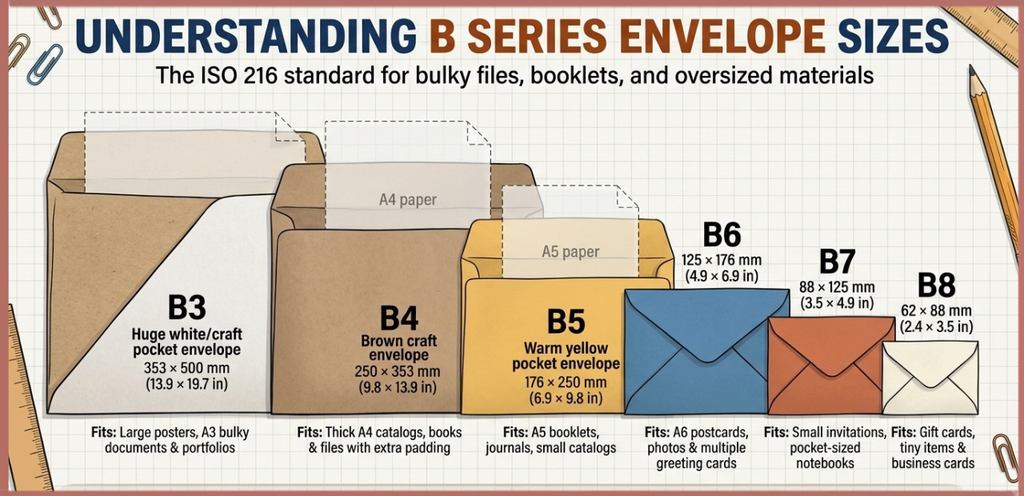
The B series provides additional paper and envelope formats. Depending on the product and standard being followed, B-series envelopes can accommodate larger materials or provide a different fit for related paper sizes.
| Envelope size | Approx. dimensions (mm) | Common applications |
|---|---|---|
| B4 | 250 × 353 | Larger documents and A4 materials with extra room |
| B5 | 176 × 250 | A5 documents and booklets |
| B6 | 125 × 176 | Smaller cards and correspondence |
The B4 and B5 formats can be useful when a C-series envelope feels too snug for the contents. However, the exact suitability depends on the dimensions and thickness of the materials you’re sending.
Before purchasing B5 envelope size or B4 envelope size products, confirm that the listing specifies the envelope’s actual dimensions rather than the paper size it is intended to hold.
Envelope Flap Styles and Construction
Envelope design isn’t only about size. The flap also affects the envelope’s appearance, ease of sealing, and suitability for different occasions.
Pointed Flap Envelopes
Pointed flaps form a triangular or tapered shape. They are often associated with invitation envelopes, announcement stationery, and formal correspondence.
A pointed flap can create a traditional appearance without requiring additional decoration. It works particularly well with textured paper and carefully selected envelope colors.
Commercial Flap Envelopes
Commercial flap styles are designed for practical everyday use. Depending on the envelope, the flap may be straight, triangular, or another functional shape.
These designs prioritize convenient sealing, consistent production, and compatibility with routine mailing processes. They are common in office stationery and large-volume business mail.
Square Flap Envelopes
Square flaps have a more geometric appearance and are often found on contemporary stationery and greeting card envelopes. They can create a clean, modern finish for personal notes or event invitations.
Envelope Sealing Options
Common sealing methods include:
- Gummed flaps: Require moisture to activate the adhesive.
- Peel-and-seal flaps: Have a protective strip covering the adhesive.
- Self-seal flaps: Use adhesive surfaces that bond when pressed together.
- Clasp closures: Use a metal fastener and may allow repeated opening and closing.
For occasional personal letters, a traditional gummed flap may be perfectly adequate. Businesses preparing hundreds of envelopes might prefer peel-and-seal products for convenience.
How to Choose the Right Envelope Size
Selecting an envelope becomes easier when you start with the contents instead of the envelope itself. A card that measures 5 × 7 inches may need an A7 envelope, while a full A4 sheet may require a C4 envelope or a larger US-format mailer, depending on the destination.
Follow these practical steps.
- Measure the contents: Record the length, width, and thickness of the document, card, or item.
- Decide whether folding is acceptable: Choose an envelope that fits the unfolded document if creases must be avoided.
- Allow room for insertion: Avoid an envelope that fits so tightly that the paper catches on the edges.
- Consider the weight: Thick cardstock and multiple inserts can increase postage costs.
- Match the style to the occasion: Formal invitations may benefit from baronial envelopes, while invoices usually suit commercial envelopes.
- Check the mailing destination: US and international envelope systems use different common formats.
- Confirm postal requirements: Square shapes, unusual dimensions, rigid contents, and bulky envelopes may affect handling and postage.
A useful rule is to compare the envelope’s internal usable space with the actual contents, rather than choosing solely by the product name.
Which Envelope Size Fits an A4 Sheet?
An A4 sheet measures 210 × 297 mm.
- A C4 envelope measuring 229 × 324 mm generally holds A4 paper unfolded.
- A C5 envelope measuring 162 × 229 mm is suitable when A4 paper is folded in half.
- A DL envelope measuring 110 × 220 mm is typically used when A4 paper is folded into thirds.
These options provide different balances between document protection, convenience, and envelope size.
Envelope Addressing and Printing Guidelines
Even the right envelope can cause problems if the address is difficult to read or positioned incorrectly. Good envelope addressing helps your mail move through postal systems efficiently.
How to Address an Envelope Properly
For most standard letters, place the recipient’s address prominently on the front of the envelope. Put the return address in the upper-left area or another position permitted by the destination postal service.
Include the recipient’s name, street address, city or locality, state or region where applicable, postal code or ZIP code, and country for international mail.
Write clearly and avoid decorative lettering that makes important details hard to recognize. If you’re sending international mail, follow the destination country’s preferred address format.
Envelope Printing Requirements
When printing addresses, confirm that the envelope dimensions are supported by your printer. Some printers can handle standard commercial envelopes but struggle with thick, square, or unusually small formats.
Before printing a large batch:
- Select the correct envelope size in the printer settings.
- Check the orientation and feeding direction.
- Use a test print to confirm alignment.
- Ensure the recipient’s address is fully visible on window envelopes.
- Keep essential address information away from edges and folds.
- Check ink drying time to prevent smudging.
Automated postal systems may use optical character recognition (OCR) to read printed addresses. Clear fonts, strong contrast, and appropriate address placement can help improve readability.
For direct marketing mail, consistent formatting is especially valuable because a small printing error repeated across hundreds of envelopes can waste considerable time and money.
Frequently Asked Questions About Envelope Styles and Sizes
What Are the Different Envelope Sizes?
Common envelope sizes include No. 10, No. 9, Monarch, A2, A6, A7, C4, C5, C6, DL, B4, and B5. Each size serves different purposes, from business letters and greeting cards to unfolded documents and international correspondence.
What Is a Standard Envelope Size?
There isn’t one universal standard envelope size. In the United States, the No. 10 envelope is widely used for business letters, while C4, C5, C6, and DL formats are common in international and European correspondence.
What Are Commercial Envelopes Used For?
Commercial envelopes are primarily used for business letters, invoices, checks, account statements, and everyday correspondence. Their practical construction makes them suitable for routine office mailing.
What Are Announcement Envelopes?
Announcement envelopes are designed for invitations, birth announcements, graduation cards, greeting cards, and similar occasions. They often feature decorative paper, attractive flap designs, or colors that complement the enclosed card.
What Is a DL Envelope Used For?
A DL envelope usually measures 110 × 220 mm and is commonly used for business letters, bills, and statements. It is particularly suitable for A4 paper folded into thirds.
What Are Window Envelopes Used For?
Window envelopes allow an address printed on the enclosed document to show through a transparent panel. They are frequently used for invoices, bills, statements, and business correspondence.
What Is the Difference Between Open-End and Open-Side Envelopes?
An open-end envelope has an opening along its short side, while an open-side envelope opens along its long side. The best option depends on the dimensions and orientation of the documents being inserted.
How Do I Choose the Right Envelope Size?
Measure the contents first, decide whether folding is acceptable, and select an envelope with enough room for comfortable insertion. Also consider the envelope’s weight capacity, intended use, and destination postal requirements.
Creative Ways to Use Different Envelope Styles
Envelopes can do more than transport paperwork. With a little imagination, they can become part of the experience of giving, communicating, or organizing.
- Personal letters: Choose a textured or colored envelope that reflects the tone of your message.
- Wedding invitations: Pair a suitable announcement envelope with matching stationery for a coordinated appearance.
- Thank-you notes: Use a small greeting card envelope and add a handwritten name for a personal touch.
- Business correspondence: Select commercial envelopes with consistent branding and easy-to-read addresses.
- Certificates and artwork: Use an appropriately sized rigid mailer or document envelope to reduce bending.
- Gift cards: Pick a compact envelope that keeps the gift secure and gives the presentation a finished look.
- Scrapbooking and journaling: Use small coin envelopes or decorative envelopes to store photographs, notes, and keepsakes.
Even a plain envelope can feel special when it matches the occasion. Sometimes a handwritten name or a small detail on the flap is all it takes.
Frequently Asked Question
types of envelopes
Envelopes come in various types, including commercial, announcement, booklet, catalog, and window envelopes. Each type is designed for specific mailing needs, such as business letters, invitations, documents, and invoices.
what are the different envelope sizes
Envelope sizes vary depending on their purpose and the paper they need to hold. Common options include US standard sizes, such as #10 and A7, and ISO sizes, such as C4, C5, C6, and DL.
different size envelopes
Different size envelopes are available for letters, greeting cards, invitations, brochures, and large documents. Choosing the right size ensures your contents fit properly without unnecessary folding.
envelope b5 size
A B5 envelope measures approximately 176 × 250 mm (7 × 9.8 inches). It is part of the ISO envelope size system and is commonly associated with holding documents or accommodating a C5 envelope.
types of envelopes sizes
Envelope types and sizes include commercial, announcement, booklet, catalog, and ISO-standard envelopes. Their dimensions vary according to their intended use, from small invitation envelopes to larger envelopes for reports and documents.
Read this blog https://avenzorixy.com/types-of-envelopes/
Conclusion: Find the Envelope That Fits Your Purpose
Understanding Envelope Styles and Sizes helps you make better choices for business correspondence, personal letters, invitations, and document mailing.
From everyday commercial envelopes to elegant baronial designs, every type offers a different balance of appearance, convenience, and protection.
Start by measuring the contents, comparing the available envelope dimensions, and considering how the item will be delivered. A No.
10 envelope may be ideal for a routine business letter, while a C4 envelope is a better choice for an unfolded A4 document. For a wedding invitation or special announcement, the right decorative style can make the first impression feel just as meaningful as the message inside.
And don’t overlook the small details. Clear addressing, suitable paper, reliable sealing, and correct postage all contribute to a better mailing experience. With a little planning, choosing an envelope becomes less of a guessing game and more of a simple, useful skill.
Which envelope style or size do you use most often? Share your favorite options, practical tips, or questions in the comments. Your experience might help someone else find the perfect envelope for their next letter, invitation, or important document.