There is a funny little moment that happens when you find the ring you really want. You look at it, imagine it on your finger, perhaps even picture the outfit you’ll wear with it and then comes the slightly less romantic question: What is my ring size? Suddenly a beautiful ring has become a tiny mathematical mystery.
That is where a good ring size conversion chart becomes surprisingly important. A US size, UK letter, European number, or Japanese size can describe roughly the same finger, but the sizing systems don’t speak exactly the same language.
A US ring size 7, for example, isn’t simply “7” everywhere else. In another country, it may have a completely different-looking identifier.
This guide is designed to make that mystery much smaller. You’ll find an international ring size chart, practical ways to measure your finger, explanations of inside diameter and inside circumference, and helpful advice for engagement rings, wedding bands, wide rings, and those awkward moments when you’re sitting between two sizes.
The important thing is this: ring sizing isn’t merely about finding a number on a chart. Your finger changes a little throughout the day, rings have different widths and interior shapes, and even the hand you measure can matter. So, lets take it one step at a time.
| Measurement | Details |
|---|---|
| US Ring Sizes | 3 13 |
| UK Ring Sizes | A–Z+ |
| EU Ring Sizes | Based on finger circumference (mm) |
| Japan Ring Sizes | Numeric sizing system |
| Measure Method | String, paper strip, or ring sizer |
| Best Time to Measure | At normal body temperature |
| Between Sizes | Choose the larger size |
| Common Unit | Millimeters (mm) |
Understanding Ring Size Conversion
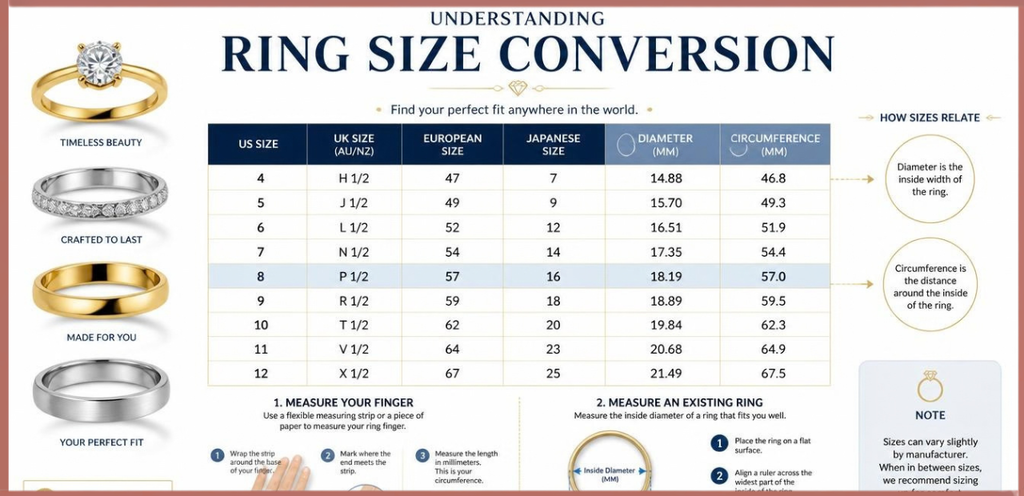
At its simplest, ring size conversion means translating one country’s sizing system into another country’s system. The United States and Canada commonly use numerical sizes, while the United Kingdom and several Commonwealth markets use letters and half-letter sizes. Many European systems use a numerical measurement related to circumference, while Japan uses its own numerical scale.
That sounds rather tidy until you actually shop internationally.
A ring described as US 7, UK N, EU 54, or Japan 14 may represent closely related dimensions, but the systems are not interchangeable by simply changing the number. The underlying measurement is what really matters.
The international standard ISO 8653:2016 defines ring-size measurement and designation, and its approach is based on controlled ring measurements rather than simply treating every country’s number as equivalent. I ISO
For everyday shoppers, this leads to one useful rule: use a conversion chart as a guide, but use millimeter measurements as your reality check.
Here are some of the systems you are most likely to encounter:
- US ring size: A numerical system commonly used in the United States and Canada.
- UK ring size: An alphabetic system that includes half sizes such as L½ or N½.
- European ring size: Usually expressed numerically and closely associated with inner circumference in millimeters.
- ISO ring size: An international designation associated with standardized ring-size measurement.
- Japanese ring size: A separate numerical sizing system commonly encountered when buying jewelry from Japan.
- Asian ring sizes: This is a broad term and should be treated carefully because different countries and sellers may use different conventions.
So if a website says “international ring size,” don’t assume that phrase alone tells you the exact system. Have a peek at the seller’s sizing notes too, because manufacturers can use different charts.
Ring Size Conversion Chart: US, UK, EU, and Japan
The following is a practical reference for common sizes. Values are approximate equivalents, and individual jewelers can have slightly different conversion practices.
A particularly important point is that EU ring sizes are commonly tied to circumference in millimeters, while US sizes don’t work that way. So an EU 52 is not “US 52”; it is a completely different style of identifier.
Common approximate equivalents include:
- US 5 approximately UK J½–K approximately EU 49 approximately Japan 9
- US 6 approximately UK L–L½ approximately EU 52 approximately Japan 12
- US 6½ approximately UK M–M½ approximately EU 53 approximately Japan 13
- US 7 approximately UK N–N½ approximately EU 54 approximately Japan 14
- US 8 approximately UK P–P½ approximately EU 57 approximately Japan 17
- US 9 approximately UK R–R½ approximately EU 59 approximately Japan 18 19
- US 10 approximately UK T–T½ approximately EU 62 approximately Japan 21
- US 11 approximately UK V–V½ approximately EU 65 approximately Japan 23
- US 12 approximately UK X–Y approximately EU 67–68 approximately Japan 25
These should be treated as a ring size comparison rather than an absolute promise. The exact equivalent can vary according to the seller’s chart, rounding, and the particular sizing system being used.
For instance, someone searching what is US ring size 6 in UK sizing will often encounter L or L½ depending on the conversion chart. Similarly, US ring size 10 in UK sizing is commonly around T or T½.
That’s why measuring the actual ring diameter or finger circumference is often smarter than trusting a single cross-country conversion.
Ring Size Conversion Chart in Millimeters
Millimeters are wonderfully unglamorous, and that’s precisely why they are useful.
Instead of asking whether a ring is “about a US 7,” you can look at the inside diameter or inside circumference and compare that measurement against a sizing chart.
For a perfectly circular ring, the basic mathematical relationship is:
Circumference = diameter × π
So, if the inside diameter is about 17.2 mm, multiplying that measurement by approximately 3.1416 gives an inside circumference of roughly 54.0 mm.
That number can then be compared with an international sizing chart.
Some useful approximate dimensions include:
- 11.6 mm inside diameter very small ring size
- 16.5 mm inside diameter around the US 5½ 6 region
- 17.3 mm inside diameter around US 7
- 18.2 mm inside diameter around US 8
- 18.9 mm inside diameter around US 9
- 19.8 mm inside diameter around US 10
- 20.7 mm inside diameter around US 11
- 21.4 mm inside diameter around US 12
The exact size corresponding to each dimension depends on the chart and the sizing standard used.
This is why terms such as ring size in mm, ring diameter to size, ring circumference to ring size, and ring size measurement in millimeters are so closely connected. They are different doors leading into basically the same little room.
How to Measure Ring Size at Home
You don’t always need a jeweler standing nearby with a professional sizing kit. You can get a useful estimate at home, provided you measure carefully.
One easy method uses a strip of paper.
- Cut a narrow strip of paper that can wrap comfortably around the finger.
- Wrap it around the base of the finger where the ring will sit.
- Make sure it is snug but not squeezing the skin.
- Mark the point where the paper meets itself.
- Lay the paper flat and measure the length in millimeters.
- Compare that finger circumference with a reliable ring size chart.
- Repeat the measurement a couple of times rather than trusting one hurried attempt.
String can work too, but paper is usually easier to measure because string can stretch or twist without you noticing. A printed ruler can also be handy, though its printing scale should be checked before you trust it.
And please don’t wrap the strip around your finger so tightly that you think you’re measuring a finger belonging to a very determined sausage. You want the eventual ring to pass over the knuckle while still sitting securely.
Measuring an Existing Ring Without a Ring Sizer
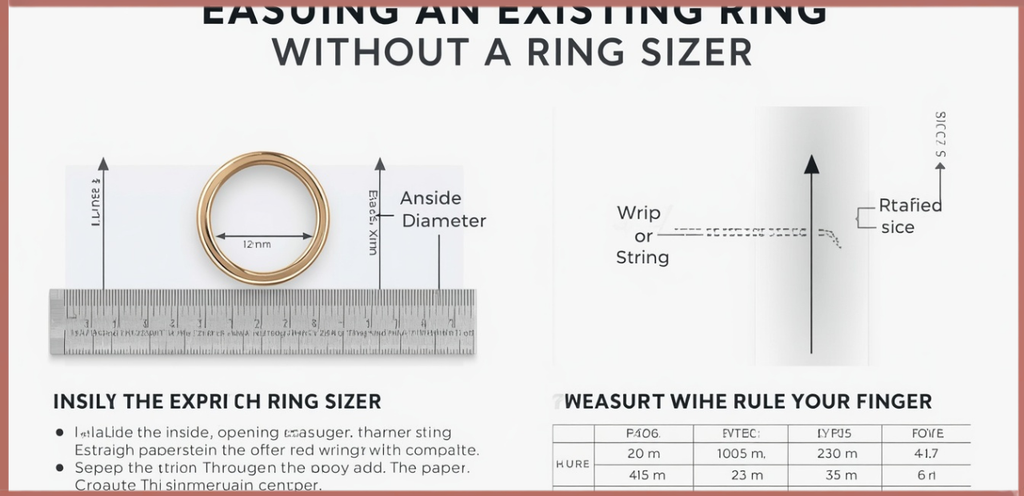
Already have a ring that fits beautifully? Excellent. That ring can become your measuring assistant.
Place it on a ruler and measure the inside diameter, not the outside diameter. Measure straight across the middle of the interior from one inner edge to the opposite inner edge.
This method works best when the ring is perfectly round. The Gemological Institute of America notes that an existing ring can be measured using a ring stick or mandrel, and that the ring should be properly round for inside-dimension conversion to work accurately. Ggia
At home, you can:
- Place the ring on a flat surface.
- Measure across the interior at its widest central point.
- Record the result in mm.
- Avoid including the thickness of the metal.
- Compare your measurement with the seller’s chart.
- If the ring is unusually wide or has a complicated interior, have it checked professionally.
This technique is especially useful when buying a surprise gift. A ring belonging to the intended wearer can provide a clue without asking the question, “By the way, what size finger are you?”
Just make absolutely sure the ring is worn on the same finger and hand. A ring worn on an index finger may not tell you the size needed for a ring finger, and the left and right hands can differ too. GIA notes that hand dominance and the particular finger can affect measurements. G GIA 4Cs
US to UK Ring Size and UK to US Ring Size
The US to UK ring size conversion is one of the most searched sizing questions, and understandably so. The two systems look completely unrelated at first glance.
For example:
- US 6 is approximately UK L L½.
- US 7 is approximately UK N N½.
- US 8 is approximately UK P P½.
- US 9 is approximately UK R R½.
- US 10 is approximately UK T T½.
Going the other direction, someone asking how to convert UK ring size to US might start with a UK letter such as N and discover that it is approximately equivalent to US 7.
The half sizes are important. UK sizing isn’t just a simple sequence of whole letters, and the difference between two neighboring sizes can matter when a ring is already a close fit.
When shopping, therefore, don’t type “UK N = US 7” into your mental filing cabinet and slam the drawer shut. Check the actual retailer’s chart too.
US to European Ring Size Conversion
The US to European ring size conversion is a little easier to understand when you remember that European sizing is closely connected to circumference.
For common sizes:
- US 6 approximately EU 52
- US 6½ approximately EU 53
- US 7 approximately EU 54
- US 8 approximately EU 57
- US 9 approximately EU 59
- US 10 approximately EU 62
Thus, someone asking what is European ring size 52 in US is generally looking at approximately US 6.
But here is the sneaky bit: rounding differences can appear between charts. If your measured circumference is near a boundary, don’t let one website’s rounded conversion bully you into choosing the wrong size.
Use the measurement itself whenever possible.
Japanese Ring Size to US Conversion
Japanese sizing is another system that can cause confusion because its numbers do not correspond directly to American sizes.
Some commonly encountered approximate relationships are:
- Japan 12 approximately US 6
- Japan 14 approximately US 7
- Japan 17 approximately US 8
- Japan 18 19 approximately US 9
- Japan 21 approximately US 10
So if someone searches what is Japan size 12 in US, the practical answer is approximately US 6, although the actual manufacturer’s chart should still be checked.
Likewise, a Japanese ring listed as Japan 21 isn’t remotely the same thing as a US 21. Different sizing systems, different numbering logic, same small piece of jewelry causing unnecessary confusion.
How Ring Width Changes the Fit
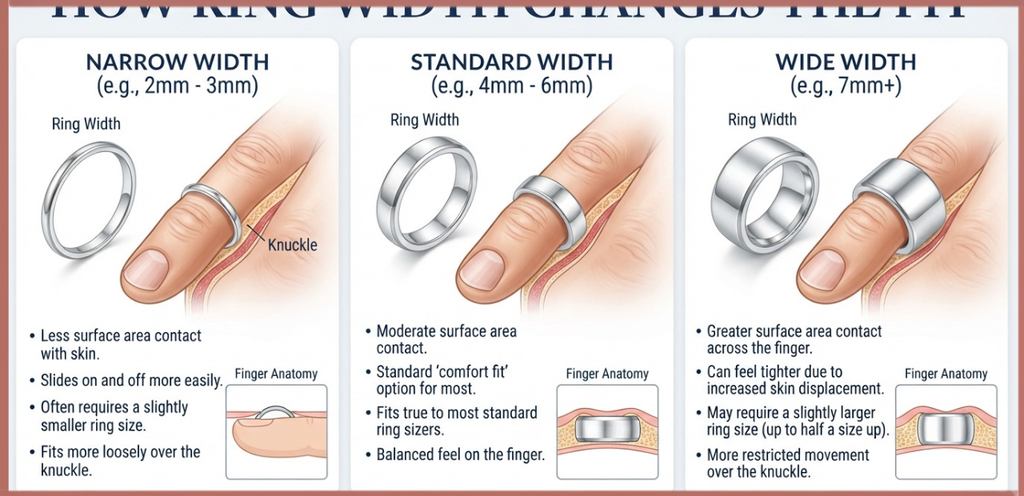
Here is where the chart stops being the whole story.
A narrow ring and a broad ring can have the same nominal size but feel noticeably different on your finger. A wide band covers more of the finger, creating more contact with the skin. Because of that, wider rings often need special consideration.
GIA specifically recommends using appropriate sizing gauges for wider rings and notes that bands wider than about 4 mm need different consideration than narrow rings. Ggia
This matters especially with:
- 6 mm band designs
- Chunky wedding bands
- Stacked rings
- Wide eternity bands
- Bridal sets
- Heavy comfort-fit rings
So, does ring width affect ring size? Yes, it can affect how the ring feels and how it should be sized.
Don’t automatically add half a size to every wide ring, though. The correct adjustment depends on the design, finger shape, interior profile, and jeweler’s sizing method. GIA’s guidance specifically distinguishes narrow and wide sizing gauges rather than applying one universal adjustment. Ggia
Comfort Fit, Flat Interior, and Ring Shape
Two rings with identical measurements can still feel different.
A comfort-fit band usually has a rounded or slightly domed interior, reducing the amount of metal pressing against the finger. A ring with a flat interior can feel more substantial because more surface area sits directly against the skin.
The outside shape matters too, but don’t confuse outside appearance with inside dimensions. A dramatic-looking ring isn’t necessarily a dramatically different size.
Gemstone settings can create another wrinkle. Some rings have components extending into the inner opening, so simply measuring across the widest point may give a misleading result. Professional sizing tools are useful when a mounted stone or unusual construction interferes with measurement. Ggia
What If You Are Between Ring Sizes?
This is one of those questions where there isn’t one magical answer.
If your measurement sits directly between two available sizes, consider:
- How wide is the ring?
- Does the design have a comfort-fit interior?
- Is your knuckle larger than the finger base?
- Will you wear the ring in hot weather?
- Does your finger swell during exercise?
- Is the ring intended for everyday wear?
- Can the particular ring be resized later?
A slightly larger size may be more comfortable if your finger changes substantially during the day, but too much looseness can allow the ring to rotate or slip.
GIA recommends that a properly sized ring should be loose enough to pass over the finger joint while settling comfortably where it will be worn. Ggia
That little “pass the knuckle” test is often more useful than obsessing over a decimal point in a measurement.
Temperature, Time of Day, and Finger Swelling
Your fingers are not perfectly fixed cylinders. They have moods, apparently.
Cold temperatures can make fingers smaller, while heat can cause them to swell. Time of day, humidity, altitude, and physical activity can also influence finger size. GIA specifically highlights temperature, humidity, altitude, and time of day as factors that can affect sizing. G GIA 4Cs
For a more dependable ring size measurement:
For a more dependable ring size measurement:
- Measure when your hands are at a normal temperature.
- Avoid measuring immediately after intense exercise.
- Don’t measure when your fingers are unusually cold.
- Take measurements at different times of day.
- Repeat the measurement rather than relying on one reading.
- Consider the normal swelling pattern of your fingers.
This is especially useful for an engagement ring or wedding ring, because these are pieces you may expect to wear for years, not just on one perfectly temperate afternoon.
Knuckles and Finger Shape Matter Too

Some people have slim fingers with prominent knuckles. Others have fingers that are relatively uniform in width.
If the knuckle is significantly larger than the finger base, the ring has to pass over that wider point. A size that sits perfectly at the base may become difficult to put on or remove.
That’s why knuckle clearance should be considered alongside the finger measurement.
A ring should not be so loose that it feels ready to escape whenever you wave hello, but it also shouldn’t require an engineering team and three people to remove it.
If you have prominent knuckles, professional sizing can be particularly useful because a jeweler can discuss options such as sizing beads or other fit adjustments where appropriate.
Ring Size Calculator: What It Can and Can’t Do
A ring size calculator can be convenient, especially when it asks for inside diameter or finger circumference. But the calculator is only as good as the number you feed into it.
If you measure 17.8 mm when the actual diameter is 17.4 mm, the calculator doesn’t know you were holding the ruler slightly crooked. It will cheerfully calculate the wrong answer with complete confidence, which is rather unhelpful.
For this reason, a calculator should be treated as a conversion tool, not a magical sizing oracle.
The most dependable approach is usually:
measure verify compare with the retailer’s chart consider ring width confirm with a professional if the purchase is important.
For expensive jewelry, especially an engagement ring, that extra confirmation can be well worth the few minutes.
Wedding Ring and Engagement Ring Sizing Tips
A wedding ring deserves a little extra thought because it may be worn beside another ring.
If an engagement ring and wedding band are designed to sit together, their combined width can change the overall sensation on the finger. GIA notes that bridal sets wider than roughly 4 5 mm when worn together require special consideration. Ggia
For a wedding ring:
If the knuckle is significantly larger than the finger base, the ring has to pass over that wider point. A size that sits perfectly at the base may become difficult to put on or remove.
That’s why knuckle clearance should be considered alongside the finger measurement.
Ring Size Calculator: What It Can and Can’t Do
If you measure 17.8 mm when the actual diameter is 17.4 mm, the calculator doesn’t know you were holding the ruler slightly crooked. It will cheerfully calculate the wrong answer with complete confidence, which is rather unhelpful.
- Measure the finger with the intended band width in mind.
- Consider whether another ring will sit beside it.
- Ask about comfort-fit construction.
- Check whether the design can be resized.
- Pay special attention to eternity bands.
- Don’t assume the engagement-ring size automatically transfers perfectly.
An eternity band can also present a special challenge because gemstones may circle the entire band, limiting how much metal can be removed or added during resizing.
Can a Ring Be Resized?
Many rings can be resized, but not every ring can be adjusted easily.
Plain gold and platinum bands are often more straightforward candidates for resizing than intricate designs. Rings with continuous gemstones, unusual construction, delicate settings, or extensive engraving may have limitations.
The metal also matters. A jeweler can tell you whether a particular ring can safely be made larger or smaller.
This is one reason to ask about ring resizing before purchasing rather than after the ring arrives and discovers it has become a tiny bracelet for your finger.
If a seller offers a resizing window or warranty, read the terms carefully. Don’t assume every purchase automatically includes resizing, and don’t rely on a generic “60 days” or similar period unless the actual seller’s policy says so.
How Accurate Is a Ring Sizer?
A professional ring sizer is generally more dependable than a paper strip because it uses physical rings or calibrated tools designed for sizing.
GIA describes finger-sizing gauges as tools used to determine finger size and notes that different gauges can be appropriate for narrow and wider rings. Ggia
Home tools can still be useful:
- Plastic ring sizer
- Reusable ring sizer
- Adjustable ring gauge
- Paper strip
- Printed ruler
- Existing-ring measurement
If you’re buying inexpensive fashion jewelry, a home estimate may be perfectly practical. If you’re ordering a valuable gold, platinum, diamond, engagement, or wedding ring, professional measurement is a much safer route.
Common Ring Size Measurement Mistakes
Sometimes the problem isn’t the conversion chart at all. It’s the measuring.
Watch out for these surprisingly common mistakes:
- Measuring the outside diameter instead of the inside diameter.
- Measuring the wrong finger.
- Measuring the opposite hand.
- Pulling string too tightly.
- Measuring when the hands are unusually cold.
- Ignoring a large knuckle.
- Forgetting the effect of a wide band.
- Assuming every retailer follows the same conversion table.
- Measuring once and treating the result as sacred.
- Copying the size from a ring worn on a different finger.
The most annoying mistake is probably the last one because the ring may look perfectly reasonable on the wrong finger while being completely unsuitable for the finger you actually care about.
A Simple Ring Sizing Checklist
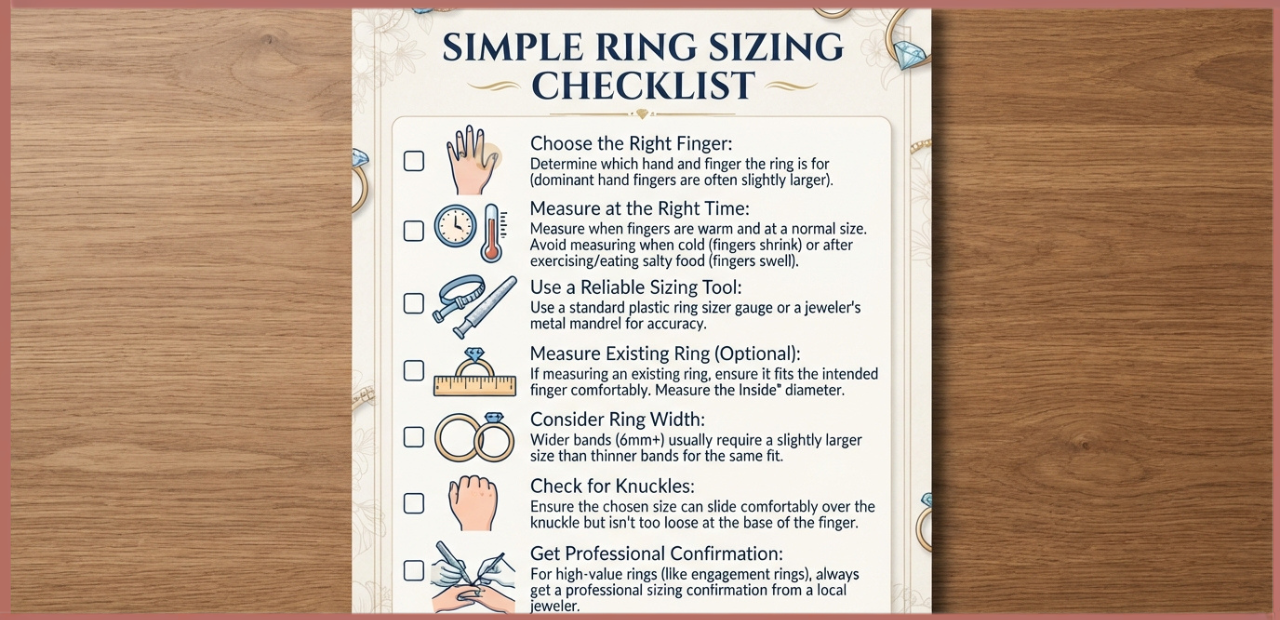
Before ordering your next ring, pause for a minute and run through this little checklist:
- Do I know the US ring size, UK size, EU size, or Japanese size being used?
- Do I know the inside diameter or inside circumference?
- Have I measured the correct finger?
- Have I considered the dominant hand?
- Is the band narrow, wide, or around 6 mm?
- Does the ring have a comfort-fit interior?
- Are my knuckles prominent?
- Have I measured at a normal temperature?
- Did I take more than one measurement?
- Does the seller provide its own ring size chart?
- Is resizing available if the fit isn’t right?
If you can answer those questions, you’re already far less likely to make the classic “beautiful ring, mysterious finger” mistake.
Frequently Asked Question
inches to ring size converter
An inches to ring size converter helps you match an inch measurement to the corresponding ring size. For accurate results, compare the measurement with a standard ring size chart.
ring size in inches
Ring size can be measured in inches using the inside diameter or circumference of the ring. Convert the inch measurement to millimeters for easier comparison with standard sizing charts.
ring size chart in inches
A ring size chart in inches shows the inside diameter and circumference for different ring sizes. It makes it easier to find the closest US, UK, European, or Japanese size.
inches to ring size
To convert inches to a ring size, measure the ring’s inside diameter or circumference and compare it with a ring size conversion chart. Because sizing systems differ, use the appropriate country-specific chart.
2 inch ring size
A 2-inch measurement around the finger equals 50.8 mm in circumference, which is approximately a US ring size 5¼. Always confirm the fit with a proper ring sizer because small measurement differences can affect the size.
Read this blog https://avenzorixy.com/inches-to-ring-size-converter-3/
Final Thoughts on Ring Size Conversion
A good international ring size conversion chart is useful, but it should never be treated as the entire story. The number printed beside a ring size is simply a label for a physical dimension.
Your actual finger, meanwhile, has curves, knuckles circle fit comfortably around a very human finger, so the ring can do what it was bought to do stay there, look lovely, and common physical reference even when the sizing systems themselves are speaking different little dialects. And yes, checking twice is mildly boring; wearing, temperature changes, swelling, and inconvenient opinions of its own.
The safest approach is to measure carefully in millimeters, understand the difference between ring diameter and ring circumference, then compare your measurement with the seller’s specific sizing system. For valuable jewelry, a professional ring sizer or jeweler’s measurement adds another layer of confidence.
Whether you’re searching for US to UK ring size, UK to US ring size, US to European ring size, or Japanese ring size to US, don’t be afraid of the alphabet soup and strange numbers. Once you understand what each system is actually measuring, the whole thing becomes much less mysterious.
And perhaps that is the nicest way to think about ring sizing: the chart isn’t really about numbers. It’s about making a small circle fit comfortably around a very human finger, so the ring can do what it was bought to do stay there, look lovely, and become part of someone’s everyday story.
If you have a ring size that you’re trying to convert, start with the measurement in mm whenever possible. It gives you a common physical reference even when the sizing systems themselves are speaking different little dialects. And yes, checking twice is mildly boring; wearing the wrong size all day is much more boring.