Have you ever looked at the clock late at night and wondered what the time would be when you wake up, finish your work, or finally get a little rest? Time has a funny way of moving quietly while we’re busy with other things.
One moment it’s late evening, and before you know it, morning is waiting just around the corner. Knowing What Time Is 8 Hours From Now can help you plan your day, organize your work, and manage those little commitments that make life run more smoothly.
If the current time is 11:29 PM PDT on Friday, October 16, 2026, then 8 hours from now is 7:29 AM on Saturday, October 17, 2026.
That’s an overnight calculation, which means the clock moves past midnight and into the next calendar day. It sounds simple, but understanding how hours move across midnight can prevent missed appointments and confusing schedules.
Whether you’re planning an early morning meeting, setting an alarm, tracking a work shift, or figuring out when an eight-hour break will end, this guide will help you understand the calculation in a practical way.
We’ll explore time arithmetic, clock formats, time conversions, and useful everyday examples so you can calculate a future time without second-guessing yourself.
What Time Is 8 Hours From Now?
The answer depends on the current time and the time zone you’re using. Based on the example of 11:29 PM Pacific Daylight Time, adding eight hours takes you to 7:29 AM the following day.
CURRENT TIME
11:29 PM
Friday, October 16, 2026 · Pacific Daylight Time (PDT)
ADD 8 HOURS
+ 8 hours
FUTURE TIME
7:29 AM
Saturday, October 17, 2026
The important detail is that the calculation crosses midnight. The date changes from Friday to Saturday, but the minutes remain the same because we’re adding whole hours rather than extra minutes.
Here’s the answer in a few useful formats:
- What Time Is 8 Hours From Now: 7:29 AM.
- Current date and time: Friday, October 16, 2026, at 11:29 PM PDT.
- Future date: Saturday, October 17, 2026.
- Time interval: Eight hours.
- Total duration: 480 minutes.
- Clock format: 12-hour clock.
Remember that 11:29 PM is the starting point for this example, not a permanent answer. If you’re reading this article at another time or in another time zone, your exact future clock time will be different.
How to Calculate 8 Hours From Now
Calculating a future time doesn’t require complicated mathematics. A simple addition method works for most everyday situations, and once you’ve practised it a couple of times, it becomes almost automatic.
Start by identifying the hour and minute shown on your clock. Then add eight hours to the hour while keeping the minutes unchanged.
For example, if the current time is 11:29 PM, adding eight hours gives the following sequence:
- 12:29 AM one hour later.
- 1:29 AM two hours later.
- 2:29 AM hree hours later.
- 3:29 AM four hours later.
- 4:29 AM five hours later.
- 5:29 AM six hours later.
- 6:29 AM seven hours later.
- 7:29 AM eight hours later.
The clock moves through midnight along the way, so the final answer belongs to the next calendar day.
A Simple Time Calculation Formula
You can use this basic rule whenever you need to calculate future time:
Future time = Current time + 8 hours
If the result passes midnight, move the calendar forward by one day. If the starting time is already in the early morning, afternoon, or evening, the same principle still applies.
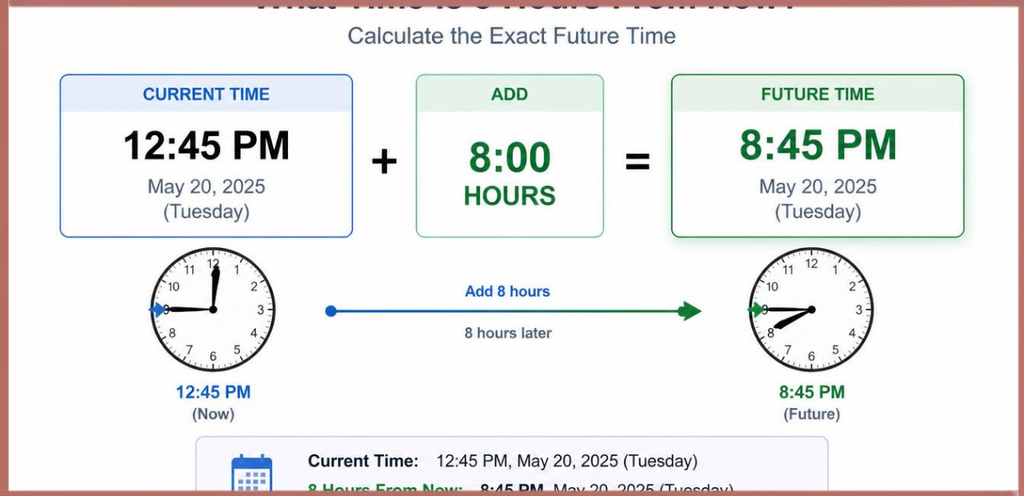
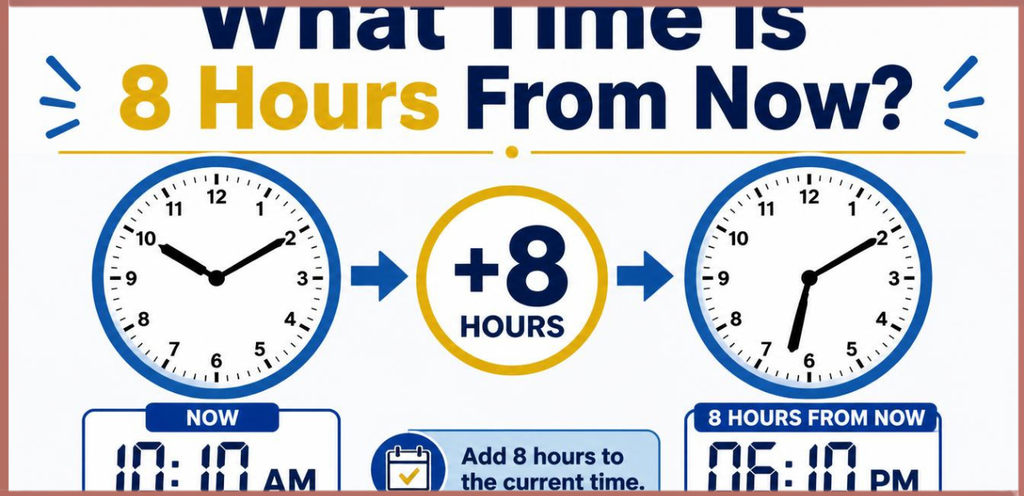
For instance, 9:15 AM plus eight hours equals 5:15 PM on the same day. Meanwhile, 8:45 PM plus eight hours equals 4:45 AM the next day.
The trick is to remember that a clock repeats its hours every 12 hours in the 12-hour clock format, while the calendar continues moving forward. This is where time arithmetic becomes useful, especially when you’re planning something that begins late at night.
Understanding 8 Hours From Now With a Time Calculator
An online time calculator can make time addition easier when you’re handling multiple appointments or working with unusual schedules.
Instead of counting each hour manually, you enter the starting time, select the number of hours to add, and let the calculator produce the result.
A typical hours from now calculator uses three pieces of information:
- The starting clock time.
- The number of hours to add.
- The relevant date and time zone, when applicable.
For a quick calculation, you can also use the interactive calculator below. Enter a time, choose AM or PM, and calculate the result eight hours later.
Hours From Now Calculator
Choose a starting date and time, then calculate the future clock time.Starting date
10/16/26Starting hour
11Minutes
29AM or PMAMPMHours to add
8 hours
8
24
48
Calculated future time
07:29 AM
Saturday, 2026-10-17
This calculator performs local clock arithmetic using the entered date and time as a UTC-based reference. It does not automatically determine your local time zone or daylight-saving transitions.
A calculator is especially helpful when you’re working with many hours, planning ahead for the next day, or checking a time far in the future. Just remember that the starting time must be accurate if you want an accurate result.
Why 8 Hours Later Can Be on a Different Day

One small detail that often confuses people is the calendar date. When you add hours to a clock time, you aren’t always staying on the same day.
Imagine that you’ve finished a late shift at 11:29 PM and need to know when eight hours will have passed. You begin counting through the remaining minutes of Friday, cross midnight, and continue into Saturday morning.
That means 8 hours from now can describe a future time on either the same date or the next date, depending on when the calculation begins.
Here are some examples:
| Starting time | Time 8 hours later | Day change |
|---|---|---|
| 7:00 AM | 3:00 PM | Same day |
| 10:30 AM | 6:30 PM | Same day |
| 2:15 PM | 10:15 PM | Same day |
| 6:45 PM | 2:45 AM | Next day |
| 11:29 PM | 7:29 AM | Next day |
The calendar date matters when you’re scheduling appointments, sending reminders, or arranging an online meeting with someone in a different part of the world.
A correct clock time with the wrong date can still lead to a missed appointment, which is something most of us would rather avoid.
What Does 8 Hours Mean in Minutes, Seconds, and Milliseconds?
Time can be measured in several different units. While most people use hours and minutes for everyday planning, seconds and milliseconds are helpful in technical work, digital systems, and scientific calculations.
Eight hours can be converted into smaller units using straightforward multiplication.
Hours
8 hours
Minutes
480 minutes
8 × 60 = 480
Seconds
28,800 seconds
480 × 60 = 28,800
Milliseconds
28,800,000 milliseconds
28,800 × 1,000 = 28,800,000
These conversions are useful when you need to convert hours to minutes, convert hours to seconds, or convert hours to milliseconds.
For example, a computer program may measure an eight-hour interval in milliseconds, while someone planning a work break may prefer to think in minutes.
The underlying duration doesn’t change. Eight hours remains the same interval regardless of whether you describe it in hours, minutes, seconds, or milliseconds.
Understanding AM, PM, Noon, and Midnight
The 12-hour clock divides a day into two periods: AM and PM. Each period contains twelve hours, but the labels can sometimes be confusing if you’re not used to working with them.
AM covers the period from midnight up to, but not including, noon. PM covers the period from noon up to midnight.
Here are the key reference points:
- 12:00 AM: Midnight, when a new calendar day begins.
- 7:29 AM: Morning.
- 12:00 PM: Noon.
- 3:00 PM: Afternoon.
- 8:00 PM: Evening.
- 11:59 PM: The final minute before the next midnight.
If the current time is 11:29 PM, adding eight hours results in 7:29 AM. Notice how the AM/PM label changes during the calculation, while the minutes remain at 29.
This is one reason a future time calculator can be handy. You don’t have to worry about accidentally leaving the result marked PM when it should be AM.
The same method applies to other calculations, including adding hours to an appointment time or subtracting hours to figure out when an activity began.
What Time Was 8 Hours Ago?
Looking backward uses the same logic as looking forward, except that you subtract time instead of adding it. The answer to what time was 8 hours ago depends on the current clock time.
If the reference time is 11:29 PM on Friday, October 16, 2026, then eight hours earlier was 3:29 PM on Friday, October 16.
Here’s the calculation:
- Starting time: 11:29 PM.
- Subtract eight hours.
- Result: 3:29 PM on the same date.
In this example, subtracting eight hours doesn’t cross midnight because there are more than eight hours between midnight and 11:29 PM.
However, if the starting time were 4:00 AM on Saturday, subtracting eight hours would take you back to 8:00 PM on Friday.
The difference between 8 hours ago and 8 hours from now is simply the direction of the calculation. One moves backward along the timeline, while the other moves forward.
Everyday Situations Where Knowing the Time 8 Hours From Now Helps
Time calculations aren’t only for maths exercises. They can help with ordinary decisions, from setting alarms to coordinating a workday. Once you understand the duration, you can use it to make a schedule feel less uncertain.
Planning sleep and wake-up times
If you go to bed at 11:29 PM and sleep for eight hours, your target wake-up time is 7:29 AM the following day. That’s a useful reference when planning a morning routine, though your ideal sleep duration depends on your individual needs.
You might set an alarm, prepare your clothes, or leave a note reminding yourself what needs doing when you wake up. A simple time calculation can make tomorrow morning feel a little less rushed.
Managing work shifts
An eight-hour work period is common in many jobs. If a shift starts at 8:00 AM, an eight-hour interval ends at 4:00 PM, excluding any additional unpaid break that must be accounted for separately.
For overnight workers, the date change becomes particularly important. A shift that starts at 10:00 PM and lasts eight hours ends at 6:00 AM the next day.
Taking medication at scheduled intervals
Some medicines have specific timing instructions. If a healthcare professional or medication label directs you to take a dose at an eight-hour interval, time arithmetic can help you understand when the next dose is due. Always follow the prescribed directions, including any limits on daily doses, rather than relying on a general calculator alone.
Scheduling meetings and online events
Suppose a colleague asks you to attend a meeting eight hours after a particular time. Adding the interval helps you work out when to join. If the other person lives in another time zone, you’ll also need to convert the result into their local clock time.
Planning cooking and household tasks
Some activities require a planned duration, whether you’re preparing a meal, running a household appliance, or arranging a long project.
Knowing the expected finish time helps you coordinate other commitments and avoid checking the clock every few minutes.In each situation, the calculation is the same. What changes is how you use the answer.
How Time Zones Affect the Exact Future Time
A clock time only makes complete sense when you know which time zone it refers to. The world is divided into time zones because different places experience daylight and darkness at different times.
For example, Pacific Daylight Time (PDT) is used in parts of North America during daylight-saving time. It is UTC−7. Pakistan Standard Time is UTC+5, so Pakistan is twelve hours ahead of PDT when both offsets apply.
Using the example of 11:29 PM PDT on Friday, October 16, 2026, the corresponding time in Pakistan is 11:29 AM on Saturday, October 17. Eight hours later, it would be 7:29 AM PDT on Saturday, or 7:29 PM in Pakistan on that same Saturday.
The key is that adding eight hours to an instant gives the same instant everywhere, but its displayed local clock time depends on the time zone.Daylight-saving transitions can also affect calculations that cross a clock change.
On those dates, adding eight elapsed hours may not always produce the same wall-clock result as simply adding eight to the displayed hour. For ordinary dates without a transition, the simple method usually works perfectly.
Using a Time Conversion Calculator for Different Clock Formats
Sometimes the challenge isn’t adding the hours. It’s understanding the format in which the answer is presented.
The 12-hour clock uses AM and PM, while the 24-hour clock represents the day from 00:00 through 23:59. Both can describe the same instant.
For the example in this article:
| Format | Starting time | Time 8 hours later |
|---|---|---|
| 12-hour clock | 11:29 PM | 7:29 AM next day |
| 24-hour clock | 23:29 | 07:29 next day |
| Duration | 8 hours | 480 minutes |
A time conversion calculator can help when you need to switch between these formats or convert hours into other time units. This is particularly useful for travel itineraries, digital schedules, work rosters, and international communication.
For example, an airline itinerary may display 07:29, while a message from a friend might say 7:29 AM. There’s no difference in the clock time; the presentation is simply different.
Common Mistakes When Calculating 8 Hours From Now
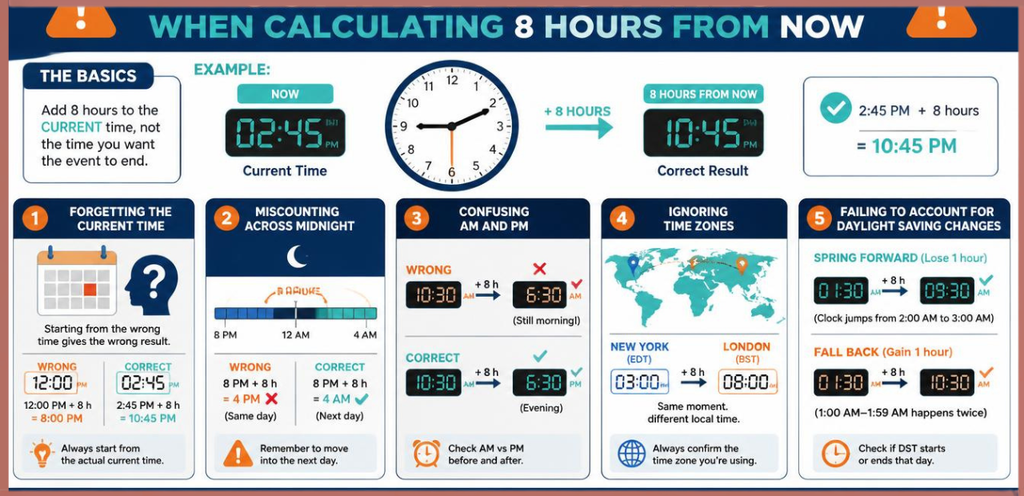
Even a basic calculation can go wrong if you overlook a small detail. Here are a few mistakes worth avoiding.
- Forgetting midnight: If the starting time is late in the evening, remember that adding eight hours may move the result to the next date.
- Mixing up AM and PM: A result of 7:29 AM is not the same as 7:29 PM. Check the half-day label carefully.
- Keeping the wrong date: A future clock time may belong to tomorrow, even when the numerical hour looks correct.
- Ignoring the time zone: A time shown in PDT isn’t automatically the same as the local time in Pakistan or another country.
- Assuming every calculator uses the same reference: Some tools use your device’s current time, while others ask you to enter a starting time manually.
- Confusing elapsed time with clock changes: An eight-hour duration measures an interval. Daylight-saving transitions can alter displayed local clock readings.
These errors are easy to avoid when you write down the starting time, add the hours, and verify the date and time zone. It takes only a moment, and that small check can save a surprising amount of confusion later.
Frequently Asked Questions About What Time Is 8 Hours From Now
What time will it be in 8 hours?
If the current time is 11:29 PM PDT on Friday, October 16, 2026, it will be 7:29 AM on Saturday, October 17. If your current time is different, add eight hours to your own starting time to get the correct answer.
How many minutes are there in 8 hours?
There are 480 minutes in eight hours because each hour contains 60 minutes. Multiply 8 by 60 to get the result.
How many seconds are there in 8 hours?
Eight hours contains 28,800 seconds. This is calculated by multiplying eight by 60 minutes and then by 60 seconds per minute.
How do I calculate 8 hours from now without a calculator?
Read the current time, add eight hours, and check whether the result passes midnight. If it does, move the date forward by one day. Remember to change AM to PM or PM to AM when appropriate.
Does 8 hours from now always mean tomorrow?
No. If it’s 8:00 AM, eight hours later is 4:00 PM on the same day. If it’s 8:00 PM, eight hours later is 4:00 AM the next day.
Is 8 hours from now the same in every time zone?
The elapsed duration of eight hours is the same, but the displayed local clock time differs across time zones. When coordinating with someone elsewhere, make sure you convert the result into the correct local time.
Can I use an hours-from-now calculator for more than eight hours?
Yes. Most time calculators let you add or subtract a chosen number of hours. Some also support minutes, dates, and time-zone conversions, making them useful for longer schedules.
Read This Blog https://avenzorixy.com/11-hours-ago/
Frequently Asked Question
8 hours from now is what time
8 hours from now is the exact clock time you get by adding eight hours to the current time. Use an hours-from-now calculator for an accurate result based on the current time.
what is 8 hours from now
What is 8 hours from now refers to the exact future time and date after adding eight hours to the present time. The result changes depending on the current time.
what time is it in 8 hours
The time in 8 hours is calculated by adding eight hours to the current local time. It provides the exact future clock time instantly.
what time will it be in 8 hours
The time will be in 8 hours by simply adding eight hours to the current time. An online calculator gives the precise answer automatically.
what time is 8 hours from now
The time 8 hours from now is the future clock time after an eight-hour interval from the present moment. The exact result depends on your current time and time zone.
Final Thoughts on Calculating 8 Hours From Now
Knowing What Time Is 8 Hours From Now is a small but genuinely useful skill. It helps you plan a morning, organize an overnight shift, schedule a call, or simply understand when a certain amount of time will have passed.
And once you’ve learned to add hours while keeping track of midnight, the calculation becomes much easier.Using our example, 11:29 PM PDT on Friday, October 16, 2026, plus eight hours equals 7:29 AM on Saturday, October 17, 2026.
The interval is eight hours, or 480 minutes, or 28,800 seconds. The arithmetic is simple; the most important thing is to keep the date, AM/PM label, and time zone straight.
A clock can tell you what time it is, but a little planning helps you decide what to do with the hours ahead. Whether you’re preparing for work, getting ready for bed, or making plans with someone you care about, a reliable time calculation can bring a welcome bit of clarity to your day.