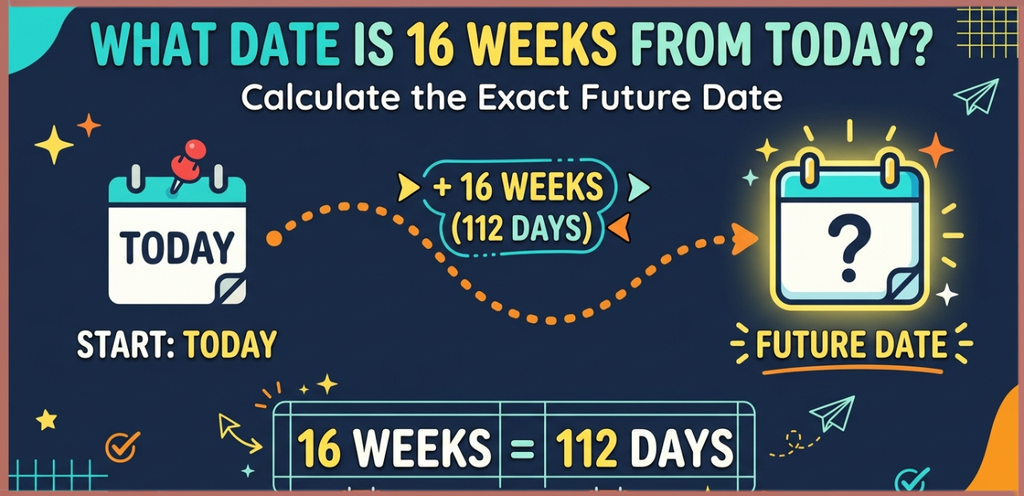
Have you ever looked at a calendar and wondered how far away a special day really is? Maybe you’re planning a family celebration, preparing for an important appointment, setting a personal goal, or simply curious about where you’ll be sixteen weeks from now.
Sometimes, a date that seems far away arrives sooner than we expect, and knowing the exact day makes planning feel a whole lot easier.
If you’re asking What Date Is 16 Weeks From Today, the answer depends on today’s date and the way you count the weeks. Starting from October 17, 2026, sixteen weeks takes you into February 2027.
That’s enough time for plans to grow, habits to change, projects to move forward, and little moments to become meaningful memories.
Let’s calculate the date, understand the number of days involved, and explore practical ways to use this time period. Whether you’re arranging an event, counting down to a milestone, or working toward a personal dream, a simple calendar calculation can bring welcome clarity.
| Calculation | Result |
|---|---|
| Today’s Date | October 17, 2026 |
| Weeks Added | 16 Weeks |
| Total Days | 112 Days |
| Future Date | February 6, 2027 |
| Day of the Week | Saturday |
What Date Is 16 Weeks From Today?
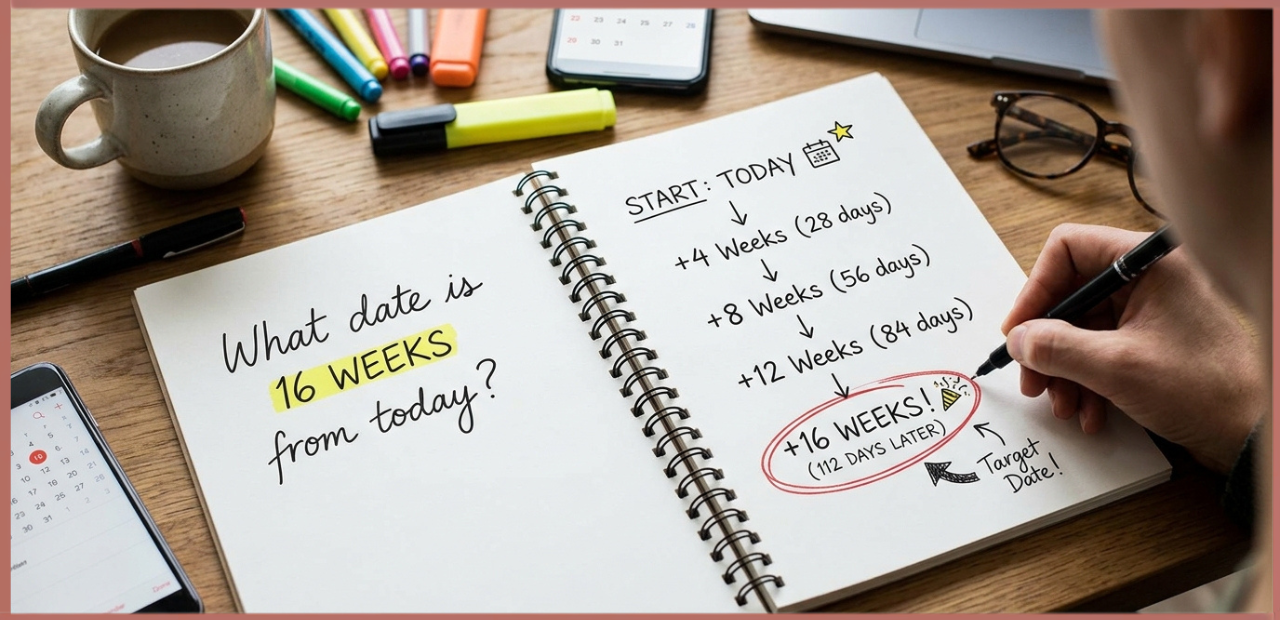
Starting from October 17, 2026, the date sixteen weeks later is Saturday, February 6, 2027.
Sixteen weeks is equivalent to 112 days. Adding those days to the starting date gives us the exact future calendar date, making it easier to plan appointments, celebrations, work deadlines, and personal commitments.
Here is the essential information at a glance:
- Today’s date: October 17, 2026
- Time duration: Sixteen weeks
- Total days: 112 days
- Future date: February 6, 2027
- Day of the week: Saturday
- Month and year: February 2027
- Total hours: 2,688 hours
- Total minutes: 161,280 minutes
- Total seconds: 9,676,800 seconds
So, if someone asks, “What date is 16 weeks from today?” you can confidently answer February 6, 2027, using October 17, 2026, as the starting point.
It’s a Saturday, which could be particularly convenient for a weekend gathering, a family dinner, a small celebration, or a long-awaited day out. Of course, whether the date works for you depends on your own plans, but having the answer makes the first step simple.
How to Calculate 16 Weeks From Today
The easiest way to calculate sixteen weeks ahead is to convert the weeks into days and add that number to today’s date. You don’t need complicated mathematics, and a regular calendar is often all you need.
The calculation follows a straightforward formula:
Future date = Starting date + (Number of weeks × 7 days)
For sixteen weeks, the calculation is:
16 × 7 = 112 days
Now add 112 days to October 17, 2026, to get February 6, 2027.
This method works because a standard calendar week always contains seven days. Whether the period crosses from October into November, December, January, and February, the total number of days remains the same.
A future date calculation is particularly useful when a deadline is expressed in weeks rather than a specific calendar date. For example, a project manager might say that a task must be completed sixteen weeks after it begins. Instead of estimating the deadline by looking at the same day of the month, you can use this calculation to find the correct date.
One small detail matters here: the starting date is not counted as the first elapsed day. October 17 is day zero for this calculation, and October 18 is one day later. This distinction helps avoid the common mistake of arriving one day too early or too late.
Date in 16 Weeks: A Week-by-Week Calendar Guide
Sometimes, knowing the final date isn’t enough. You may want to see how the weeks unfold, especially if you’re planning something that needs preparation along the way.
Starting on October 17, 2026, each additional week moves the calendar forward by seven days.
| Weeks Ahead | Calendar Date | Day |
|---|---|---|
| 1 week | October 24, 2026 | Saturday |
| 2 weeks | October 31, 2026 | Saturday |
| 3 weeks | November 7, 2026 | Saturday |
| 4 weeks | November 14, 2026 | Saturday |
| 5 weeks | November 21, 2026 | Saturday |
| 6 weeks | November 28, 2026 | Saturday |
| 7 weeks | December 5, 2026 | Saturday |
| 8 weeks | December 12, 2026 | Saturday |
| 9 weeks | December 19, 2026 | Saturday |
| 10 weeks | December 26, 2026 | Saturday |
| 11 weeks | January 2, 2027 | Saturday |
| 12 weeks | January 9, 2027 | Saturday |
| 13 weeks | January 16, 2027 | Saturday |
| 14 weeks | January 23, 2027 | Saturday |
| 15 weeks | January 30, 2027 | Saturday |
| 16 weeks | February 6, 2027 | Saturday |
Notice how every date falls on a Saturday. This happens because adding a whole number of weeks preserves the day of the week. Sixteen weeks later, the calendar returns to Saturday, just as it does after one, two, or fifteen weeks.
The table also provides a practical planning tool. You could use the first few weeks to research options, the middle weeks to make arrangements, and the final weeks to confirm details. A large goal often feels more manageable when it’s broken into smaller weekly intervals.
What Day Will It Be in 16 Weeks?
The answer is Saturday, February 6, 2027.
To understand why, remember that seven days make one complete week. After seven days, the calendar returns to the same weekday. Adding another seven days does the same thing, and this pattern continues throughout the sixteen-week period.
Since October 17, 2026, is a Saturday, the day of the week remains Saturday after 112 days.
This is useful for anyone who prefers to make arrangements around specific weekdays. Perhaps you usually schedule appointments on Saturdays, attend a weekly class, or reserve weekends for family time. Knowing the weekday alongside the date can help prevent confusion.
For example, if you’re organizing a birthday dinner or planning a weekend trip, February 6, 2027, gives you a clear starting point for checking availability, arranging transport, or inviting guests.
Just remember that the date itself doesn’t tell you whether a venue, service, or business will be available. Those details still need to be confirmed separately.
How Many Days Are in 16 Weeks?
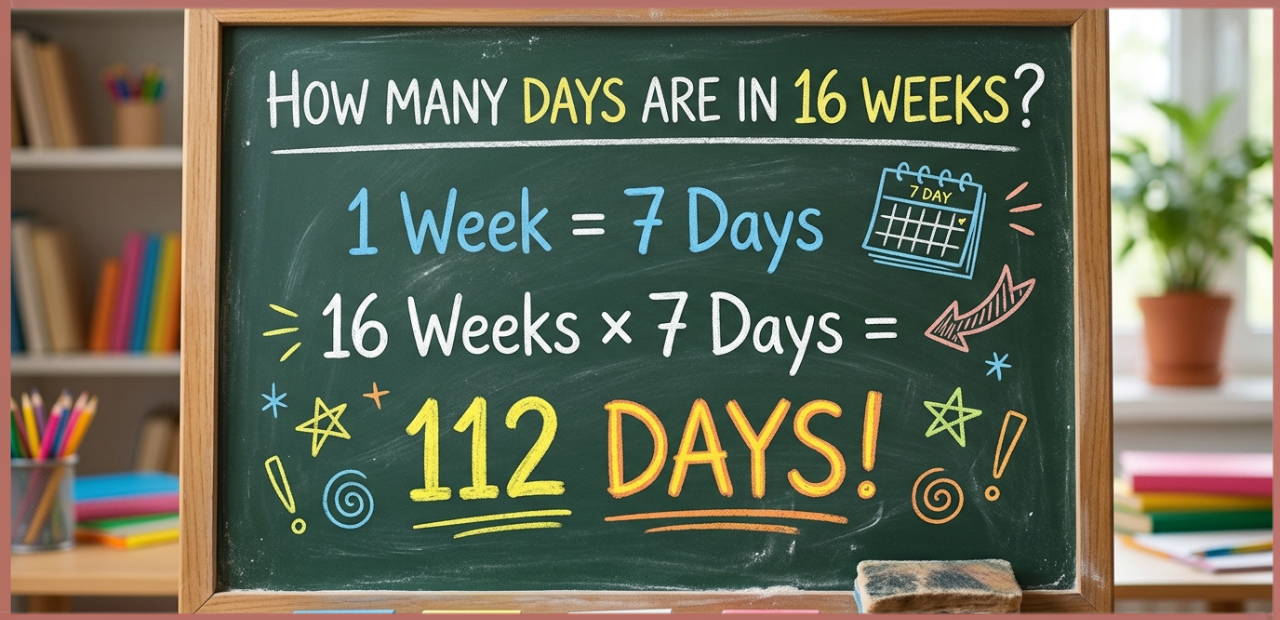
Sixteen weeks contains 112 days.
The conversion is simple:
- One week equals 7 days.
- Two weeks equal 14 days.
- Four weeks equal 28 days.
- Eight weeks equal 56 days.
- Sixteen weeks equal 112 days.
This is the basic week to day conversion used by calendars and date calculators. It allows you to compare periods expressed in different units without having to count each date individually.
For example, if a course lasts sixteen weeks, its duration is 112 calendar days when measured as an elapsed period. That doesn’t necessarily mean you’ll attend classes on all 112 days, because courses usually include weekends, holidays, and breaks.
The same distinction applies to work schedules and project plans. A sixteen-week project can cover 112 calendar days even if the actual working days are fewer.
If you’re trying to understand how long is 16 weeks, think of it as slightly more than three and a half months. The exact number of calendar months depends on which months the period crosses, because months do not all contain the same number of days.
Converting 16 Weeks Into Hours, Minutes, and Seconds
Weeks are useful for long-term planning, but smaller units can sometimes make a duration easier to understand. A time duration calculator can convert sixteen weeks into hours, minutes, and seconds.
Here’s the full breakdown:
| Time Unit | Calculation | Total |
|---|---|---|
| Weeks | Given duration | 16 |
| Days | 16 × 7 | 112 |
| Hours | 112 × 24 | 2,688 |
| Minutes | 2,688 × 60 | 161,280 |
| Seconds | 161,280 × 60 | 9,676,800 |
The figures above assume standard 24-hour days and use elapsed-time arithmetic.
A total of 2,688 hours might sound enormous when you first see it written down. Yet those hours pass one after another, often filled with ordinary routines, unexpected conversations, unfinished tasks, and the small joys that make a season memorable.
These conversions are useful for countdown applications, programming projects, time-management systems, and educational exercises. They’re also helpful when comparing a duration expressed in weeks with one expressed in hours or minutes.
For everyday calendar planning, however, you usually don’t need to convert everything into seconds. The date itself, February 6, 2027, is the most practical answer for most people.
Why February 6, 2027, Is the Correct Future Date
A reliable calendar calculation needs to account for the number of days in each month rather than assuming that every month lasts four weeks.
Let’s work through the dates step by step.
Starting date: October 17, 2026.
- The remaining days after October 17 bring us to the end of October.
- November contributes 30 days.
- December contributes 31 days.
- January 2027 contributes 31 days.
- The remaining days take us into February.
A more precise way to check the calculation is to use the day-of-year method. October 17 is the 290th day of 2026. Adding 112 days gives day 402, which carries into the following year because 2026 has 365 days.
402 − 365 = 37
Day 37 of 2027 is February 6, since January contains 31 days and February 6 is the sixth day of the following month.
This confirms that the February 6 2027 date is correct.
It also demonstrates why estimating sixteen weeks as four months can produce a different result. Four calendar months after October 17 would be February 17, 2027, which is eleven days later than the date obtained by adding exactly 112 days.
When accuracy matters, count the weeks or days rather than substituting calendar months.
Using a Weeks From Today Calculator
A weeks from today calculator is a convenient way to find future dates without manually moving through a calendar. These tools are especially useful when you need to repeat the calculation for different starting dates or durations.
Most online date calculators work by accepting two pieces of information: a starting date and a number of weeks. The tool converts the weeks into days, adds the result to the starting date, and displays the future date.
For this example, enter:
- Starting date: October 17, 2026
- Number of weeks: 16
- Calculation direction: Future
- Expected result: February 6, 2027
A 16 week date calculator can also be useful for calculating deadlines, tracking a course, arranging travel, and planning appointments.
Before relying on a result, check that the starting date is correct. Some calculators automatically use the current date, while others let you select a date manually. If you are calculating from a date in the past, make sure you haven’t accidentally selected the wrong year.
For international users, it’s also wise to check the date format. October 17, 2026, may appear as 10/17/2026 in a month-first format, while other regions use day-first formatting. Writing the month in words can prevent misunderstandings.
A good online date calculator should make the input and result clear, so you can verify the answer without guessing.
Planning Events and Personal Milestones Sixteen Weeks Ahead

Sixteen weeks can be a meaningful planning window. It’s long enough to prepare carefully, but short enough that the final date doesn’t feel impossibly far away.
Imagine you’re arranging a family gathering for February 6, 2027. You might begin by discussing the date with relatives, estimating the budget, choosing a venue, and considering who needs an invitation. A few weeks later, you could confirm arrangements and handle smaller details.
The same approach works for personal milestones.
- Education: Create a sixteen-week study plan and divide the material into manageable sections.
- Fitness: Set realistic goals, monitor progress, and make adjustments when necessary.
- Work projects: Establish milestones, assign responsibilities, and review progress regularly.
- Travel: Compare destinations, plan transport, and check booking requirements.
- Family events: Discuss availability, prepare invitations, and arrange food or decorations.
- Personal habits: Track small improvements instead of expecting everything to change overnight.
A clear date can turn an idea into a commitment. Instead of saying, “I’ll get around to it someday,” you have a point on the calendar that helps you decide what needs to happen next.
Still, be flexible. Some plans change because life gets busy, circumstances shift, or new priorities appear. The purpose of a date is to guide your efforts, not to make every unexpected change feel like failure.
What Was 16 Weeks Ago From Today?
Future-date questions often lead to a related question: what was sixteen weeks ago from today?
Using October 17, 2026, as the starting date, subtracting 112 days takes you back to June 27, 2026, a Saturday.
This is the reverse of the future-date calculation:
Past date = Starting date − (Number of weeks × 7 days)
The same basic arithmetic works in both directions. To calculate weeks ago from today, convert the number of weeks into days and subtract those days from the starting date.
A previous date calculation can help you review earlier appointments, determine when a project began, or work out the approximate date of a past event. It can also help you compare past and future milestones using the same calendar method.
Keep in mind that the result is a calendar date, not a guarantee about what happened on that day. If you’re checking a particular event, you’ll still need the relevant records or confirmation.
How to Calculate Weeks Between Two Dates
Sometimes, you know the starting date and ending date but don’t know how many weeks separate them. In that situation, a date difference calculator or weeks and days calculator can be helpful.
The method is straightforward:
- Find the number of elapsed days between the two dates.
- Divide the total by seven.
- Use the whole-number result as the number of complete weeks.
- Treat any remainder as additional days.
For example, 112 days divided by seven equals sixteen weeks exactly. If the total were 115 days, the result would be sixteen weeks and three days.
This approach is useful for tracking project timelines, measuring the time between appointments, reviewing study schedules, and planning personal milestones.
When comparing two dates, use the same counting convention throughout. Counting both the start and end dates as full days can produce a different total from calculating the elapsed time between them. Being consistent is what makes the answer dependable.
Common Mistakes When Calculating 16 Weeks From Now
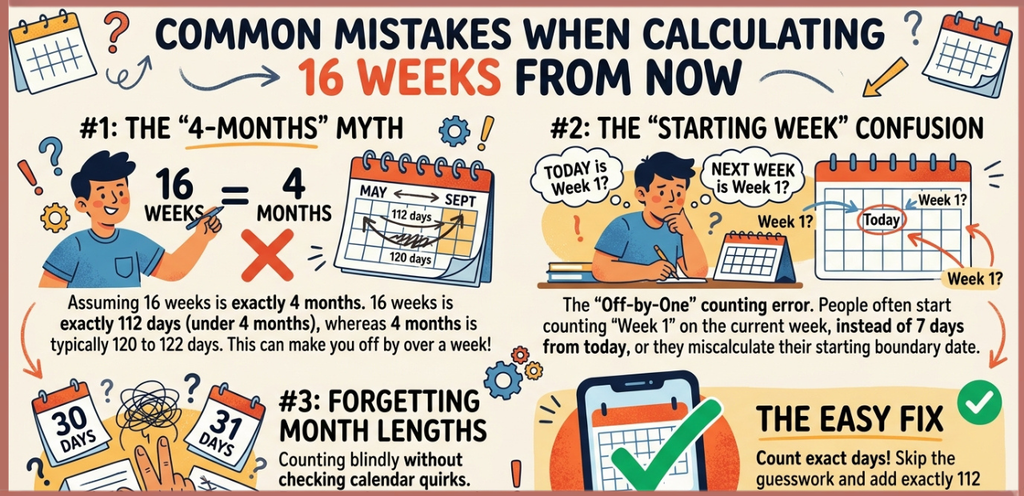
Date calculations are simple, but a few small mistakes can lead to incorrect answers.
Assuming sixteen weeks equals four months
Four months and sixteen weeks aren’t the same thing. Four calendar months can contain a different number of days from 112, depending on the months involved.
Counting the starting date as day one
When adding 112 elapsed days to October 17, the starting date is not counted as the first day after the start. The following day is day one.
Forgetting to cross into a new year
The calculation begins in October 2026 but ends in February 2027. Remembering the year change is essential when recording the final date.
Mixing up date formats
A date written entirely in numbers may be interpreted differently in different countries. Writing “February 6, 2027” makes the intended date clearer.
Confusing calendar days with working days
Sixteen weeks represents 112 calendar days, including weekends. If a deadline allows sixteen working weeks, holidays and weekends may need to be handled differently.
These checks are small, but they can make a meaningful difference when scheduling appointments, arranging travel, or setting a formal deadline.
Frequently Asked Questions About 16 Weeks From Today
What date is 16 weeks from today?
Using October 17, 2026, as today’s date, sixteen weeks later is February 6, 2027. The date falls on a Saturday.
What is 16 weeks from today in days?
Sixteen weeks equals 112 days because each week contains seven days. Multiplying sixteen by seven gives the total.
What day will it be in 16 weeks?
It will be Saturday, February 6, 2027. Adding a whole number of weeks preserves the weekday, so a Saturday remains a Saturday sixteen weeks later.
Is 16 weeks the same as four months?
No. Sixteen weeks equals 112 days, while four calendar months can contain a different number of days. The two periods may be close in length, but they aren’t interchangeable for an exact deadline.
What is 16 weeks from now in hours?
Sixteen weeks contains 2,688 hours, based on 112 standard 24-hour days.
What was 16 weeks ago from October 17, 2026?
Sixteen weeks before October 17, 2026, was June 27, 2026. That date was a Saturday.
How can I find a date 16 weeks after a different starting date?
Enter the starting date into a date calculator, multiply sixteen by seven to get 112 days, and add that number of days. You can also use a physical calendar and move forward by sixteen weekly intervals.
Does a date calculator include the starting date?
Most future-date calculators treat the starting date as day zero and add the requested elapsed duration. However, some countdowns count calendar dates inclusively, so it’s always worth checking the tool’s method when accuracy is important.
Frequently Asked Question
what is 16 weeks from today
16 weeks from today is Saturday, February 6, 2027. It is calculated by adding 112 days to today’s date.
16 weeks from now
16 weeks from now means the same future date, which is February 6, 2027. This time period equals 112 days, 2,688 hours, or 16 complete weeks.
16 weeks from today
16 weeks from today refers to the date that falls exactly 16 weeks after the current day. You can find it by moving forward one week at a time on a calendar.
what day will it be in 16 weeks
In 16 weeks, it will be Saturday, February 6, 2027. The exact day depends on the starting date used for the calculation.
how many weeks is 16 days
16 days is equal to 2 weeks and 2 days. It is calculated by dividing 16 days by 7 days per week.
Do you like this personality?
Read this blog https://avenzorixy.com/8-hours-from-now-is-what-time/
Conclusion: Make the Next Sixteen Weeks Count
Knowing What Date Is 16 Weeks From Today gives you a simple but useful answer: starting from October 17, 2026, the date is Saturday, February 6, 2027.
The calculation is easy to verify. Sixteen weeks equals 112 days, which is also 2,688 hours, 161,280 minutes, or 9,676,800 seconds. Whether you’re arranging an appointment, preparing for an important occasion, working toward a personal goal, or simply satisfying your curiosity, these numbers provide a clear way to understand the time ahead.
But a date is more than a number on a calendar. It can be a reason to begin preparing, a reminder to follow through on a promise, or a gentle nudge to make room for something that matters to you.
You don’t need to plan every hour between now and February. Start with one useful step, give yourself room to adjust, and let the weeks unfold naturally.
If you’ve used a sixteen-week countdown to prepare for a special event or reach a personal milestone, share your experience or favorite planning tip in the comments. Your approach might help someone else make better use of the time ahead.