Time has a funny habit of sneaking past us. You blink once, answer a few messages, grab another cup of coffee, and somehow the whole day has drifted into another shape.
Every now and then, though, you need to look backward instead of forward. Maybe you’re checking when an email was sent, confirming a work shift, tracking a delivery, or simply trying to remember when something happened.
That’s where asking What Time Was It 11 Hours Ago suddenly becomes surprisingly useful. It feels like a tiny question, but it solves very real situations.
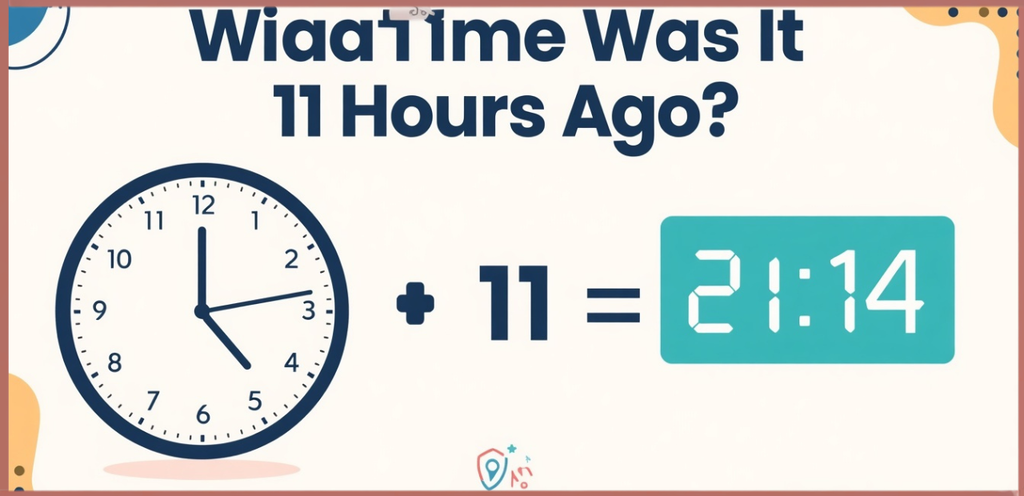
If the Current time is 8:45 PM PDT on Thursday, October 15, 2026, then 11 hours ago was 9:45 AM on the same day. It sounds almost too simple, yet people search for this exact answer thousands of times because life rarely leaves enough room to do mental math comfortably. Funny enough, our brains are excellent at remembering stories but not always at subtracting hours on demand.
This guide explains how to calculate past times, understand Time calculation, convert hours into smaller units, and use a Time calculator without getting tangled in numbers.
| Detail | Information |
|---|---|
| Current Time | 8:45 PM PDT |
| Current Date | Thursday, October 15, 2026 |
| Time Subtracted | 11 Hours |
| Total Minutes | 660 Minutes |
| Total Seconds | 39,600 Seconds |
| Time 11 Hours Ago | 9:45 AM |
| Previous Date | Thursday, October 15, 2026 |
What Time Was It 11 Hours Ago?

The answer depends entirely on the Current time.
For this example:
- Current Time: 8:45 PM PDT
- Date: Thursday, October 15, 2026
- Subtract Eleven hours
- Result: 9:45 AM
So, the answer to What Time Was It 11 Hours Ago is 9:45 AM.
Since eleven hours doesn’t cross midnight in this example, the date remains Thursday, October 15, 2026 instead of moving to the Previous day. Thats a tiny detail people often overlook.
Understanding Time Calculation
A proper Time calculation is simply adding or subtracting a period from a known point in time. In this case, you’re performing Hour subtraction.
Instead of guessing, imagine a clock moving backward exactly eleven spaces. Every hour moves the hands one position until you reach the desired Past time.
Many online tools automate this process, especially a Hours ago calculator, Time calculator, or Time difference calculator, making calculations nearly instant regardless of the starting time.
Why People Search for 11 Hours Ago
People rarely search time questions just because they’re curious. Usually there’s a practical reason.
Someone may need to:
- Verify a work log.
- Check when medication was taken.
- Confirm a text message timestamp.
- Review server logs.
- Calculate delivery updates.
- Compare different Timezone records.
- Understand an Elapsed time between events.
Oddly enough, something that sounds tiny can become really important when accuracy matters.
How to Calculate 11 Hours Ago Manually
If calculators aren’t available, you can calculate it yourself.
Start with your current clock.
Example:
Current Time:
8:45 PM
Subtract eleven hours.
8:45 PM 7:45 PM (1)
6:45 PM (2)
5:45 PM (3)
4:45 PM (4)
3:45 PM (5)
2:45 PM (6)
1:45 PM (7)
12:45 PM (8)
11:45 AM (9)
10:45 AM (10)
9:45 AM (11)
Simple, although after counting a few steps most people lose track somewhere around noon.
What Happens When the Time Crosses Midnight?
Not every subtraction stays on the same date.
Imagine the Current time is 6:00 AM.
Subtract eleven hours.
The answer becomes 7:00 PM on the Previous day.
Whenever subtraction passes midnight, the calendar changes automatically. That’s one reason people rely on an online Past time calculator instead of mental arithmetic.
What Is Eleven Hours in Other Time Units?
Understanding conversions helps with scheduling and technical work.
| Time Unit | Equivalent |
|---|---|
| Eleven hours | 11 hours |
| Minutes | 660 minutes |
| Seconds | 39,600 seconds |
| Milliseconds | 39,600,000 milliseconds |
These values stay the same regardless of the date or Timezone because they’re based on fixed Time units.
Why Minutes and Seconds Matter
While everyday life usually revolves around hours, computers rarely think that way.
Many applications record timestamps using:
- Minutes
- Seconds
- Milliseconds
So knowing that eleven hours equals 660 minutes, 39,600 seconds, or 39,600,000 milliseconds becomes useful for developers, engineers, analysts, and anyone working with precise Date and time records.
It feels oddly satisfying seeing one simple period stretched into so many smaller pieces.
Using an Hours Ago Calculator
A Hours ago calculator removes almost every chance of making mistakes.
Most calculators only require:
- Enter the Current time
- Enter the number of hours
- Choose subtraction
- View the calculated Past time
Some advanced calculators even account for Timezone conversion, daylight saving adjustments, and different calendar systems.
They’re much quicker than counting backward hour by hour.
What Time Is 11 Hours From Now?
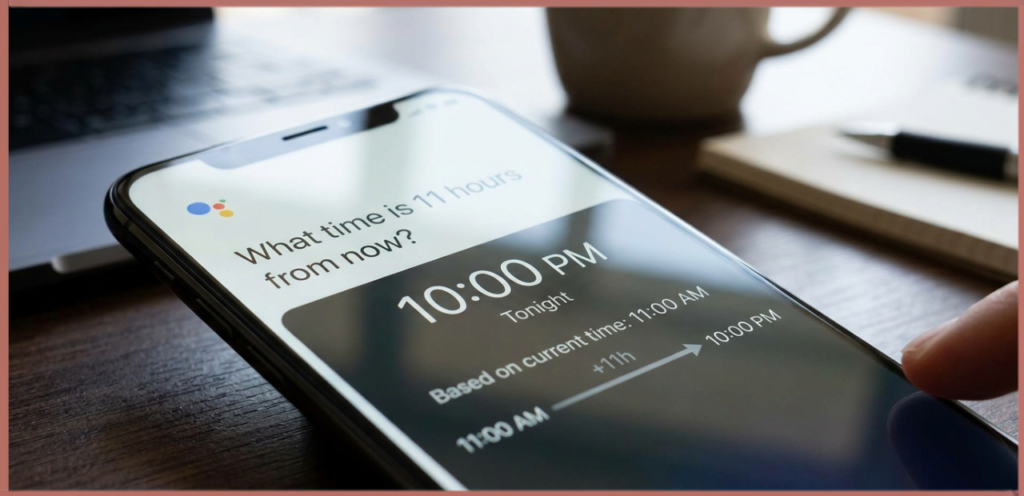
People searching backward often want the opposite calculation too.
Instead of subtracting hours, simply add them.
That’s exactly what a Hours from now calculator or Future time calculator does.
It uses the same Clock arithmetic, only in the opposite direction.
This symmetry makes Relative time calculations easy whether you’re looking ahead or behind.
Time Difference Explained
The Time difference between two events tells you exactly how much time separates them.
Suppose an activity started at 9:45 AM and ended at 8:45 PM.
The difference is:
- 11 hours
- 660 minutes
- 39,600 seconds
This is known as measuring Elapsed hours or Time duration.
Businesses, airlines, hospitals, and software systems rely heavily on accurate Time measurement every single day.
AM and PM Made Easy
Many mistakes happen because of confusion between AM and PM.
Here’s a quick reminder.
- AM covers midnight until before noon.
- PM covers noon until before midnight.
In this example:
- 9:45 AM = Morning
- 8:45 PM PDT = Evening
Understanding AM/PM notation prevents accidental scheduling errors that can be surprisingly embarrasing.
Morning, Afternoon, and Evening

People naturally divide the day into parts.
Morning generally runs from sunrise until noon.
Afternoon begins after midday.
Evening usually starts near sunset and continues into nighttime.
When calculating Clock time, recognizing these periods makes results feel more intuitive rather than just numerical.
Timezones Can Change the Answer
One interesting complication is Timezone.
Our example uses PDT (Pacific Daylight Time).
If another person checks the same moment in London or Tokyo, the local clock will display something entirely different.
The actual moment remains identical.
Only the displayed local Clock time changes.
That’s why international meetings almost always mention the timezone alongside the time.
Digital Clocks and Time Arithmetic
Modern devices perform Time arithmetic automatically.
Phones.
Computers.
Smartwatches.
Online booking systems.
Every one of them continuously calculates Date calculation, Relative time, and Time conversion behind the scenes.
We barely notice it until we ask something like, “what time was 11 hours ago?”
Common Uses for Past Time Calculations
Knowing an exact Previous time can help with many activities.
- Tracking work shifts.
- Calculating sleep duration.
- Reviewing surveillance footage.
- Finding transaction timestamps.
- Monitoring software backups.
- Planning travel schedules.
- Checking communication history.
- Comparing event logs.
Sometimes the smallest calculations save the biggest headaches.
Tips for Accurate Time Calculations
Accuracy matters more than speed.
Keep these suggestions in mind.
- Verify the Current day before subtracting hours.
- Check whether midnight is crossed.
- Confirm the correct Timezone.
- Use a trusted Online time calculator when precision matters.
- Double-check AM and PM.
Tiny mistakes can create surprisingly large misunderstandings.
Manual Time Conversion

Besides subtracting hours, converting units is equally useful.
Remember:
- 1 hour = 60 minutes
- 1 minute = 60 seconds
- 1 second = 1,000 milliseconds
Therefore:
- 11 hours = 660 minutes
- 11 hours = 39,600 seconds
- 11 hours = 39,600,000 milliseconds
These conversions appear frequently in engineering, computing, and scientific Time measurement.
Frequently Asked Questions
What time was it exactly 11 hours ago?
If the Current time is 8:45 PM PDT on Thursday, October 15, 2026, then the exact time was 9:45 AM.
What day was 11 hours ago?
In this example, it remains Thursday, October 15, 2026 because subtracting eleven hours does not reach midnight.
How many minutes are in eleven hours?
There are 660 minutes in eleven hours.
How many seconds are in eleven hours?
There are 39,600 seconds.
How many milliseconds are in eleven hours?
Exactly 39,600,000 milliseconds.
Can an hours ago calculator cross dates?
Yes. If subtraction passes midnight, the result automatically shifts to the Previous day.
Frequently Asked Question
11 hours ago
Eleven hours ago refers to the time exactly 11 hours before the current moment. It is commonly used to calculate a past time or check when an event occurred.
11 hours ago from now
Although “11 hours ago from now” is a common phrase, it simply means the exact time that was 11 hours before the current time. A time calculator can determine it instantly.
how long ago was 11 hours
11 hours ago means a duration of exactly 11 hours has passed since that moment. It is equal to 660 minutes or 39,600 seconds in the past.
what was 11 hours ago
What was 11 hours ago depends on the current time. Simply subtract 11 hours from the present time to find the exact past hour and date.
when was 11 hours ago
11 hours ago was the exact date and time occurring 11 hours before the current moment. The result changes automatically based on the current local time.
Read this blog https://avenzorixy.com/sizes-of-envelopes/
Final Thoughts
Looking backward through time sounds almost poetic, yet it is usually done for very practical reasons. Whether you’re checking an appointment, confirming an event, reviewing a system log, or satisfying simple curiosity, understanding What Time Was It 11 Hours Ago makes daily planning easier.
In our example, subtracting eleven hours from 8:45 PM PDT on Thursday, October 15, 2026 gives 9:45 AM, a straightforward answer supported by simple Time calculation and reliable Clock arithmetic.
Once you understand how Hour subtraction, Time conversion, and Elapsed time work together, calculating any past or future moment becomes much less intimidating.
And if you’d rather skip the math altogether, an online Hours ago calculator, Past time calculator, or Time calculator can provide instant, accurate results whenever you need them.
Time keeps moving whether we notice or not, but knowing how to step backward across it even for eleven hours gives you a clearer view of where you’ve already been.