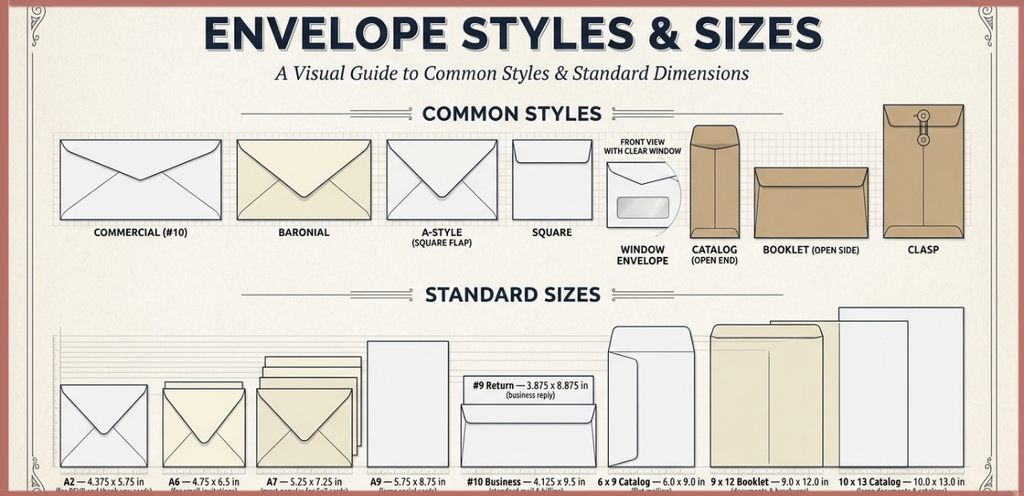
There’s something oddly comforting about holding an envelope before it has a story inside. Maybe it’s a wedding invitation waiting to surprise someone, a handwritten thank-you note, a business proposal that could change a career, or a birthday card tucked away for years in a memory box.
We often think about what’s inside the envelope, but almost never pause to appreciate the envelope itself. Funny enough, the wrapper quietly decides first impressions, protects precious papers, and even helps mail travel safely across continents. It’s kinda easy to overlook, yet it does so much.
Understanding Envelope Styles and Sizes isn’t only for designers, printers, or office managers. Anyone who mails invitations, business letters, reports, greeting cards, or promotional material benefits from knowing which envelope fits the occasion.
Picking the wrong one can wrinkle documents, increase postage costs, or simply make an otherwise thoughtful presentation feel… a little off. Small choices matter more than we’d guess.
Whether you’re sending formal correspondence, organizing office paperwork, or preparing elegant invitations, this guide explores the different envelope constructions, measurements, standards, and practical uses so you can confidently choose the perfect envelope every time.
| Envelope Style | Best Use |
|---|---|
| Commercial Envelope | Business letters and invoices |
| A-Style Envelope | Invitations, greeting cards, announcements |
| Square Envelope | Special invitations and marketing mail |
| Booklet Envelope | Brochures, catalogs, booklets |
| Catalog Envelope | Large documents and reports |
| Window Envelope | Bills, statements, and official mail |
| Security Envelope | Confidential documents |
| Coin Envelope | Coins, keys, seeds, and small items |
| Expansion Envelope | Thick documents and bulky files |
| Bubble Mailer | Shipping fragile or padded items |
Understanding Envelope Styles and Sizes
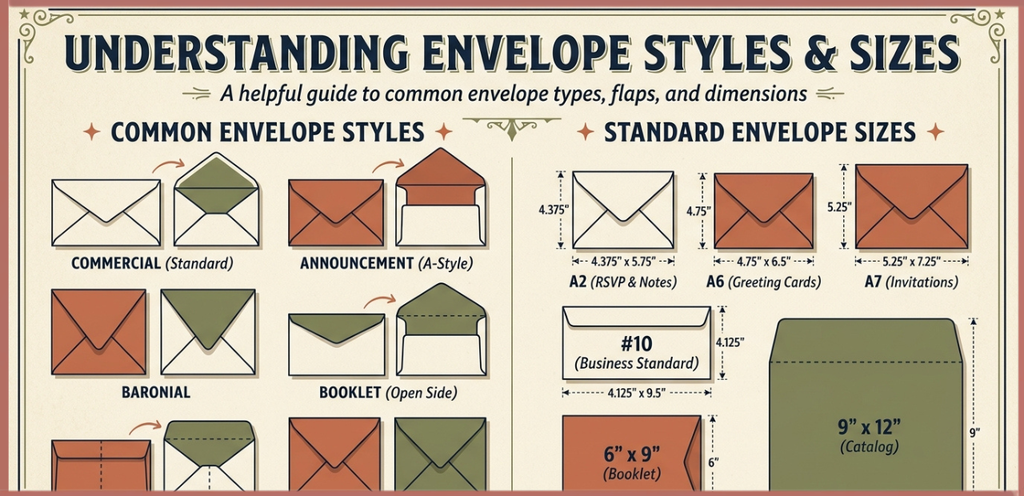
The phrase Envelope Styles and Sizes covers much more than measurements alone. It includes shape, construction, opening direction, flap design, printing compatibility, and intended purpose. Different industries rely on different envelope formats because every document has its own personality, if that makes sense.
A legal contract deserves a different envelope than a birthday invitation. Marketing brochures need different protection than personal letters. Choosing correctly helps reduce damage during Mail Processing, improves appearance, and complies with various Postal Guidelines.
Some of the most important considerations include:
- Envelope purpose
- Document dimensions
- Postal regulations
- Printing method
- Address placement
- Closure style
- Window requirements
- Paper compatibility
These elements together create an efficient mailing experience while maintaining a professional appearance.
Parts of an Envelope
Knowing the Parts of an Envelope makes selecting the right style much easier.
The main components include:
- Envelope Body holds the contents securely.
- Envelope Face the front side containing recipient information.
- Envelope Flap folds over the opening and seals the contents.
- Seal Flap the adhesive portion that closes the envelope.
- Opening where documents are inserted.
- Envelope Window (if applicable) transparent section showing printed addresses.
- Address Zone reserved space for the recipient’s details.
- Window Position and Window Size standardized to align with printed documents.
Each component contributes to appearance, security, and postal efficiency.
Envelope Construction Explained
Envelope Construction varies depending on intended use.
Some envelopes prioritize strength, while others focus on elegant presentation.
Common construction characteristics include:
- Side seams
- Center seams
- Diagonal seams
- Heavy paper stock
- Lightweight stationery paper
- Moisture-resistant coatings
- Self-seal adhesives
- Peel-and-stick closures
- Traditional gummed seals
Business environments usually favor durable construction, while invitation envelopes often emphasize appearance over ruggedness.
Common Envelope Flap Styles
The Envelope Flap influences both appearance and functionality.
Popular Flap Styles include:
- Commercial flap
- Square flap
- Wallet flap
- Deep pointed flap
- Baronial flap
Square flaps often appear on invitations because they look elegant. Commercial flaps are practical for everyday mailing, while wallet flaps provide a premium appearance for corporate correspondence.
The flap shape may seem like a tiny detail, but it quietly changes the overall impression of the envelope.
Open End vs Open Side Envelopes
One of the easiest distinctions to understand is the opening direction.
Open End Envelopes
Open End Envelopes have their opening on the shorter side.
They’re commonly used for:
- Reports
- Catalogs
- Certificates
- Large documents
- Booklets
These minimize folding and provide easier insertion of thicker materials.
Open Side Envelopes
Open Side Envelopes open along the longer edge.
They’re ideal for:
- Letters
- Business correspondence
- Invitations
- Greeting cards
- Everyday mailing
This design remains the most common style used worldwide.
Commercial Envelope Types
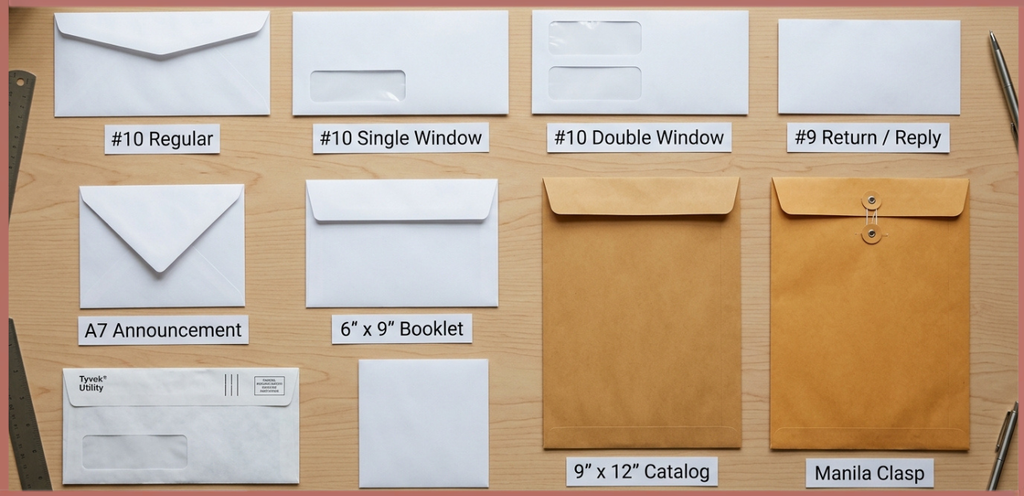
A Commercial Envelope remains the everyday champion of business communication.
Typical applications include:
- Letters
- Invoices
- Statements
- Checks
- Office correspondence
Common commercial sizes include:
- #6¼ Envelope
- #6¾ Envelope
- #7¾ Envelope
- #8⅝ Envelope
- #9 Envelope
- #10 Envelope
- #11 Envelope
- #12 Envelope
- #14 Envelope
Among these, the #10 Envelope has become the standard choice for folded letter-sized paper.
Monarch Envelope
The Monarch Envelope is taller and slimmer than standard commercial envelopes.
People often choose it for:
- Executive stationery
- Formal correspondence
- Personalized letters
- Premium invitations
Its elegant proportions make ordinary communication feel slightly more special, almost without trying.
Announcement and Baronial Envelopes
The Announcement Envelope is commonly paired with invitations, greeting cards, and social announcements.
Typical uses include:
- Wedding invitations
- Graduation announcements
- Holiday cards
- Birth announcements
Similarly, the Baronial Envelope offers classic styling with a pointed flap that complements formal stationery beautifully.
Popular announcement sizes include:
- A2 Envelope
- A6 Envelope
- A7 Envelope
- A8 Envelope
- A10 Envelope
These work exceptionally well with invitation cards.
Booklet and Catalog Envelopes
The Booklet Envelope opens along the long edge and accommodates thicker documents.
Perfect for:
- Booklets
- Manuals
- Brochures
- Reports
- Marketing materials
The Catalog Envelope opens on the short side.
Its strength makes it ideal for:
- Product catalogs
- Contracts
- Educational materials
- Large reports
- Printed presentations
Businesses frequently rely on these for secure document delivery.
Window Envelopes
A Window Envelope eliminates the need to print or label recipient addresses separately.
There are two primary styles.
Single Window Envelope
The Single Window Envelope displays only the recipient address.
Common for:
- Utility bills
- Statements
- Office invoices
Double Window Envelope
The Double Window Envelope displays both:
- Recipient address
- Return address
These simplify high-volume mailing while supporting Automatic Mail Insertion systems.
The placement follows strict Window Placement, Window Position, and Envelope Window Dimensions to ensure compatibility with automated postal equipment.
Metal Clasp Envelopes
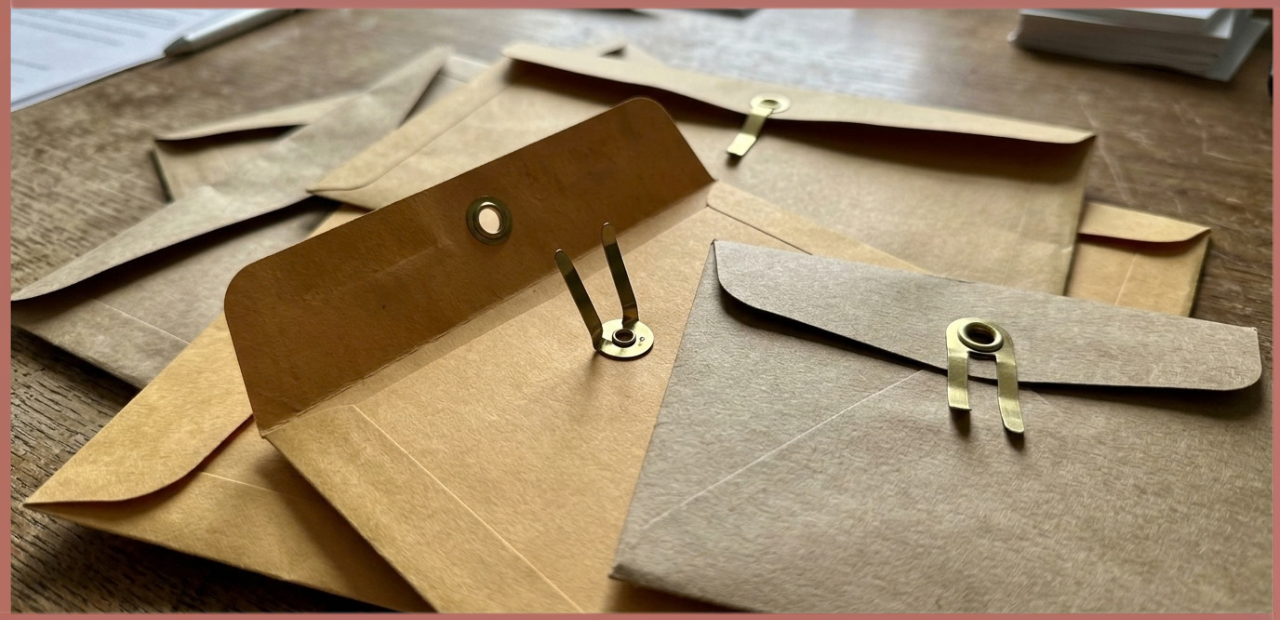
The Metal Clasp Envelope provides reusable security.
Frequently used for:
- Internal office mail
- Legal files
- Medical records
- Financial paperwork
The clasp allows repeated opening and closing without damaging the envelope.
Coin Envelopes
Despite the name, Coin Envelopes store much more than coins.
They’re useful for:
- Jewelry
- Keys
- Seeds
- Hardware
- Craft supplies
- Small parts
- Collectibles
Their compact design makes organization pleasantly easy.
US Envelope Sizes
The most common US Envelope Sizes follow standardized dimensions.
Frequently used examples include:
| Envelope | Typical Use |
|---|---|
| #9 | Business reply mail |
| #10 | Standard business letters |
| #11 | Larger correspondence |
| #12 | Reports |
| #14 | Large business documents |
| A2 | Small invitations |
| A6 | Greeting cards |
| A7 | Wedding invitations |
| A8 | Announcements |
| A10 | Large invitation cards |
| Slim Envelope | Long invitations |
These remain the backbone of business and personal correspondence throughout the United States.
ISO Envelope Standards
Outside North America, ISO Envelope Standards dominate international mailing.
Popular sizes include:
- C3
- C4
- C5
- C6
- C6/C5
- C7
- C7/6
The C-series is specifically designed around A Paper Sizes, allowing documents to fit without awkward trimming.
For example:
- C4 fits unfolded A4 Paper.
- C5 fits folded A4 Paper.
- C6 fits folded A5 Paper.
- DL Envelope fits A4 folded into thirds.
The B Series Envelopes, including B4, B5, and B6, provide slightly larger alternatives for thicker contents.
Envelope Dimensions and Measurements
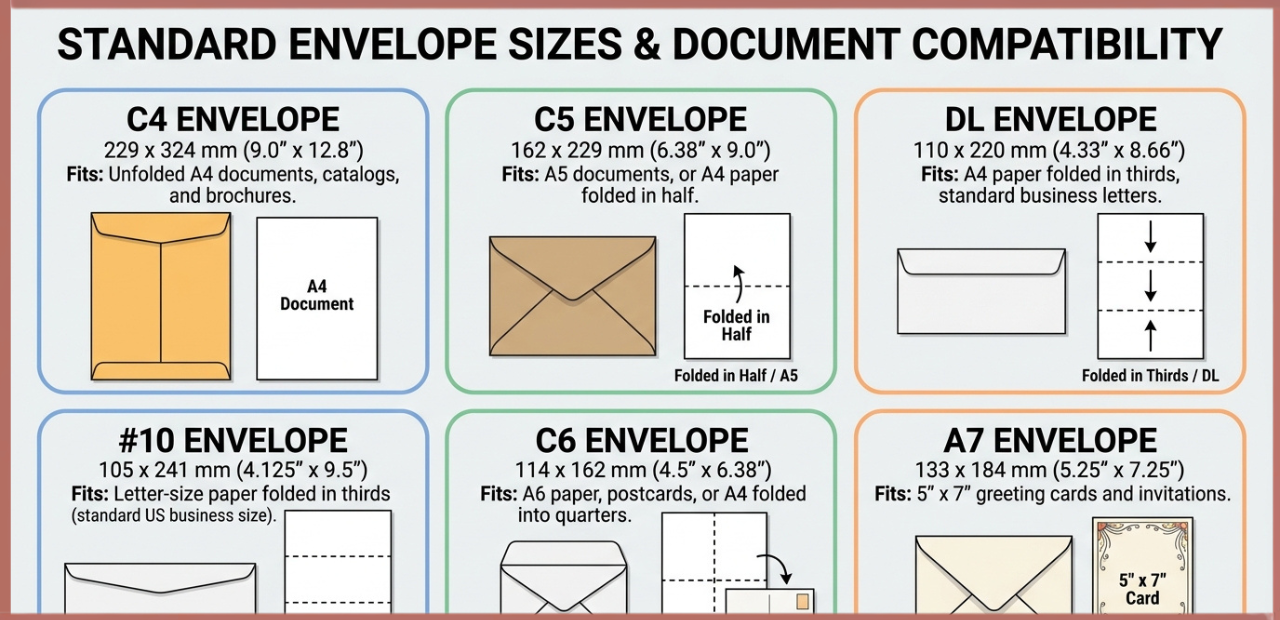
Understanding Envelope Dimensions helps avoid unnecessary folding.
Measurements generally consider:
- Long Dimension
- Short Dimension
- Internal capacity
- Flap clearance
- Window dimensions
Keeping documents proportional improves appearance while minimizing damage during transit.
Many offices rely on an Envelope Size Chart for quick reference when selecting appropriate mailing supplies.
Standard Envelope Sizes for Different Documents
Matching document type with envelope type creates better presentation.
| Document | Recommended Envelope |
|---|---|
| Letterhead | #10 Commercial |
| Invoice | Window Envelope |
| Statement | Double Window Envelope |
| Check | #9 Envelope |
| Greeting Card | A6 or A7 |
| Invitation | Announcement Envelope |
| Brochure | Booklet Envelope |
| Catalog | Catalog Envelope |
| Report | Open End Envelope |
| Magazine | Catalog Envelope |
Selecting the right pairing simply feels cleaner and more professional.
Addressing Envelopes Correctly
Proper Envelope Addressing remains essential for efficient delivery.
Include:
- Recipient Address
- Mailing Address
- Return Address
- ZIP Code
- Postal Code
Correct Address Position, Address Placement, and Address Formatting help postal systems recognize addresses quickly.
Automated sorting equipment relies heavily on clean layouts and readable printing.
USPS and Postal Automation
The USPS encourages standardized formatting because automated systems process millions of mail pieces daily.
Modern systems depend upon:
- Optical Character Recognition (OCR)
- Barcode Printing
- Readable Address
- Postal automation
- Mail sorting
When addresses are properly aligned, OCR accurately reads destination information, reducing delivery delays.
Following USPS Envelope Standards can also lower mailing costs for businesses sending high volumes of mail.
Envelope Printing
Modern Envelope Printing supports branding as well as functionality.
Businesses commonly print:
- Company logos
- Return addresses
- Promotional graphics
- QR codes
- Corporate colors
Both Laser Printer and Inkjet Printer technologies handle envelopes effectively, though choosing compatible paper stock matters a bit more than people realize.
Laser Printing
Advantages include:
- Fast output
- Crisp text
- High-volume production
Inkjet Printing
Advantages include:
- Rich colors
- Excellent image quality
- Flexible media compatibility
Choosing between Laser Printing and Inkjet Printing depends on printing volume and design requirements.
Choosing the Right Envelope
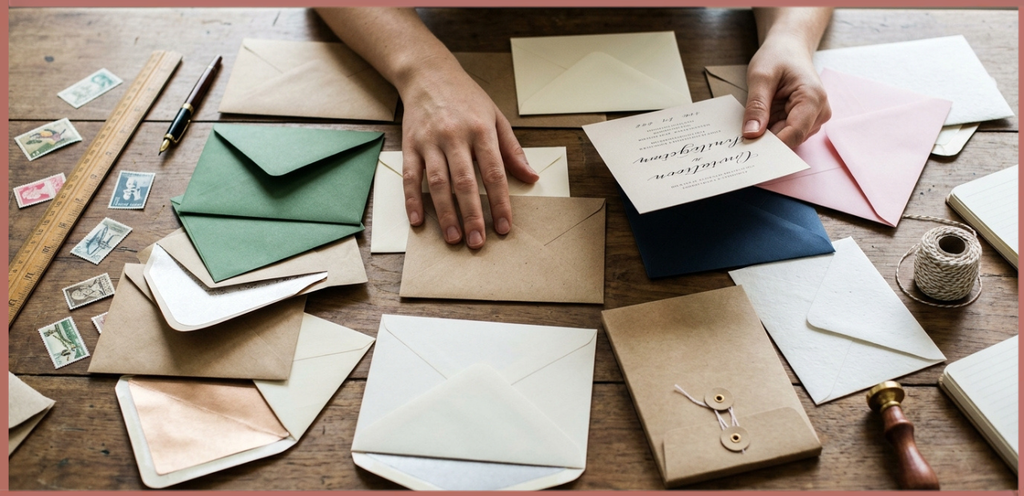
Before selecting an envelope, ask yourself a few practical questions.
- Is the document folded?
- Does it require window addressing?
- Will it travel internationally?
- Is presentation important?
- Does it need additional protection?
- Is automatic insertion required?
- Will branding be printed?
Answering these usually points toward the ideal envelope style surprisingly fast.
Why Envelope Standards Matter
Without Envelope Standards, mailing systems would become frustratingly inconsistent.
Standardization improves:
- Delivery speed
- Postal automation
- Cost efficiency
- Print compatibility
- International mailing
- Equipment reliability
Whether following US Envelope Sizes or ISO Envelope Standards, consistency benefits everyone involved.
Practical Tips for Everyday Mailing
Small habits can make envelopes look much more professional.
- Avoid overstuffing envelopes.
- Keep addresses centered within the Address Zone.
- Use quality paper.
- Choose the correct flap style.
- Verify Postal Code and ZIP Code accuracy.
- Match document size carefully.
- Keep envelopes clean before mailing.
- Test printer alignment before large print runs.
These little details often seperate average mail from memorable correspondence.
Frequently Asked Question
types of envelopes
There are many types of envelopes, including commercial, announcement, booklet, catalog, baronial, and window envelopes. Each type is designed for specific mailing and document needs.
different size envelopes
Different size envelopes are available for letters, invitations, brochures, catalogs, and business documents. Choosing the right size helps ensure your contents fit securely and professionally.
envelope styles
Envelope styles vary by their shape, flap design, opening direction, and intended use. Popular styles include commercial, booklet, catalog, and window envelopes.
envelope b5 size
A B5 envelope measures 176 × 250 mm (7 × 9⅞ inches) and is commonly used to hold a C5 envelope or documents that require extra space.
what are the different envelope sizes
Envelope sizes range from small invitation envelopes to large catalog envelopes and follow both US Standard and ISO sizing systems. Common sizes include #10, A7, C4, C5, C6, and DL envelopes.
Read this blog https://avenzorixy.com/inches-to-ring-size-converter-4/
Final Thoughts on Envelope Styles and Sizes
At first glance, envelopes appear wonderfully ordinary. Yet behind that simple rectangle lives an impressive world of engineering, design, postal science, and thoughtful presentation.
From Commercial Envelopes and Window Envelopes to elegant Announcement Envelopes, practical Catalog Envelopes, sturdy Booklet Envelopes, and internationally recognized DL Envelope, every style exists for a reason.
Understanding Envelope Styles and Sizes means making smarter choices about protection, appearance, efficiency, and cost. It also helps your documents arrive exactly as intended clean, organized, and ready to make the right impression.
Whether you’re mailing a heartfelt letter, an important contract, colorful promotional material, or beautifully printed invitations, the right envelope quietly does its job so well that nobody notices. And honestly, maybe that’s the nicest compliment an envelope could ever get.