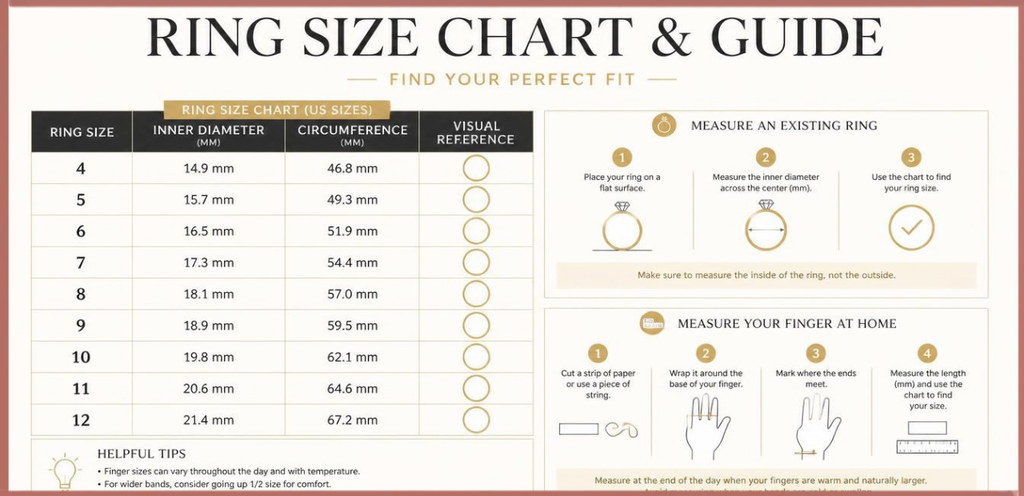
Buying a ring sounds easy until the tiny little circle decides it wants to test your patience. Funny thing is, a ring doesn’t care if it’s expensive or simple, if the size isn’t right, it’ll remind you every single day. That’s why a proper Ring Size Chart & Guide matters way more than most people first imagine.
I remember watching someone hide an engagement ring inside a coffee mug, only to discover later that the ring stopped halfway down the finger. Everyone laughed, but the poor fellow looked like he wanted the floor to open up. It was sweet though, somehow unforgettable.
Whether you’re buying a gift, planning a proposal, replacing an old family piece, or simply treating yourself because, well, why not, understanding Ring Size, measurements, and fitting techniques saves both money and stress.
This guide brings together practical advice, measurement methods, conversion tips, and professional recommendations so you can confidently choose a ring that feels almost like it already belonged there.
| Measurement | Description |
|---|---|
| US Ring Size | Standard ring size used in the United States (e.g., 5, 6, 7, 8). |
| Inside Diameter (mm) | The inner width of the ring measured in millimeters. |
| Finger Circumference (mm) | The measurement around the finger used to determine ring size. |
| UK Ring Size | Letter-based sizing system used in the United Kingdom (A–Z). |
| EU Ring Size | European ring size based on finger circumference in millimeters. |
| Best Measuring Method | Use a ring sizer, printable chart, or measure an existing ring for accuracy. |
| Between Sizes? | Choose the larger size for a more comfortable fit. |
| Best Time to Measure | Measure your finger at room temperature when it’s not swollen or cold. |
Why a Ring Size Chart & Guide Matters
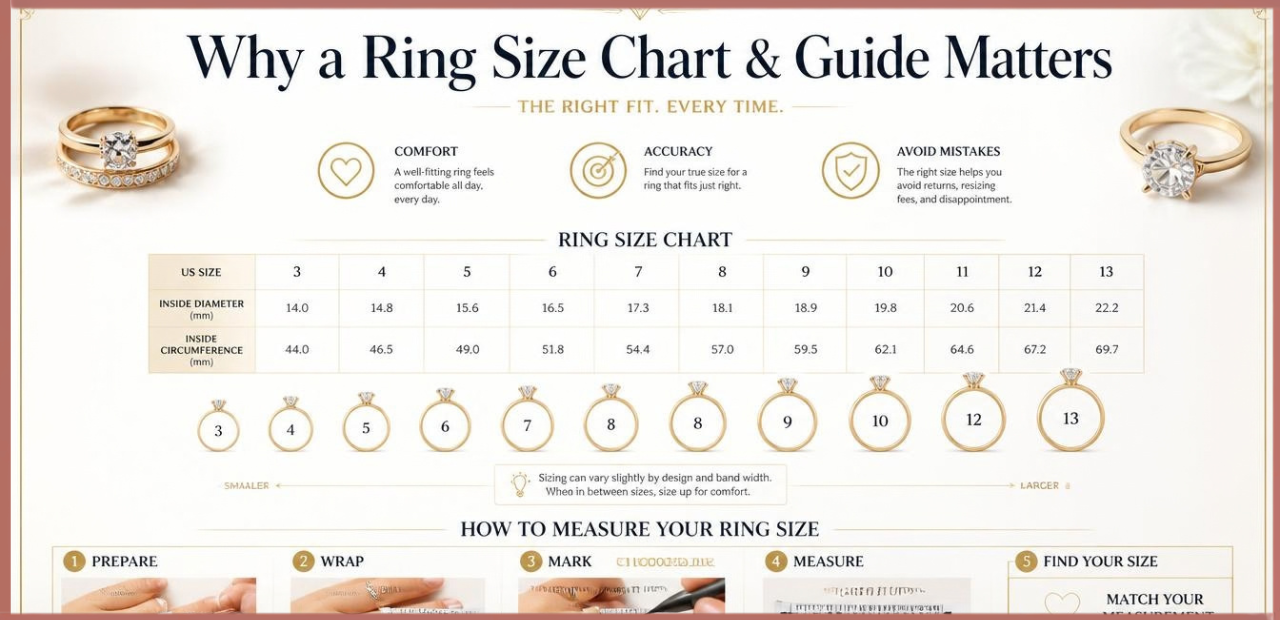
A ring isn’t just jewelry. It quietly becomes part of everyday life.
People often spend hours comparing gemstones and metals, then guess the size. Thats honestly the quickest way to ruin an otherwise perfect purchase. A reliable Ring Size Chart, combined with a trustworthy Ring Size Guide, helps eliminate uncertainty before it becomes an expensive mistake.
Correct sizing means:
- Better daily comfort
- Lower chance of losing the ring
- Easier online shopping
- Fewer resizing costs
- More confidence when buying surprise gifts
- Better overall Ring Comfort
- Longer-lasting satisfaction with your purchase
Even the finest Diamond Ring won’t feel luxurious if it squeezes your finger every afternoon.
Understanding Ring Measurements
Before measuring anything, it’s useful to understand what jewelers actually measure.
The most important sizing terms include:
- Ring Diameter
- Inside Diameter
- Ring Circumference
- Finger Circumference
- Finger Measurement
- Ring Measurement
- Millimeters (mm)
- Inches
The Inside Diameter measures the inside width of the ring, while the Ring Circumference measures the entire inside distance around the ring.
Some countries use diameter.
Others rely on circumference.
Many use completely different numbering systems altogether, which explains why international shopping can become slightly confusing if you don’t have a proper Ring Size Comparison Chart nearby.
Ring Size Chart & Guide for International Ring Sizes
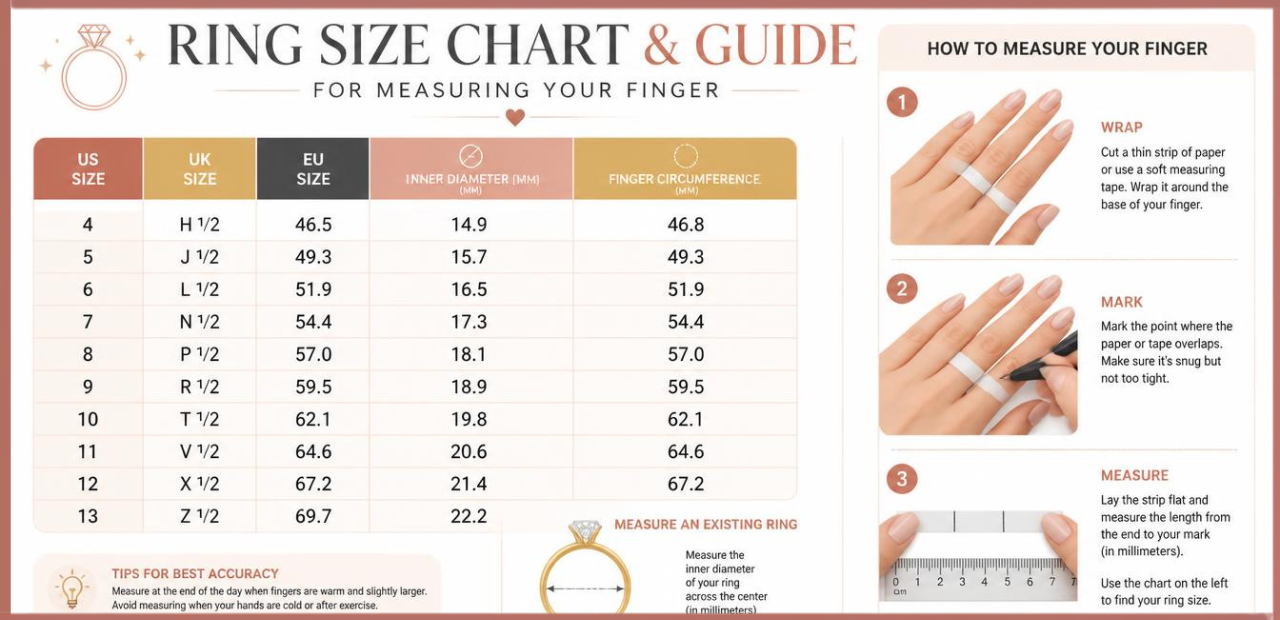
Shopping across borders has become normal now. A ring sold in America may use completely different sizing from one sold in Europe or Japan.
A complete International Ring Sizes reference generally includes:
| Region | Common System |
|---|---|
| US Ring Size | Numeric (3–16+) |
| UK Ring Size | Letters (A–Z+) |
| EU Ring Size | Circumference in mm |
| Japan Ring Size | Numeric |
| DK Ring Size | Scandinavian measurements |
Using an International Ring Size Chart or Ring Size Conversion Chart makes converting between countries much easier.
Many online stores also provide US to UK ring size conversion, EU ring size chart, and international ring size conversion tables for convenience.
How to Measure Ring Size at Home
The nice thing is you don’t always need a jewelry store.
Several simple methods work surprisingly well if done carefully.
Paper Strip Method
The Paper Strip Method remains one of the easiest approaches.
Cut a narrow strip of paper.
Wrap it around the base of your finger.
Mark where it overlaps.
Measure the length using a Ruler Measurement.
Compare that measurement against a ring circumference chart.
Simple? Yep. Accurate enough? Usually, yes.
Thread Method
The Thread Method works similarly.
Use a piece of thread instead of paper.
Avoid stretching it while measuring because thread can slightly change length under tension.
Measure the final length in Millimeters (mm) for greater precision.
Measure an Existing Ring
Already own a perfectly fitting ring?
Then simply Measure Your Ring.
Measure the Inside Diameter using a ruler or digital caliper.
Compare it with a ring diameter chart or ring size by diameter reference.
Many people find this to be the most accurate home option.
Ring Size Chart & Guide for Measuring Your Finger
Sometimes measuring the finger directly gives the best result.
When you Measure Your Finger, remember that fingers naturally change throughout the day.
For better accurate ring sizing, follow these suggestions:
- Measure during the evening.
- Avoid measuring immediately after exercise.
- Measure several times.
- Keep hands at normal Body Temperature.
- Measure both hands.
- Compare multiple readings.
This simple ring measurement guide greatly improves accuracy.
Factors That Can Affect Ring Size
One thing many buyers never realize is that fingers don’t stay exactly the same size all day.
Several natural factors influence sizing.
Finger Swelling
Finger Swelling happens naturally.
Heat.
Exercise.
Long walks.
Salty food.
Even sleeping.
All of these can slightly increase finger size.
Cold Weather
Cold Weather usually causes fingers to shrink a little.
Someone measured during winter may require a slightly different fit than someone measured in midsummer.
Water Retention
Hormonal changes, hydration levels, and Water Retention all affect finger measurements.
Its actually pretty surprising how noticeable the difference can become.
Dominant vs Non Dominant Hand
Your Dominant Hand is often slightly larger than your Non-Dominant Hand.
That means your wedding ring may not fit equally well on both hands.
Always measure the finger where the ring will actually be worn.
Ring Band Width Changes Everything
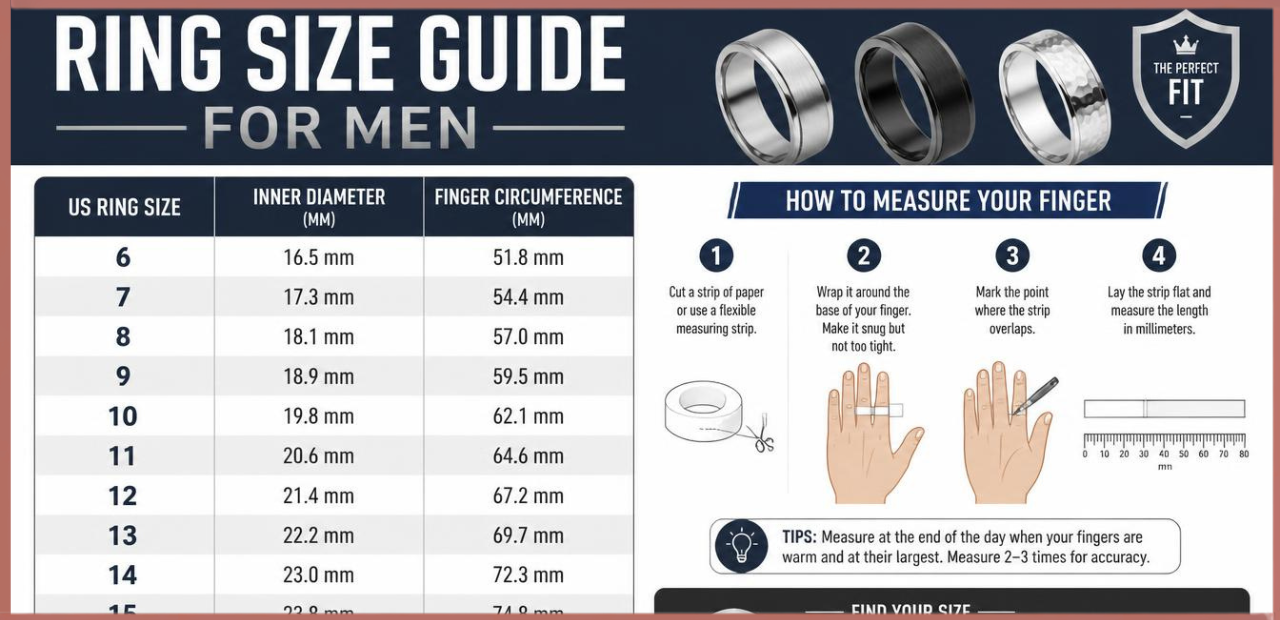
Many shoppers overlook one important detail.
The width of the band.
A Wide Ring Band usually feels tighter than a Slim Ring Band, even if both technically share the same size.
General advice:
- Thin bands usually fit true to size.
- Wide bands often feel snugger.
- Some people choose a Half Ring Size larger for wider bands.
This is one of the most useful ring band sizing tips professionals regularly recommend.
Ring Styles and Their Fit
Different rings don’t behave exactly the same.
Engagement Ring
An Engagement Ring often prioritizes elegance and daily comfort.
Many feature a Solitaire Ring design with a single center stone.
Wedding Ring
A Wedding Ring usually stays on every day.
Comfort becomes especially important here.
Statement Ring
A bold Statement Ring may feel heavier because of its design.
Cocktail Ring
A Cocktail Ring often includes larger gemstones and decorative settings.
Stacking Ring
A Stacking Ring is designed to sit alongside several others.
Sizing should leave just enough room without becoming loose.
Knuckle Ring
A Knuckle Ring intentionally sits higher on the finger and therefore uses a different measurement.
Adjustable Ring
An Adjustable Ring offers flexibility for changing finger sizes.
Open Ring
An Open Ring features a slight opening, allowing minor adjustments.
Gemstone Ring
A colorful Gemstone Ring may include larger settings that influence comfort.
Diamond Ring
A classic Diamond Ring remains one of the most popular choices for engagements.
Zircon Ring
A Zircon Ring offers beautiful sparkle while remaining budget friendly.
Ring Size Guide for Men
The Ring Size Guide for Men differs slightly because average finger sizes tend to be larger.
Typical average men’s ring size often falls between US sizes 9 and 11.
However, there’s no perfect average.
Lifestyle, height, hand structure, and genetics all influence sizing.
Always measure instead of assuming.
Ring Size Guide for Women
The Ring Size Guide for Women generally centers around smaller average sizes.
Typical average women’s ring size usually ranges between US sizes 5 and 7.
Again, these are only averages.
Everyone’s hands are wonderfully different.
Ring Size Conversion Made Easy
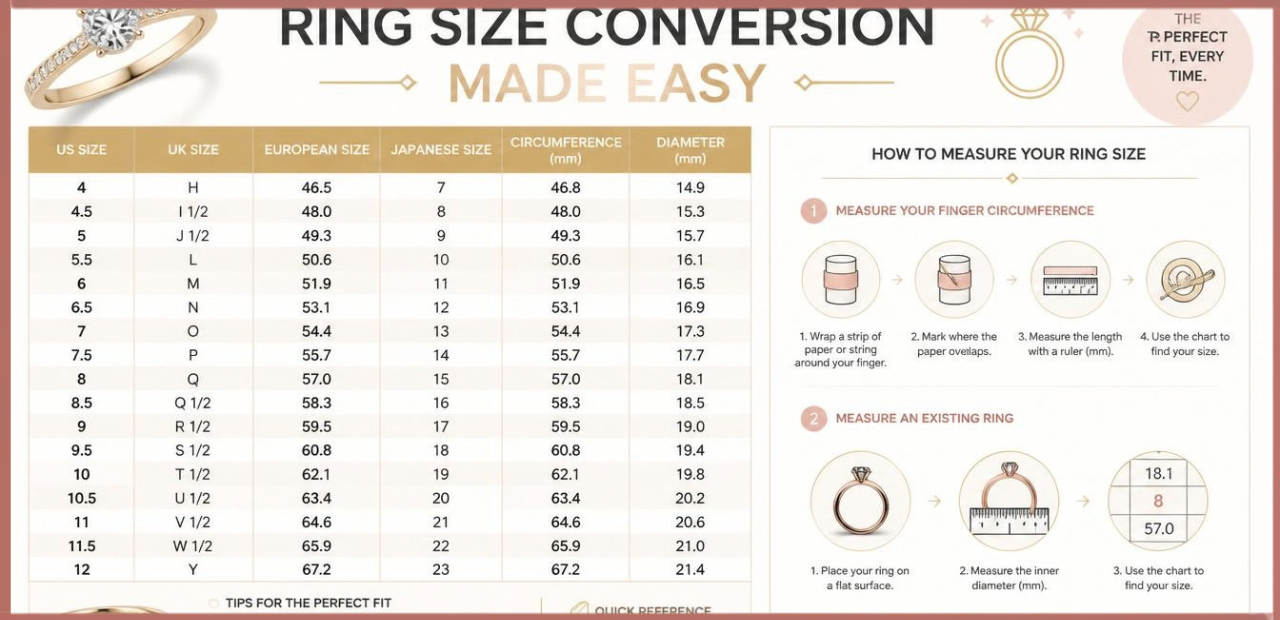
International shopping becomes much easier with a reliable Ring Size Conversion reference.
You may encounter:
- ring size chart US to UK
- ring size chart in mm
- convert ring sizes
- ring size conversion chart
- ring measurement conversion
- worldwide ring sizes
Keeping a conversion chart nearby prevents ordering mistakes.
Online Ring Shopping Tips
Buying jewelry online has become completely normal now.
Still, there are smart habits worth following.
- Use a trusted Ring Size Chart & Guide.
- Read customer sizing reviews.
- Check resizing policies.
- Confirm whether measurements use diameter or circumference.
- Save your exact ring size in millimeters.
- Compare sizing with an international ring size chart.
- Review the retailer’s Ring Exchange policy.
Experienced Jewelry Experts also recommend measuring twice before ordering.
Ring Resizing: When Is It Possible?
Sometimes mistakes happen.
Fortunately, many rings can undergo Ring Resizing.
Factors include:
- Metal type
- Stone placement
- Band thickness
- Ring design
Some intricate Ring Design styles cannot safely be resized.
Always ask before purchasing.
Helpful Ring Sizing Tips
Small details often make a huge difference.
Some practical ring sizing tips include:
- Never measure swollen fingers.
- Measure more than once.
- Avoid measuring after heavy exercise.
- Don’t guess from shoe size or glove size.
- Use a ring size calculator if available.
- Compare with a ring size lookup chart.
- Measure existing rings whenever possible.
- Remember that comfort matters more than perfection.
Its better for a ring to slide gently over the knuckle than become impossible to remove.
Common Mistakes to Avoid
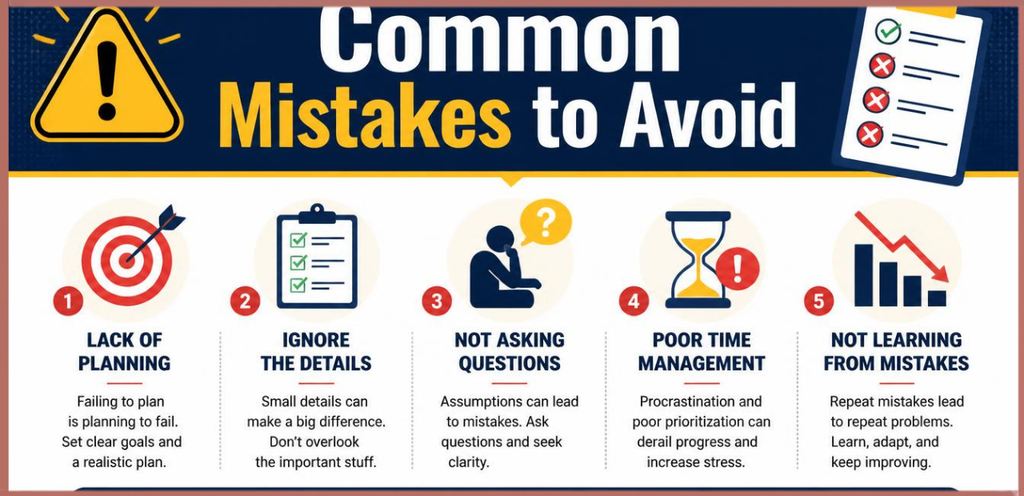
Many sizing problems come from simple oversights.
Avoid these common mistakes:
- Measuring only once
- Ignoring Knuckle Measurement
- Forgetting seasonal changes
- Choosing fashion over comfort
- Skipping the finger measurement chart
- Using stretched thread
- Confusing diameter with circumference
- Forgetting ring fitting guide recommendations
Tiny errors of one or two millimeters can noticeably change the final fit.
Choosing the Correct Ring Size for Gifts
Buying rings as surprises can feel risky.
A few clever ideas include:
- Borrow a ring your recipient already wears.
- Trace its inner circle.
- Ask close friends discreetly.
- Consult family members.
- Consider an Adjustable Ring if uncertain.
This approach is especially useful for engagement ring sizing or wedding ring sizing surprises.
Professional Ring Measurement vs Home Measurement
Home methods have improved dramatically.
Still, professional jewelers possess specialized measuring tools that deliver exceptional accuracy.
If you’re purchasing a high-value ring, especially a custom Solitaire Ring or luxury Diamond Ring, professional sizing offers extra confidence.
For everyday purchases, careful home ring measurement usually performs remarkably well.
Frequently Asked Question
65mm ring size
A 65mm ring size refers to a ring with an inside circumference of approximately 65 millimeters. It generally corresponds to a larger finger size, though the exact size varies slightly by country.
60mm ring size
A 60mm ring size has an inside circumference of about 60 millimeters and usually fits a medium to large finger. Always compare it with a ring size chart for the most accurate match.
65 mm ring size
A 65 mm ring size indicates a ring measuring 65 millimeters around the inside circumference. It is commonly converted into US, UK, or EU ring sizes using a standard conversion chart.
circumference to ring size
To convert circumference to ring size, measure the inside circumference of your finger in millimeters and match it to a ring size chart. This method helps you find the most accurate ring size.
60 mm ring size
A 60 mm ring size represents a ring with a 60-millimeter inner circumference. It is a popular size that can be easily converted to US, UK, and European ring size standards.
Read this blog https://avenzorixy.com/ring-size-in-inches/
Final Thoughts
Finding the correct ring size isn’t about luck. It’s about understanding measurements, comparing international standards, considering weather, hand dominance, ring width, and using reliable measurement techniques.
A thoughtful Ring Size Chart & Guide becomes more than just a tabl it becomes a practical companion that helps every ring feel like it was made specifically for you.
Whether you’re searching for a forever Wedding Ring, planning a surprise Engagement Ring, stacking fashionable bands, or simply exploring Online Ring Shopping, taking a few extra minutes to measure properly can save days of frustration later.
Keep a trusted Ring Size Guide, compare measurements carefully, and don’t hesitate to seek advice from experienced Jewelry Experts whenever needed.
In the end, the perfect ring isn’t only about sparkle. It’s the one that slips on comfortably, stays secure through ordinary days and extraordinary moments, and quietly reminds you that even the smallest details are worth getting right.