A Coke can is one of those everyday objects that almost everyone recognizes without giving it a second thought. It sits beside a lunch plate, travels inside a backpack, rests in a refrigerator door, and occasionally becomes the unofficial measuring tool when someone needs to estimate the size of a small object.
Yet, have you ever stopped to wonder exactly how tall it is, how wide its circular body measures, or why a mini Coke can looks so different from a regular one?
The familiar red Coca-Cola container carries more interesting details than its simple appearance suggests. Behind that shiny aluminum surface is thoughtful engineering, careful material selection, and a design developed to protect a carbonated drink while making it easy to store, transport, and enjoy.
Understanding Coke can size is useful for more than satisfying curiosity. It can help when organizing refrigerator shelves, designing custom labels, choosing cup holders, planning beverage displays, or comparing different drink containers. Even a small difference in height or diameter can matter when space is limited.
In this complete guide, we’ll explore Coke can dimensions, standard measurements, mini formats, slim cans, tallboy options, metric conversions, and practical comparisons. We’ll also look at the clever engineering that makes a lightweight aluminum can strong enough to hold a pressurized carbonated beverage.
Let’s take a closer look at the measurements hiding inside this familiar red package.
| Measurement | Standard 12 oz (355 ml) Coke Can |
|---|---|
| Height | 4.83 in (12.3 cm) |
| Diameter | 2.60 in (6.6 cm) |
| Circumference | 8.17 in (20.7 cm) |
| Lid Diameter | 2.13 in (5.4 cm) |
| Capacity | 12 oz (355 ml) |
What Is the Standard Coke Can Size?
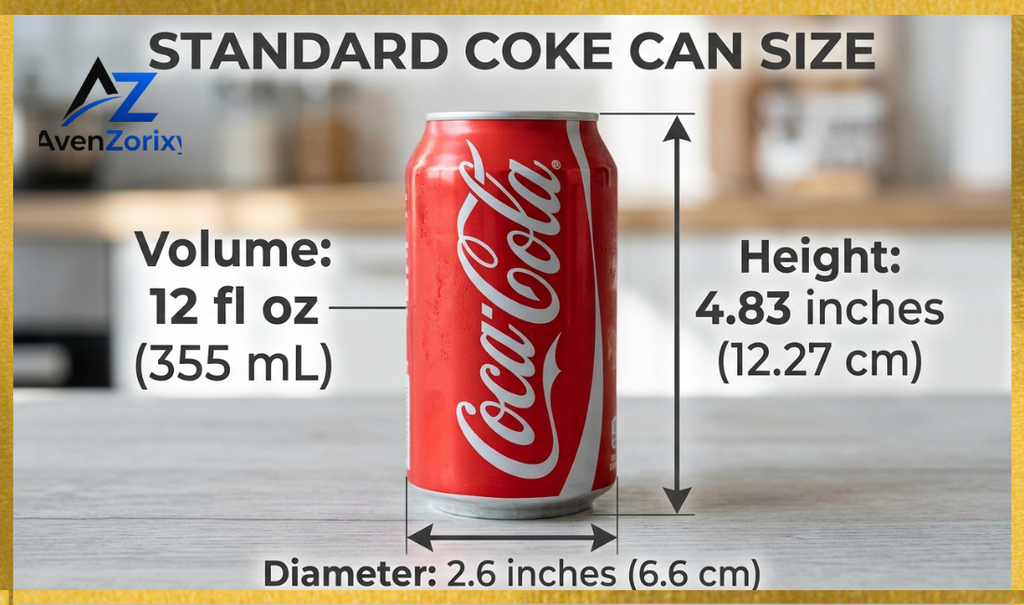
The most recognizable Coca-Cola container in the United States is the standard 12 oz Coke can, which holds approximately 355 milliliters of liquid.
It has a cylindrical body, a slightly narrower top, a rounded shoulder, and a circular aluminum bottom. Although the exact dimensions can vary slightly between manufacturers and production specifications, a typical standard can has the following measurements.
Coca-Cola Classic Soda, Crisp Delicious Refreshment, 12oz Cans, Pack of 18 – Walmart.com
| Measurement | Approximate size |
|---|---|
| Capacity | 12 fl oz |
| Volume | 355 ml |
| Height | 4.83 inches |
| Height in centimeters | 12.27 cm |
| Height in millimeters | 122.7 mm |
| Body diameter | 2.60 inches |
| Body diameter in centimeters | 6.60 cm |
| Body diameter in millimeters | 66 mm |
| Radius | 1.30 inches |
| Circumference | 8.17 inches |
| Circumference in centimeters | 20.75 cm |
These are useful reference dimensions, not guaranteed specifications for every Coca-Cola product. Can profiles, manufacturers, and regional packaging formats can introduce small differences.
The standard can is designed to balance capacity, portability, and strength. It holds enough soda for an ordinary serving without becoming too bulky for refrigerators, coolers, or vending machines.
Coke Can Dimensions: Height, Diameter, and Circumference Explained
Knowing the capacity of a beverage can is one thing, but understanding its physical dimensions gives a much clearer picture. Three measurements matter most: height, diameter, and circumference.
Beverage Can – 12 oz Dimensions & Drawings | Dimensions.com
Coke Can Height
The typical Coke can height is approximately 4.83 inches, or 12.27 centimeters.
That makes the standard container slightly shorter than five inches. Imagine placing a small paperback book vertically beside it, and you’ll have a reasonable visual reference.
The height includes the can’s top and bottom construction. It is especially important for refrigerator shelves, vending machine compartments, and beverage storage organizers.
Coke Can Diameter
The body diameter of a standard Coke can is approximately 2.60 inches, equivalent to 6.60 centimeters.
This measurement describes the width across the cylindrical body rather than the narrower neck or lid.
The diameter matters because it determines how much horizontal space a can occupies. A few millimeters might not sound important, but when arranging dozens of cans inside a cooler, those little differences add up.
Coke Can Circumference
The Coke can circumference is approximately 8.17 inches, or 20.75 centimeters.
Circumference measures the distance around the outside of the cylindrical body.
You can calculate it with this simple formula:
\[ C = \pi \times D \]
Where:
- C represents circumference.
- π is approximately 3.1416.
- D represents the diameter.
For a can with a diameter of 2.60 inches:
\[ C = 3.1416 \times 2.60 \]
\[ C \approx 8.17 \text{ inches} \]
This measurement becomes particularly useful when creating custom can wraps, measuring packaging materials, or designing promotional labels.
Coke Can Radius
The radius is half the diameter.
For a standard Coke can:
\[ R = \frac{2.60}{2} = 1.30 \text{ inches} \]
That is approximately 3.30 centimeters.
Although radius is less commonly used in everyday conversations, it is useful for calculating the cross-sectional area of a cylindrical container.
Coke Can Dimensions Chart: Every Common Format
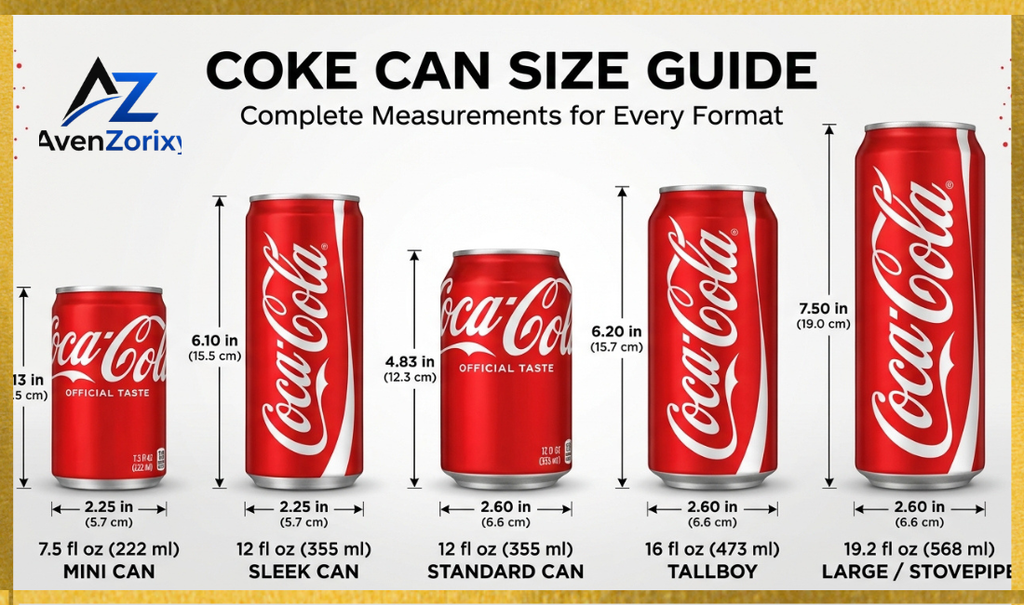
Not every Coca-Cola product comes in the same container. Different countries, retailers, and product lines use different capacities and shapes.
Here is a practical comparison of common beverage can formats.
SODA CAN COKE CLASSIC24-12FLZ CCOLA – Gordon Restaurant Market
Meet the Brands: Coca-Cola Original Taste | Coca-Cola Europacific Partners
5
| Can format | Capacity | Approximate height | Approximate diameter |
|---|---|---|---|
| Mini Coke can | 7.5 oz / 222 ml | 3.7–3.9 in | 2.25–2.4 in |
| Standard US Coke can | 12 oz / 355 ml | 4.83 in | 2.60 in |
| European Coke can | 330 ml | 4.5–4.8 in | 2.55–2.60 in |
| Australian Coke can | 375 ml | 5.2–5.4 in | 2.60–2.65 in |
| Tallboy can | 16 oz / 473 ml | 6.0–6.2 in | 2.60–2.65 in |
| Slim can | 250 ml | 5.3–5.6 in | 2.0–2.1 in |
| Large beverage can | 20 oz / 591 ml | Varies | Varies |
These height and diameter ranges are illustrative estimates for common can styles, not verified universal Coca-Cola specifications. A 20 oz Coca-Cola product is often sold in a plastic bottle rather than an aluminum can.
The most important thing to remember is that capacity alone does not determine the container’s shape. Two cans can hold similar quantities of liquid while having noticeably different heights and widths.
Mini Coke Can Size: A Smaller Serving With a Familiar Shape
Coca-Cola, Soda Pop Mini Cans, 7.5 fl oz, 6 Pack, Soft Drink – Walmart.com
The mini Coke can is a smaller version of the familiar beverage container. In the United States, one popular format holds 7.5 fluid ounces, which is approximately 222 milliliters.
It is designed for people who prefer a smaller serving rather than opening a full-size drink.
A typical mini can measures around 3.7 to 3.9 inches in height, although dimensions depend on its particular packaging design.
Why Are Mini Coke Cans Popular?
Miniature cans have become useful in several everyday situations.
- Smaller servings: They offer less soda than a standard 12 oz container.
- Lunch packing: Their compact size makes them convenient for lunchboxes.
- Portion awareness: They make it easier to choose a smaller serving.
- Party arrangements: Their appearance works well for dessert tables and beverage displays.
- Refrigerator organization: Their reduced height can help when shelf clearance is limited.
There is also something rather convenient about opening a mini can when you only want a little refreshment. You don’t have to leave half a regular can sitting around.
Slim Coke Can Dimensions: Why Are These Containers Taller and Narrower?
Buy Coca Cola Coke Can 250ml Online | Carrefour Qatar
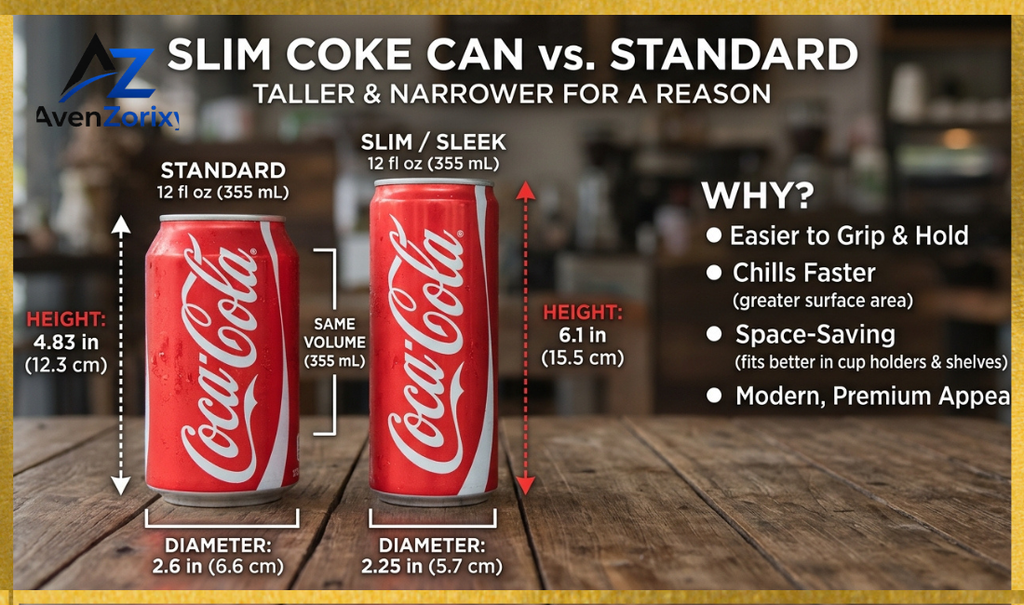
A slim Coke can has a narrower body and a taller profile than a traditional soda can.
A common slim beverage format holds 250 milliliters. Its approximate dimensions may fall around 5.3 to 5.6 inches in height and 2.0 to 2.1 inches in diameter.
The exact dimensions vary depending on the can manufacturer and packaging specification.
Slim Can vs. Standard Coke Can
| Feature | Standard can | Slim can |
|---|---|---|
| Common capacity | 355 ml | 250 ml |
| Shape | Wider and shorter | Narrower and taller |
| Body diameter | Around 2.60 in | Around 2.0–2.1 in |
| Typical height | Around 4.83 in | Around 5.3–5.6 in |
| Appearance | Traditional cylindrical | Tall, slender |
Slim packaging is often associated with energy drinks, flavored sparkling beverages, and smaller soft drink formats.
However, a slim container is not automatically more environmentally friendly or easier to recycle. Material quantity, production methods, transportation, and recycling infrastructure all matter.
Tallboy Coke Can Size: Understanding Larger Beverage Formats
Coca-Cola Soft Drink Can, 16 fl oz
The term tallboy can generally describes a taller beverage container, often holding 16 fluid ounces or approximately 473 milliliters.
A common tall beverage can measures around 6.0 to 6.2 inches tall and approximately 2.6 inches in diameter.
Compared with a standard 12 oz Coke can, it provides considerably more liquid while maintaining a relatively familiar cylindrical shape.
Where Are Tallboy Cans Useful?
Tall cans are often found in:
- Convenience stores.
- Supermarkets.
- Vending machines.
- Outdoor events.
- Beverage coolers.
- Food service environments.
Their additional height can create storage challenges, especially when refrigerator shelves have limited vertical clearance.
If you’re purchasing a tall can for a particular holder, measure the available height before assuming it will fit.
European Coke Can Size: 330 ml Measurements
Meet the Brands: Coca-Cola Original Taste | Coca-Cola Europacific Partners
The 330 ml beverage can is widely recognized across many European markets.
It contains approximately 11.16 US fluid ounces, making it slightly smaller than the standard American 12 oz can.
The dimensions depend on the particular can design, but many traditional 330 ml beverage cans have a height around 4.5 to 4.8 inches and a diameter near 2.55 to 2.60 inches.
One interesting detail is that a 330 ml can and a 355 ml can can look almost identical at first glance. Their capacities are different, but their external dimensions may be quite similar.
This is a good reminder that you cannot accurately determine a drink’s volume just by looking at its container.
Australian Coke Can Size: What Makes the 375 ml Format Different?
Approaching or Just Over Best Before Date – Coca-Cola Classic 375ml – Bunnasia
Australia is well known for its 375 ml soft drink can format.
This container holds approximately 12.68 US fluid ounces, making it somewhat larger than the American 12 oz version.
A typical 375 ml can may measure around 5.2 to 5.4 inches tall, depending on its manufacturer and profile.
The differences between Australian and American packaging reflect regional consumer preferences, beverage industry practices, and established retail formats.
It is worth remembering that not every Australian Coca-Cola product uses exactly the same can design. Packaging can differ across product varieties and manufacturers.
Coke Can Dimensions in Inches, Centimeters, and Millimeters
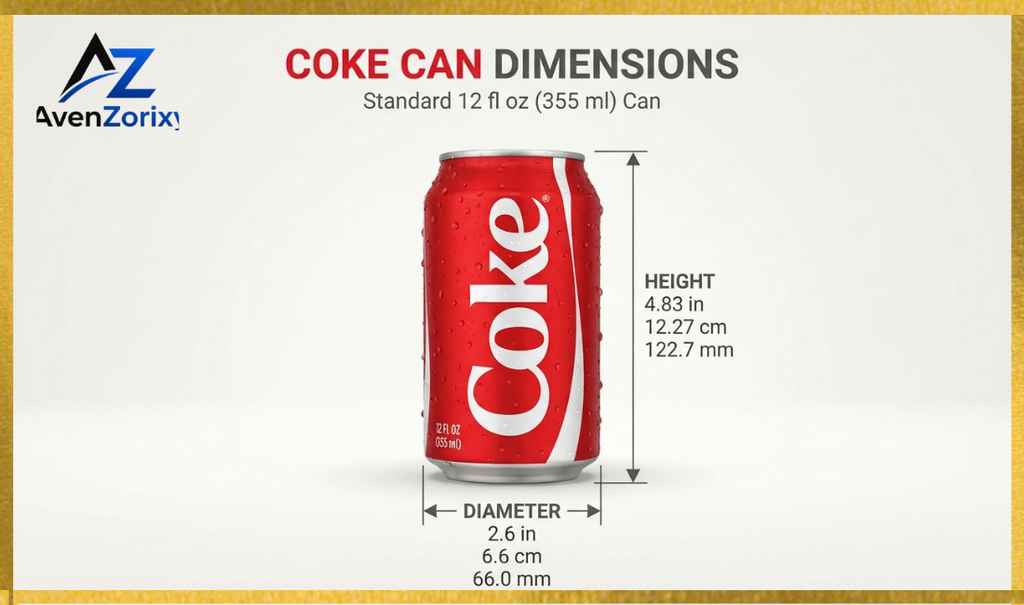
When working with product dimensions, switching between measurement systems is sometimes unavoidable.
Someone designing a custom label may prefer millimeters, while a person organizing a kitchen shelf may find inches easier to understand.
Here is a conversion reference for the standard Coke can.
| Measurement | Inches | Centimeters | Millimeters |
|---|---|---|---|
| Height | 4.83 | 12.27 | 122.7 |
| Diameter | 2.60 | 6.60 | 66 |
| Radius | 1.30 | 3.30 | 33 |
| Circumference | 8.17 | 20.75 | 207.5 |
Coke Can Dimensions in Feet
The standard can is approximately:
- Height: 0.4025 feet.
- Diameter: 0.2167 feet.
- Circumference: 0.6808 feet.
These numbers might look unusual because beverage cans are generally too small to be measured in feet.
Still, the conversion can be useful when working with larger storage layouts or packaging measurements.
How to Convert Inches Into Centimeters
The conversion formula is straightforward:
\[ 1 \text{ inch} = 2.54 \text{ cm} \]
For a standard can measuring 4.83 inches tall:
\[ 4.83 \times 2.54 = 12.2682 \text{ cm} \]
Rounded to two decimal places, the result is 12.27 cm.
How to Convert Inches Into Millimeters
One inch equals 25.4 millimeters.
Therefore:
\[ 4.83 \times 25.4 = 122.682 \text{ mm} \]
The height is approximately 122.7 mm.
Coke Can Weight: Empty vs. Full Measurements
The weight of a Coke can depends on its size, aluminum thickness, manufacturing process, and liquid content.
A standard empty 12 oz aluminum beverage can commonly weighs approximately 12 to 15 grams, although actual values vary.
Once filled, the weight increases considerably.
Coca Cola Soda Can PNG Image | Coca cola, Cola, Canning
| Type | Approximate weight |
|---|---|
| Empty standard aluminum can | 12–15 grams |
| Liquid inside a 355 ml can | Around 355 grams |
| Full standard Coke can | Around 367–370 grams |
The liquid weight is approximately 355 grams because the density of Coca-Cola is relatively close to that of water, although sugar and other ingredients make the exact density different.
Why Are Aluminum Cans So Lightweight?
Modern beverage cans are engineered to use relatively little material while maintaining enough strength to contain pressurized drinks.
Manufacturers use specialized aluminum alloys and forming techniques to create a strong structure with thin walls.
The body and end of the can may use different alloy specifications. For example:
- 3004 aluminum alloy is commonly associated with beverage can bodies.
- 5182 aluminum alloy is commonly used for can ends.
These materials help manufacturers balance strength, formability, and weight.
Coke Can Lid Diameter and Pull Tab Measurements
The top of a Coke can is not simply a flat circular piece of metal.
It contains a carefully engineered end, commonly referred to in the industry as a can end. A standard beverage can may use a 202-size end, where the nominal end diameter is approximately 2 2/16 inches, or around 52.4 mm.
The top has several important components:
- Pull tab: The small lever used to open the can.
- Scored opening: A weakened section designed to separate when the tab is lifted.
- Rivet: The central attachment holding the tab in place.
- Can end: The shaped aluminum top that seals the beverage.
- Necked section: The narrower area connecting the can body to its top.
Is the Lid Diameter the Same as the Body Diameter?
No.
The body diameter of a standard can is approximately 66 mm, while its top end is narrower.
This difference is intentional. The reduced top profile helps save material, improves stacking and packaging efficiency, and allows the can to use a smaller end.
It is a small design detail, but it plays an important role in beverage packaging.
Why Coke Cans Have a Cylindrical Shape
At first glance, the cylindrical shape of a Coke can might seem like a simple design choice. In reality, it offers several practical advantages.
N50.3 ideal necking machine for light weight cans – Hinterkopf
Strength Under Internal Pressure
Carbonated beverages contain dissolved carbon dioxide. Once sealed, the gas creates internal pressure inside the container.
A cylindrical body distributes pressure more evenly than many other basic container shapes.
This helps the can maintain its structure while holding a fizzy drink.
Efficient Storage
Cylindrical cans can be arranged in rows, trays, vending machines, and refrigerator compartments.
Their shape makes transportation and retail display relatively straightforward.
Comfortable Handling
A standard can is narrow enough for most adults to hold comfortably.
The familiar shape also makes it easy to pour into glasses or drink directly from the opening.
Lightweight Construction
Aluminum is relatively lightweight and can be formed into thin walls with carefully shaped ends.
This reduces the amount of packaging material needed compared with many alternative container designs.
Coke Can Engineering: How Is a Beverage Can Manufactured?

A modern aluminum beverage can is the result of a surprisingly sophisticated manufacturing process.
It begins with aluminum sheet material, which is cut into circular blanks. These blanks are then formed into shallow cups through a process known as drawing.
The cups pass through additional forming stages that stretch and shape the metal into the familiar can body.
The Main Manufacturing Stages
- Blanking: Circular pieces are cut from aluminum sheet.
- Drawing: The flat pieces are formed into shallow cups.
- Redrawing and ironing: The cups become taller and thinner.
- Trimming: The upper edges are cut to the required height.
- Cleaning: Residues are removed from the surface.
- Printing: Branding, colors, and product information are applied.
- Necking: The upper body is narrowed.
- Flanging: The top edge is shaped for sealing.
- End attachment: A filled can is sealed with a specially formed aluminum end.
This entire process must be carefully controlled because even small manufacturing variations can affect the final product.
Coke Can vs. Pepsi Can: Are Their Dimensions the Same?
People often assume Coca-Cola and Pepsi use exactly the same can dimensions.
In many markets, their standard 355 ml cans are similar in size because they use common beverage packaging formats.
However, similar capacity does not guarantee identical external dimensions.
| Feature | Coca-Cola | Pepsi |
|---|---|---|
| Common US capacity | 355 ml | 355 ml |
| Standard format | Aluminum can | Aluminum can |
| General shape | Cylindrical | Cylindrical |
| Typical height | Around 4.8 in | Around 4.8 in |
| Typical body diameter | Around 2.6 in | Around 2.6 in |
Exact dimensions depend on the packaging supplier and product format.
Coke Can vs. Red Bull vs. Monster Energy
Different beverage brands use different container shapes to communicate their product identity and accommodate different serving sizes.
Coca Cola Soft Drink Can | 355ML/Unit, 32 Units/Case – Walmart.com
Red Bull Energy drink 250ml – Energetické a iontové nápoje | JASO – CASH and CARRY, s.r.o.
Coca-Cola
The standard Coca-Cola can is a familiar medium-height cylindrical container. Its traditional US format holds 355 ml.
Red Bull
A common Red Bull can holds 250 ml and uses a narrow, tall design.
Its shape is noticeably slimmer than a standard Coke can.
Monster Energy
Monster Energy commonly uses a 16 oz format in the United States, equivalent to approximately 473 ml.
Its container is generally taller than a regular Coke can and provides a larger serving.
| Brand | Common capacity | General design |
|---|---|---|
| Coca-Cola | 355 ml | Standard cylindrical |
| Red Bull | 250 ml | Slim |
| Monster Energy | 473 ml | Tall |
| Celsius | 355 ml | Slim or sleek, depending on market |
These comparisons show how beverage companies use container design to distinguish their products while maintaining practical packaging dimensions.
Does a Coke Can Fit in a Standard Cup Holder?
In most cases, yes.
A standard 12 oz Coke can has a body diameter of approximately 2.60 inches, making it compatible with many ordinary vehicle cup holders.
However, not every cup holder is designed the same way.
Some have adjustable grips, while others have fixed circular openings. A particularly narrow holder might not accommodate the can comfortably.
Mini cans generally fit easily, while wider or unusually shaped beverage containers may require more space.
If you’re buying a car organizer, measuring its internal diameter is a much safer option than relying on appearance alone.
Coke Can Storage Dimensions: Refrigerator, Cooler, and Shelf Planning
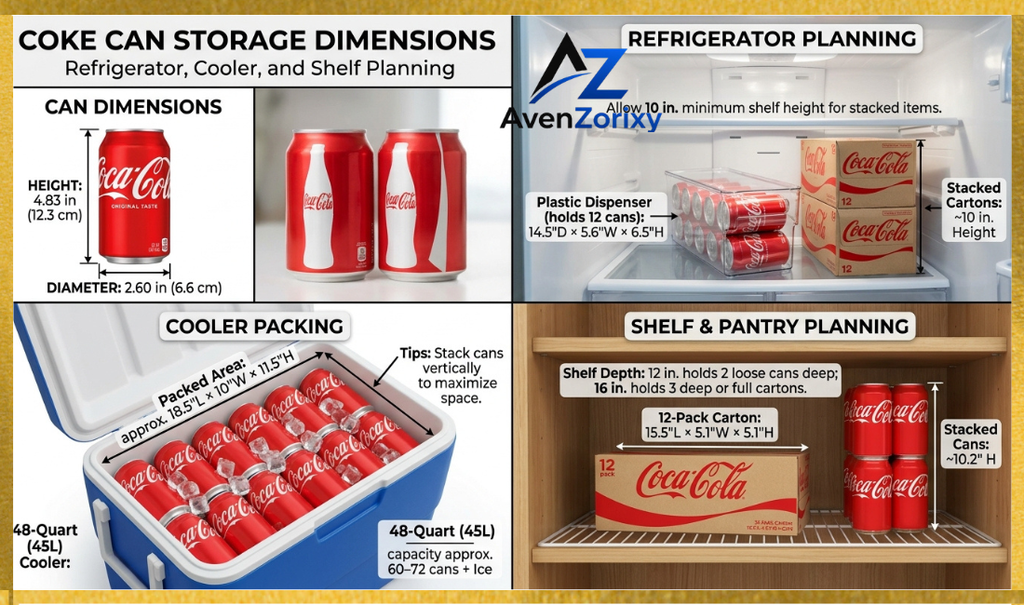
Understanding beverage dimensions can make everyday storage surprisingly easier.
Imagine preparing for a family gathering. You buy a multipack of Coca-Cola, open the refrigerator, and suddenly discover that the shelves are not quite as generous as they appeared in the shop.
This is where knowing the dimensions becomes helpful.
Refrigerator Storage
A standard Coke can requires approximately:
- 4.83 inches of vertical clearance.
- 2.60 inches of body width.
- Slightly more room for comfortable handling.
For upright storage, allow additional clearance above the can.
Cooler Packing
When arranging cans inside a cooler, consider both their height and diameter.
A standard can occupies approximately 2.60 inches of horizontal space.
For example, four cans arranged in a straight row need around 10.4 inches of body width, excluding additional gaps and cooler wall clearance.
Vending Machine Compatibility
Vending machines are designed around particular package dimensions.
The can’s diameter, height, and overall profile affect how it moves through dispensing mechanisms.
A mini can or slim can may need a different dispensing configuration from a standard beverage container.
Coke Can Label Dimensions and Custom Can Wrap Measurements
Custom can labels are popular for birthday parties, weddings, promotional events, and personalized gifts.
A red Coca-Cola can can become part of a themed party arrangement with a customized message or decorative wrap.
Customize a 12 fl oz Can of Coca-Cola | Coca-Cola Store
However, creating a label requires more than measuring the circumference.
For a standard can with an approximate body circumference of 8.17 inches, a wrap needs to account for:
- Label width.
- Label height.
- Adhesive overlap.
- Curved shoulder area.
- Bottom clearance.
- Manufacturing and printing tolerances.
A practical approach is to measure the actual can you intend to decorate.
Do not assume every standard 12 oz can has exactly the same printable surface.
If the label is too wide, the edges may overlap. If it is too tall, it could wrinkle around the shoulders or interfere with the can’s top and bottom sections.
For professional packaging, always request the manufacturer’s dieline or technical specifications.
Coke Can Volume and Capacity: How Much Liquid Does Each Size Hold?
Capacity is one of the most important differences between beverage can formats.
Here is a simple reference chart.
| Can size | Milliliters | US fluid ounces |
|---|---|---|
| 7.5 oz | 222 ml | 7.5 oz |
| 250 ml | 250 ml | 8.45 oz |
| 330 ml | 330 ml | 11.16 oz |
| 355 ml | 355 ml | 12 oz |
| 375 ml | 375 ml | 12.68 oz |
| 473 ml | 473 ml | 16 oz |
| 500 ml | 500 ml | 16.91 oz |
| 591 ml | 591 ml | 19.98 oz |
A 355 ml can holds approximately 0.355 liters of liquid.
The capacity is not the same as the can’s external geometric volume. Manufacturers leave room for the can’s internal pressure conditions and filling requirements, so the container’s physical dimensions and its advertised liquid capacity are different measurements.
Frequently Asked Questions About Coke Can Size
How tall is a Coke can?
A standard 12 oz Coke can is approximately 4.83 inches tall, or 12.27 centimeters. Different capacities and regional formats have different heights.
What is the diameter of a standard Coke can?
The body diameter is approximately 2.60 inches, equivalent to 6.60 centimeters or 66 millimeters.
What are the dimensions of a 12 oz Coke can?
A typical standard can measures approximately 4.83 inches in height and 2.60 inches in body diameter. Its capacity is 355 ml.
What is the circumference of a Coke can?
The circumference of a standard Coke can is approximately 8.17 inches, or 20.75 centimeters.
What is the radius of a standard Coke can?
Its approximate body radius is 1.30 inches, or 3.30 centimeters.
What is the height of a Coke can in centimeters?
A standard 12 oz can is around 12.27 centimeters tall.
How wide is a Coke can?
The body is approximately 2.60 inches wide. The top is narrower because of the necking process.
What size is a mini Coke can?
A popular mini Coke can holds 7.5 fluid ounces, approximately 222 ml. Its height is commonly around 3.7 to 3.9 inches.
What are slim Coke can dimensions?
A common 250 ml slim can may measure approximately 5.3 to 5.6 inches tall and 2.0 to 2.1 inches wide. Exact dimensions vary.
Why are Australian Coke cans different?
Australian markets commonly use 375 ml beverage cans, while the standard US format is 355 ml. This reflects differences in regional packaging formats and consumer markets.
What are European Coke can dimensions?
A common European format holds 330 ml. Its external dimensions vary, but many examples measure around 4.5 to 4.8 inches in height.
Does a Coke can fit in a standard cup holder?
Most standard vehicle cup holders accommodate a regular Coke can because its body diameter is approximately 2.60 inches. Some narrow or specialized holders may be different.
What is the lid diameter of a Coke can?
A common standard beverage can end is approximately 52.4 mm in nominal diameter. The actual top profile is more complicated than a simple flat circle.
How much does an empty Coke can weigh?
A typical empty 12 oz aluminum can weighs approximately 12 to 15 grams, depending on its construction.
How much does a full Coke can weigh?
A full 355 ml Coke can weighs approximately 367 to 370 grams, including the aluminum container.
How to Choose the Right Coke Can Size for Your Needs
Choosing the right beverage container is not always about selecting the largest one.
The best format depends on where you intend to use it.
For everyday drinking: A standard 12 oz can offers a familiar serving size.
For smaller portions: A 7.5 oz mini can provides a more compact alternative.
For narrow storage spaces: Slim cans may work better where horizontal space is limited, although their height needs consideration.
For larger servings: A 16 oz tallboy format offers more liquid but requires additional vertical clearance.
For parties and events: Mini cans can be easier to arrange on serving tables, while standard cans offer a familiar option for guests.
For custom packaging: Always measure the actual container before printing labels or ordering wraps.
The little details matter, especially when you’re buying packaging materials in bulk or designing something that needs to fit perfectly.
Frequently Asked Question
How Big Is a Coke Can
A standard 12 oz (355 ml) Coke can is about 4.83 inches (12.3 cm) tall and 2.6 inches (6.6 cm) in diameter, making it the most common soft drink can size worldwide.
Coke Can Size
The standard Coke can size holds 12 oz (355 ml) of beverage, although Coca-Cola also offers mini, slim, tallboy, and regional can sizes for different markets.
Coke Can Sizes
Coke can sizes include 7.5 oz (222 ml) mini cans, 12 oz (355 ml) standard cans, 250 ml slim cans, 330 ml cans, 375 ml cans, and 16 oz (473 ml) tallboy cans, depending on the country and product line.
Circumference of Coke Can
The circumference of a standard Coke can is approximately 8.17 inches (20.7 cm), based on its diameter of about 2.6 inches (6.6 cm).
Coke Can Width
The width (diameter) of a standard Coke can is approximately 2.6 inches (6.6 cm), allowing it to fit most car cup holders, vending machines, and standard beverage coolers.
Read this blog https://avenzorixy.com/what-date-is-20-weeks-ago-from-today/
Conclusion: Understanding Coke Can Size Beyond Its Familiar Appearance
A Coca-Cola can may look like an ordinary aluminum container, but its design combines useful measurements, careful engineering, and practical packaging decisions.
A standard 12 oz Coke can measures approximately 4.83 inches tall, 2.60 inches across the body, and 8.17 inches around its circumference. It holds about 355 ml of liquid and weighs roughly 367 to 370 grams when full.
Mini cans, slim cans, European 330 ml formats, Australian 375 ml containers, and larger tallboy cans offer different combinations of height, diameter, and capacity.
Understanding these variations makes it easier to choose the right beverage format, organize refrigerator shelves, plan cooler storage, create custom labels, and compare different brands.
And perhaps that’s the interesting thing about everyday objects: something as familiar as a red soda can can reveal an entire world of thoughtful design once we take a closer look.
Whether you’re measuring a can for a school project, preparing a party, designing packaging, or simply satisfying your curiosity, these measurements give you a reliable starting point. Share your favorite Coke can format or any interesting packaging measurements you’ve discovered in the comments.