Have you ever looked at a clock and wondered what the time was several hours earlier? Maybe you’re checking when a message arrived, trying to remember the time of an important phone call, or figuring out when you started working on a project.
Whatever the reason, knowing What Time Was It 9 Hours Ago can be surprisingly useful in everyday life. Sometimes, the clock seems to move forward so quickly that remembering an earlier moment feels harder than it should.
Imagine checking your watch in the evening and realizing that nine hours have passed since the beginning of your busy day. You might have started your morning with a cup of tea, answered a few messages, completed your work, and suddenly found yourself thinking about what happened earlier. A simple time calculator can help you retrace those hours without making your head spin.
The good news is that calculating the time nine hours ago is straightforward. You simply subtract nine hours from the current time, paying attention to whether the calculation crosses midnight or changes the date.
In this guide, we’ll explore how to calculate the exact past time, understand AM and PM, use time calculation tools, and apply these methods to real-life situations.
| Detail | Value |
|---|---|
| Time Offset | 9 Hours Ago |
| Calculation | Current Time − 9 Hours |
| Unit Equivalent | 540 Minutes |
| In Seconds | 32,400 Seconds |
| In Milliseconds | 32,400,000 Milliseconds |
| Result | Exact time depends on the current local time and time zone. |
What Time Was It 9 Hours Ago?
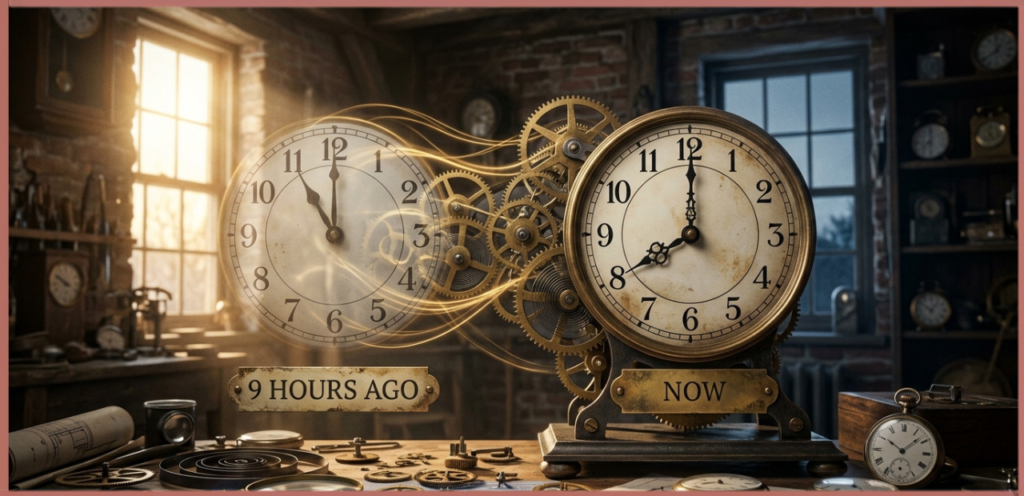
The answer depends on your current time and local timezone. To determine the time nine hours ago, subtract nine hours from the time displayed on your clock. The result may fall in the morning, afternoon, evening, or even the previous day.
For example, if your current clock shows 9:06 PM, subtracting nine hours gives you 12:06 PM on the same day. That means it was noon just over nine hours earlier.
Here are a few examples to make the calculation easier to understand:
- If the current time is 9:00 AM, nine hours ago was 12:00 AM, or midnight.
- If the current time is 12:00 PM, nine hours ago was 3:00 AM.
- If the current time is 3:00 PM, nine hours ago was 6:00 AM.
- If the current time is 6:00 PM, nine hours ago was 9:00 AM.
- If the current time is 9:00 PM, nine hours ago was 12:00 PM, or noon.
- If the current time is 11:30 PM, nine hours ago was 2:30 PM.
- If the current time is 4:00 AM, nine hours ago was 7:00 PM on the previous day.
These examples demonstrate why knowing the current time matters. There is no single answer that applies to everyone at every moment, because the calculation begins with the clock time you are using.
How to Calculate Time 9 Hours Ago
You don’t need a complicated formula or advanced mathematics to calculate the past time. A little clock arithmetic is enough, and once you understand the process, you’ll be able to do it mentally in just a few seconds.
Step 1: Check the Current Clock Time
Start by looking at your phone, computer, watch, or another reliable clock. Make sure you’re using the correct local time, especially if you’re calculating the time for a different country or timezone.
For instance, suppose your digital clock displays 7:45 PM. This is your starting point, and you’ll subtract nine hours from it.
Step 2: Subtract Nine Hours
Take the hour value and move backward by nine hours. In the example of 7:45 PM, subtracting seven hours takes you to 12:45 PM. Subtracting the remaining two hours brings you to 10:45 AM.
Therefore, nine hours before 7:45 PM was 10:45 AM.
This is an example of time subtraction, a basic form of time arithmetic that helps you determine an earlier point on the clock.
Step 3: Check Whether Midnight Was Crossed
If subtracting nine hours takes you past midnight, the answer belongs to the previous day. This is the part that often causes confusion, especially when people are working late at night or calculating a time early in the morning.
For example, if it’s 5:00 AM on Tuesday, subtracting nine hours gives you 8:00 PM on Monday. The clock moves backward into the evening of the previous day.
Step 4: Confirm AM or PM
Finally, check whether the answer falls before or after noon. A mistake between AM and PM can change the meaning of your answer completely, so it’s worth checking twice when accuracy matters.
Following these steps makes it easy to calculate time 9 hours ago without needing an online tool every time.
What Time Was It 9 Hours Ago Using a Time Calculator?
A time calculator is an online tool that performs clock arithmetic for you. Instead of manually subtracting hours, you enter a starting time, select the number of hours to subtract, and let the tool calculate the result.
An hours ago calculator is particularly helpful when you’re dealing with several time intervals, dates, or timezone differences. It can reduce mistakes when you’re tired, in a hurry, or working with information that needs to be accurate.
For example, if you want to know what time was nine hours ago from 9:06 PM, the calculation is simple:
- Starting time: 9:06 PM
- Hours to subtract: 9
- Result: 12:06 PM
- Time interval: 9 hours
- Date change: None, assuming both times fall on the same calendar day
The result is 12:06 PM, which is nine hours before 9:06 PM.
An online 9 hour time calculator may also help you work with minutes, seconds, and dates. Depending on the tool, you might be able to calculate a past date and time, compare two clock readings, or add hours instead of subtracting them.
For everyday calculations, however, the basic subtraction method is often all you need.
What Time Was It 9 Hours Ago on Tuesday, October 13, 2026?
Let’s use a specific example to see how the calculation works with a calendar date.
Suppose the date is Tuesday, October 13, 2026, and your local clock shows 9:06 PM. Subtracting nine hours gives 12:06 PM on Tuesday, October 13, 2026.
The calculation looks like this:
- Current date: Tuesday, October 13, 2026
- Current time: 9:06 PM
- Subtraction: 9 hours
- Past time: 12:06 PM
- Past date: Tuesday, October 13, 2026
Because the starting time is in the evening, moving backward nine hours takes you to midday on the same date. No calendar change is necessary.
Now consider a different starting time. If the clock shows 6:15 AM on Tuesday, October 13, subtracting nine hours takes you to 9:15 PM on Monday, October 12.
This illustrates an important point: date and time are connected. When you calculate a past time, always consider the date as well as the hour and minute.
The examples above use hypothetical clock readings to explain the calculation. They don’t establish the current time for every reader, since people in different places may be following different local clocks.
Understanding AM, PM, Noon, and Midnight
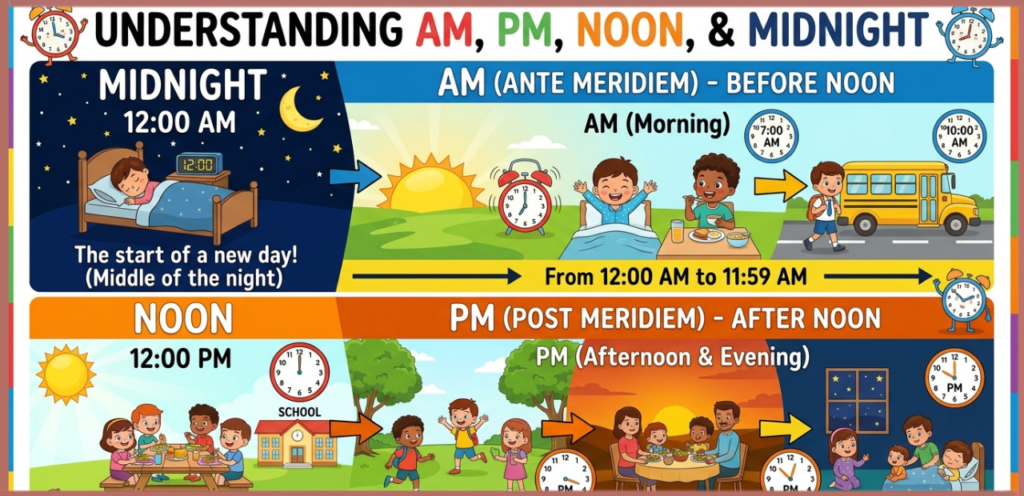
Before using an exact time calculator, it’s useful to understand the 12-hour clock. Many everyday clocks use AM and PM to distinguish the first and second halves of the day.
- AM: The period from midnight until just before noon.
- PM: The period from noon until just before midnight.
- Noon: 12:00 PM, the middle of the day.
- Midnight: 12:00 AM, the beginning of a new calendar day.
These distinctions are important when subtracting nine hours because the answer can cross from one part of the day into another.
For instance, nine hours before 2:00 PM is 5:00 AM. Meanwhile, nine hours before 2:00 AM is 5:00 PM on the previous day.
Both calculations involve subtracting the same number of hours, yet the results fall in different parts of the day. It’s a small detail, but one that makes a big difference when you’re scheduling appointments or checking past events.
A Quick AM and PM Conversion Example
Suppose you need to calculate the time nine hours before 8:20 PM.
- Begin at 8:20 PM.
- Subtract eight hours to reach 12:20 PM.
- Subtract one additional hour to reach 11:20 AM.
The final answer is 11:20 AM.
Understanding this method makes AM and PM conversion feel less confusing. Instead of memorizing countless time combinations, you can simply move backward on the clock.
Why the Previous Day Matters in Time Calculations
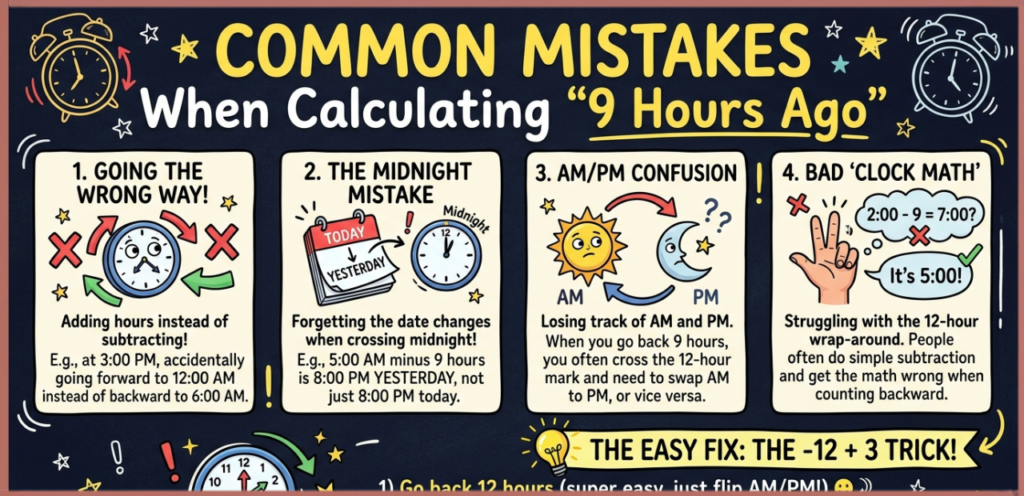
One common mistake in a past time calculation is forgetting to change the date when the subtraction crosses midnight. This can create confusion when checking emails, reviewing records, or planning a schedule.
Imagine waking up at 5:30 AM on Tuesday and trying to determine the time nine hours earlier. Subtracting nine hours produces 8:30 PM on Monday.
The correct answer is not 8:30 PM on Tuesday, because that would be later in the day rather than earlier.
Here are more examples of calculations that cross midnight:
- 1:00 AM minus 9 hours = 4:00 PM on the previous day.
- 2:30 AM minus 9 hours = 5:30 PM on the previous day.
- 4:00 AM minus 9 hours = 7:00 PM on the previous day.
- 6:45 AM minus 9 hours = 9:45 PM on the previous day.
- 8:15 AM minus 9 hours = 11:15 PM on the previous day.
- 11:00 AM minus 9 hours = 2:00 AM on the same day.
Notice that the first five calculations move into the previous evening. The final example stays on the same day because 11:00 AM is late enough in the morning for nine hours to be subtracted without reaching the previous date.
This is why a good date and time calculator should consider both the clock reading and the calendar.
Real-Life Reasons to Find Out What Time It Was 9 Hours Ago
Calculating a past time isn’t only a mathematical exercise. It can help with ordinary tasks that require you to remember when something happened, and the answer may be more useful than you initially expect.
Checking Messages and Calls
Have you ever received a message and wondered when the sender might have written it? Subtracting nine hours from the current time can help you estimate the time of an earlier event when you know its elapsed duration.
For example, if someone says they sent a message nine hours ago and it’s currently 8:00 PM, the message was sent at approximately 11:00 AM, assuming the same local timezone and no ambiguity about the elapsed period.
This can be helpful when following up on work conversations or remembering a personal discussion.
Tracking Work Hours
People who work remotely often need to keep track of when they started a task, attended a meeting, or submitted a project. Calculating the time before now can provide a quick reference when the starting time is known.
Suppose you finish a long work session at 7:30 PM and want to know the clock time nine hours earlier. The answer is 10:30 AM.
This doesn’t automatically tell you how much time you actually worked, because breaks and interruptions still matter, but it gives you a useful starting point.
Understanding Online Activity
Some websites and applications display activity timestamps such as “9 hours ago.” If you’re reviewing a post, comment, or update, the corresponding clock time can help you understand when it appeared.
However, the displayed time may depend on the platform’s timezone settings, rounding rules, or update frequency. Treat the result as an estimate unless the service provides an exact timestamp.
Managing Daily Routines
Nine hours can cover a substantial portion of a normal day. You might use this calculation to remember when you ate breakfast, started studying, began travelling, or settled into a particular activity.
Even a small calculation can make a busy day easier to reconstruct. And when several events need to be compared, writing down the dates and times helps keep the sequence clear.
Time Conversion: Nine Hours in Minutes, Seconds, and Milliseconds
Sometimes, you need more than a clock reading. A time conversion can express the same duration in different units, making it useful for calculations, software, scheduling, and technical records.
Nine hours equals:
- 540 minutes
- 32,400 seconds
- 32,400,000 milliseconds
These values represent the same duration, simply expressed using different units.
To understand the calculation, multiply nine hours by 60 to convert hours into minutes:
9 × 60 = 540 minutes.
Then multiply 540 minutes by 60 to obtain seconds:
540 × 60 = 32,400 seconds.
Finally, multiply the number of seconds by 1,000 to obtain milliseconds:
32,400 × 1,000 = 32,400,000 milliseconds.
These conversions are useful in computer programming, digital timers, video editing, and other situations where time is measured precisely.
Still, remember that nine elapsed hours and nine hours on a clock are not always identical in every unusual situation. Daylight saving changes can affect local clock readings, even though the elapsed duration remains nine hours.
Time Zones and PDT: Why Local Time Matters

Your answer may differ from someone else’s if you are using different timezones. When calculating what time was it 9 hours ago, the safest approach is to start with the clock time in the location relevant to your question.
For example, a person in Pakistan and someone in California may see different local clock readings at the same instant. Subtracting nine hours from each local time can produce different-looking answers, even though both calculations represent the same elapsed duration in their respective local clocks.
PDT (Pacific Daylight Time) is the daylight saving timezone used in parts of western North America during the applicable season. It is UTC 7. Pacific Standard Time (PST), used during standard time, is UTC 8.
If you are calculating a time for someone in California, confirm whether PDT or PST applies on the date in question. Don’t assume that every date uses the same offset.
For example, a meeting scheduled for 9:00 PM PDT corresponds to 4:00 AM UTC on the following calendar day. The date may change during timezone conversion, so always include the timezone when accuracy matters.
A time zone conversion tool is useful when comparing meeting times, coordinating international calls, or reviewing records created in another region.
Comparing 9 Hours Ago With Other Time Intervals
Nine hours is only one possible duration. Depending on your needs, you might also want to calculate 10 hours ago, 12 hours ago, or several hours from now.
Here are some examples using 9:00 PM as the starting time:
- 9 hours ago: 12:00 PM.
- 10 hours ago: 11:00 AM.
- 11 hours ago: 10:00 AM.
- 12 hours ago: 9:00 AM.
- 13 hours ago: 8:00 AM.
- 14 hours ago: 7:00 AM.
- 10 hours from now: 7:00 AM the next day.
- 11 hours from now: 8:00 AM the next day.
- 12 hours from now: 9:00 AM the next day.
- 13 hours from now: 10:00 AM the next day.
- 14 hours from now: 11:00 AM the next day.
These examples assume a starting time of 9:00 PM and ordinary clock arithmetic without a timezone transition.
An hours from now calculator works in the opposite direction from an hours-ago tool. Rather than moving backward, it adds the chosen duration to the starting time.
Likewise, a time difference calculator can compare two clock readings and determine how many hours and minutes separate them. This is particularly helpful when the interval isn’t a whole number of hours.
How an Online Hours Ago Calculator Helps
A reliable online time calculator can simplify the process when you need to calculate several intervals or work with dates.
Useful features may include:
- Subtracting a selected number of hours from a starting time.
- Adding hours to calculate a future clock reading.
- Handling changes between dates.
- Converting hours into minutes and seconds.
- Comparing two timestamps.
- Supporting different timezones.
- Calculating intervals that include minutes and seconds.
A time difference calculator is useful when you know both the starting and ending times. An elapsed time calculator, meanwhile, focuses on the duration between two moments.
For example, if you started a task at 8:15 AM and finished at 5:45 PM, the elapsed duration is nine hours and thirty minutes. If you took a one-hour lunch break, your working time would be eight hours and thirty minutes.
The clock difference and the actual time spent working are not always the same thing. A calculator can handle the arithmetic, but you still need to account for breaks and other interruptions where relevant.
Common Mistakes When Calculating Nine Hours Ago
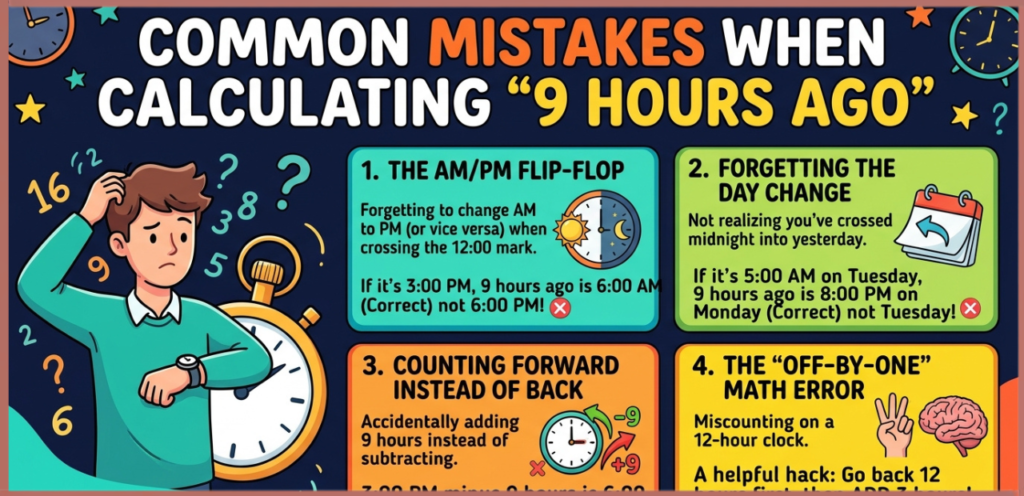
Even a simple calculation can go wrong when the starting time isn’t interpreted correctly. Fortunately, most mistakes are easy to avoid.
Forgetting to Change the Date
If the result crosses midnight, the answer belongs to the previous day. Always verify the calendar date rather than recording only the clock time.
Mixing Up AM and PM
A result of 7:00 AM is very different from 7:00 PM. Check the 12-hour clock period before finalizing your answer.
Using the Wrong Timezone
If you’re calculating the time of an online event, confirm which timezone the timestamp uses. Your local clock may not match the clock used by the website.
Ignoring Daylight Saving Time
In regions that observe daylight saving, local clock changes can affect date-and-time calculations. For exact historical timestamps, use a timezone-aware calculator rather than relying only on mental arithmetic.
Confusing Elapsed Time With a Clock Reading
Nine hours is a duration; 12:06 PM is a clock reading. The duration tells you how far apart two moments are, while the clock reading tells you when one of those moments occurred.
Understanding this difference makes time calculation more reliable and reduces confusion in everyday situations.
Frequently Asked Questions
What time was it exactly 9 hours ago?
The exact answer depends on the starting time. If it is 9:06 PM, nine hours ago was 12:06 PM on the same day. If it is 5:00 AM, nine hours ago was 8:00 PM on the previous day.
How do I calculate nine hours before the current time?
Look at your current clock, subtract nine hours, and check whether the result crosses midnight. If it does, move the calendar date back by one day.
What is nine hours in minutes?
Nine hours equals 540 minutes. Multiply nine by 60 to get the result.
How many seconds are there in nine hours?
Nine hours equals 32,400 seconds. Each hour contains 3,600 seconds, so multiplying 9 by 3,600 gives 32,400.
Does nine hours ago always mean the previous day?
No. If the current time is later than or equal to 9:00 AM, subtracting nine hours generally stays on the same calendar day. If the starting time is earlier than 9:00 AM, the result falls on the previous day under ordinary clock arithmetic.
Can I use a time calculator for dates as well?
Yes, if the tool supports calendar dates. A date and time calculator can account for the previous day, future dates, and sometimes timezone differences. Check that the tool supports the specific calculation you need.
What is the difference between a time calculator and an hours from now calculator?
A general time calculator may support both past and future calculations, as well as time differences and unit conversions. An hours from now calculator specifically adds a chosen number of hours to a starting time.
Is 12:06 PM the same as noon?
Not exactly. Noon is precisely 12:00 PM, while 12:06 PM is six minutes after noon. Both are in the afternoon portion of the 12-hour clock system, although people sometimes casually describe the period around noon as midday.
How to Make Your Time Calculations More Accurate
If you regularly calculate past times for work, appointments, or personal records, a few simple habits can save you trouble later.
- Record the date along with the time.
- Include AM or PM when using a 12-hour clock.
- Specify the timezone for international events.
- Use a reliable clock as your starting point.
- Check whether the calculation crosses midnight.
- Use a dedicated calculator when handling complex dates or daylight saving transitions.
For example, writing “Tuesday, October 13, 2026, at 12:06 PM PDT” is more informative than writing only “12:06.” The longer version identifies the date, clock time, and timezone, helping another person understand exactly which moment you mean.
You don’t need to make every everyday calculation complicated. But when time records matter, a little extra detail can prevent misunderstandings.
Frequently Asked Question
9 hours ago
Nine hours ago refers to the time exactly nine hours before the current time. It is commonly used to calculate a past time accurately.
what time was it 9 hours ago
To find what time it was 9 hours ago, simply subtract 9 hours from the current time. A time calculator can provide the exact result instantly.
how long ago was 6 hours
Six hours ago means a point in time that occurred exactly six hours before the present moment. It represents a short time interval within the same day or the previous day.
what time was 9 hours ago
The time 9 hours ago is calculated by subtracting nine hours from the current local time. The result depends on the current time and your time zone.
9 hours ago from now
Nine hours ago from now is the exact time and date that occurred nine hours before the present. You can use an hours ago calculator for a quick and accurate calculation.
Read this blog https://avenzorixy.com/4-weeks-ago-from-today/
Conclusion: Find the Time Nine Hours Ago With Confidence
Working out What Time Was It 9 Hours Ago is a simple task once you know where to begin. Check the current clock time, subtract nine hours, and remember to adjust the date if your calculation crosses midnight. With these basic steps, you can determine the earlier time without relying on guesswork.
Whether you’re checking a message, organizing your schedule, calculating working hours, or trying to remember a moment from earlier in the day, the same method applies.
A time calculator, hours ago calculator, or time difference calculator can make the process even easier when you need to handle more complicated situations.
The most important thing is to use the right starting time and pay attention to the date, timezone, and AM or PM designation. Once you understand those details, time arithmetic becomes much less intimidating.
If this guide helped you calculate the time nine hours ago, share your thoughts or your favorite time-calculation tip in the comments. Sometimes, the smallest calculations make the busiest days a little easier to manage.