There is something quietly magical about putting on a ring that fits exactly the way it should. It doesn’t shout for attention, it just sits there as if it always belonged on your finger.
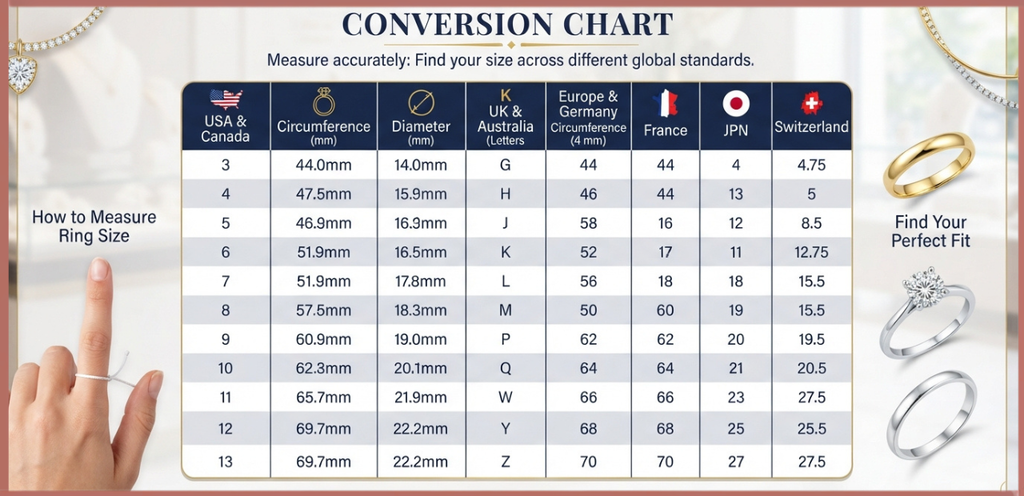
Funny enough, people often spend weeks choosing the perfect design but only a few minutes thinking about the size. That’s where a Ring Size Conversion Chart becomes surprisingly important. A tiny difference of just a few millimeters (mm) can turn a dream purchase into something uncomfortable, and honestly, nobody wants that.
Buying jewelry has changed a lot over the years. More people now shop online, compare international brands, and order engagement rings, wedding bands, and everyday accessories from stores around the world.
It sounds exciting, although it also creates one slightly annoying question. Which size should you choose when every country uses a different sizing system? It can feel a little like trying to solve a tiny puzzle while holding a sparkling diamond.
This guide explores everything you need to know about Ring Size Conversion Chart, from measuring your finger correctly to understanding international sizing standards. Along the way we’ll cover practical techniques, common mistakes, expert tips, and ways to make sure every ring feels like it was made only for you.
| Feature | Details |
|---|---|
| Main Keyword | Ring Size Conversion Chart |
| Purpose | Compare ring sizes across countries |
| Measurement | Inner diameter & circumference (mm) |
| Size Systems | US, UK, EU, Japan & more |
| Best For | Buying rings online |
| Tools Needed | Ring sizer, ruler, or string |
| Tip | Measure your finger at room temperature for the most accurate fit. |
Why a Ring Size Conversion Chart Matters
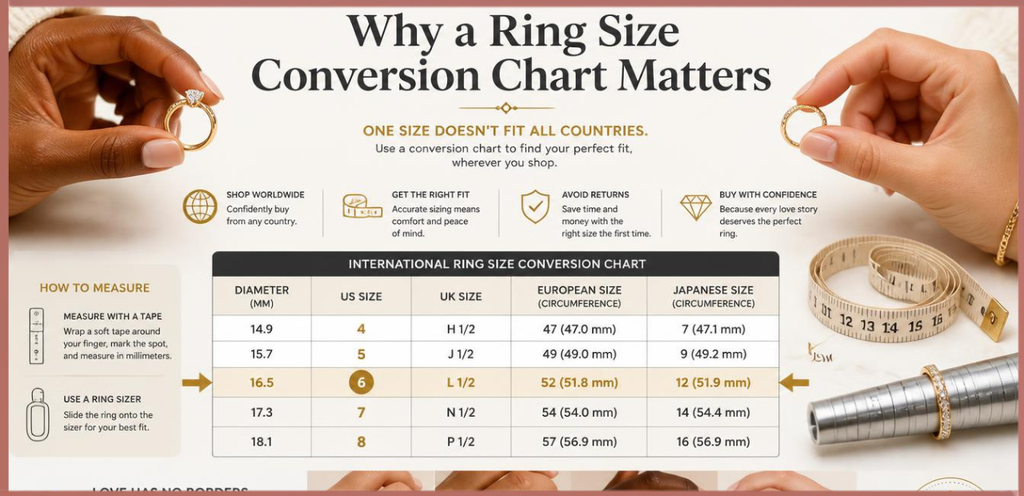
A ring isn’t simply another accessory. It often represents memories, promises, milestones, or celebrations. Whether you’re buying an engagement ring, a simple silver band, or a family heirloom, getting the size right matters more than most people first imagine.
A reliable ring size conversion chart helps compare:
- US ring size
- USA ring sizes
- Canada ring sizes
- UK ring sizes
- France ring sizes
- Germany ring sizes
- Japan ring sizes
- Switzerland ring sizes
Without a proper ring size conversion table, you might accidentally order a size that’s perfect in one country but completely wrong somewhere else. It sounds odd, but it happens every single day.
Even professional jewelers keep conversion charts nearby because different manufacturers sometimes follow different ring size standards.
Understanding Ring Size Measurements
Before looking at numbers, it helps to understand what is actually being measured.
Every ring has an inner diameter, an inside measurement taken straight across the center of the ring. Another important measurement is the ring circumference, which measures the distance around the inside edge.
Both measurements help determine your correct finger measurement.
Important sizing terms include:
- Ring diameter
- Inner diameter
- Ring circumference
- Finger circumference
- Ring dimensions
- Ring measurement
- Finger size
- Standard ring sizes
Most professional ring measurement charts display diameter and circumference together, making ring size conversion much easier.
Ring Size Conversion Chart Around the World
Shopping internationally has never been easier, although sizing definitely hasn’t become simpler.
Here’s a simplified reference.
| Country | Measurement System |
|---|---|
| United States | Numerical sizes |
| Canada | Same as US |
| United Kingdom | Alphabetical letters |
| France | Circumference in millimeters |
| Germany | Inside diameter |
| Japan | Numerical system |
| Switzerland | Modified circumference |
Because every country uses different measurements, an international ring size conversion chart is incredibly useful.
Many luxury brands publish their own international ring size chart, allowing customers to compare sizes before placing an online ring purchase.
How to Measure Ring Size at Home
One nice thing is you don’t always need a professional appointment. Several DIY methods work surprisingly well if done carefully.
Paper Strip Method
The classic paper strip ring measurement remains one of the easiest options.
You’ll need:
- A thin paper strip
- A ruler
- Pen
- Scissors
Wrap the strip around your finger base, make an overlap mark, measure the length, then compare it with a ring size reference chart.
This simple DIY ring size method works quite well when performed carefully.
String Method
Another popular option is the string method.
Wrap a soft string around your finger, mark where both ends meet, and measure it against a ruler.
The string ring measurement should never be pulled tightly because it can shrink slightly and produce inaccurate results.
Many jewelry professionals still recommend this method for quick ring size measurement.
Measure an Existing Ring
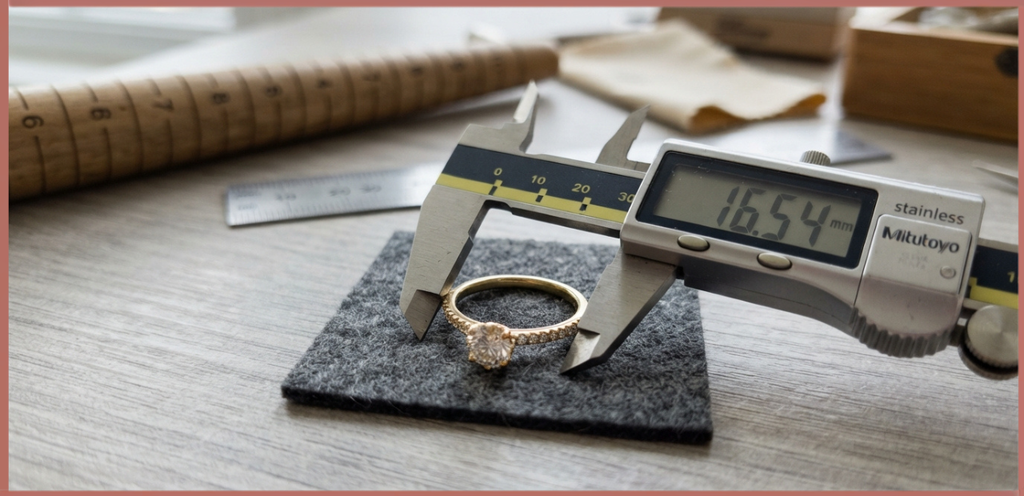
Already own a ring that fits perfectly?
Simply measure the inner diameter using a ruler with millimeters (mm).
Then compare that diameter against a ring diameter chart or ring size by diameter guide.
This method avoids guessing and usually delivers excellent measurement accuracy.
Printable Ring Sizer
Many online jewelry retailers provide a printable ring sizer.
A proper printable sizing guide usually includes:
- Measurement circles
- Printable ruler
- Ring outlines
- Calibration instructions
Always confirm your printer uses 100% scale.
Otherwise the printable ring size chart becomes inaccurate.
Many downloadable printable ring size guide PDF files also include a verification square to check printing accuracy.
Credit Card Ring Sizer
Some websites include a credit card ring sizer.
The process uses your bank card as a calibration reference.
To ensure proper credit card calibration, match your card against the screen before measuring.
Without proper calibration, the results won’t be reliable.
A credit card ring size tool offers convenience, although physical measurements are usually more accurate.
Digital Ring Sizer and Online Tools
Technology keeps making things easier.
Modern shoppers can now use a digital ring sizer, online ring sizer, or even a smartphone-based ring size calculator.
Some advanced tools adjust for:
- Screen calibration
- Browser zoom
- Device resolution
- On-screen measurements
Remember to keep browser zoom at exactly 100%.
Incorrect zoom changes measurements immediately.
Many people ask, how accurate is an online ring sizer?
They’re fairly accurate when properly calibrated, but they should ideally be confirmed using a physical ring sizer.
Ring Size Conversion Chart for Better Online Shopping
Buying rings online can actually be enjoyable once sizing becomes less confusing.
Before ordering:
- Compare your country’s sizing system.
- Check the retailer’s ring size guide.
- Review the ring size conversion guide.
- Verify whether sizes are based on diameter or circumference.
- Double-check the ring size conversion by country.
Many trusted retailers also include a ring buying guide, making online jewelry shopping much safer.
Best Time to Measure Your Finger
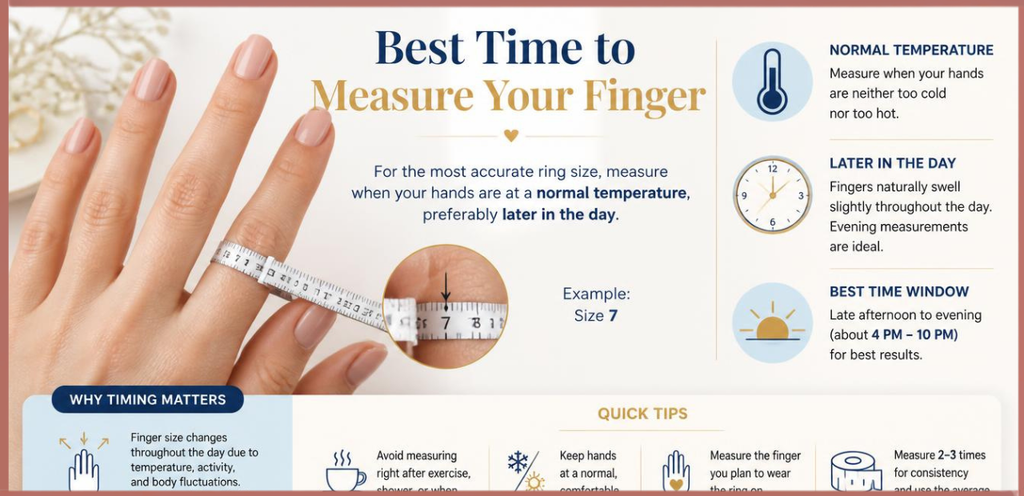
Your fingers aren’t exactly the same size all day. Strange, isn’t it?
Several factors influence finger measurement.
These include:
- Morning finger size
- Evening finger size
- Finger swelling
- Natural swelling
- Cold fingers
- Warm fingers
- Room temperature
Most jewelers recommend measuring during normal room temperature in the late afternoon when fingers are naturally closer to their average size.
Avoid measuring immediately after exercise or during extremely cold weather.
Measuring Around the Knuckle
Some people have larger knuckles than the base of their fingers.
If that’s true for you:
- Measure the knuckle.
- Measure the finger base.
- Choose a comfortable middle measurement.
This prevents a ring from getting stuck while still providing a secure fit.
Many professionals recommend slightly sizing up for larger knuckles.
Thick Band vs Thin Band
The width of the ring band affects comfort more than many people expect.
A thin band usually feels looser.
A thick band covers more skin, creating a tighter feeling.
If choosing a wider ring, many jewelers recommend increasing by a half size.
That small adjustment often creates the perfect fit.
Should You Size Up?
One of the most common questions is:
Should I size up if between ring sizes?
Usually yes.
A slightly loose ring is generally easier to wear than a painfully tight ring.
Of course, the decision also depends on:
- Finger shape
- Weather
- Daily activities
- Band width
The goal is achieving a comfortable fit without creating a ring slips off situation.
Common Ring Fit Problems
A ring should slide over the knuckle with gentle resistance.
Warning signs include:
Tight Ring
- Leaves deep marks.
- Difficult to remove.
- Restricts circulation.
Loose Ring
- Spins constantly.
- Slides off easily.
- Feels unstable.
Proper ring fitting creates both comfort and confidence.
Men’s and Women’s Ring Sizes
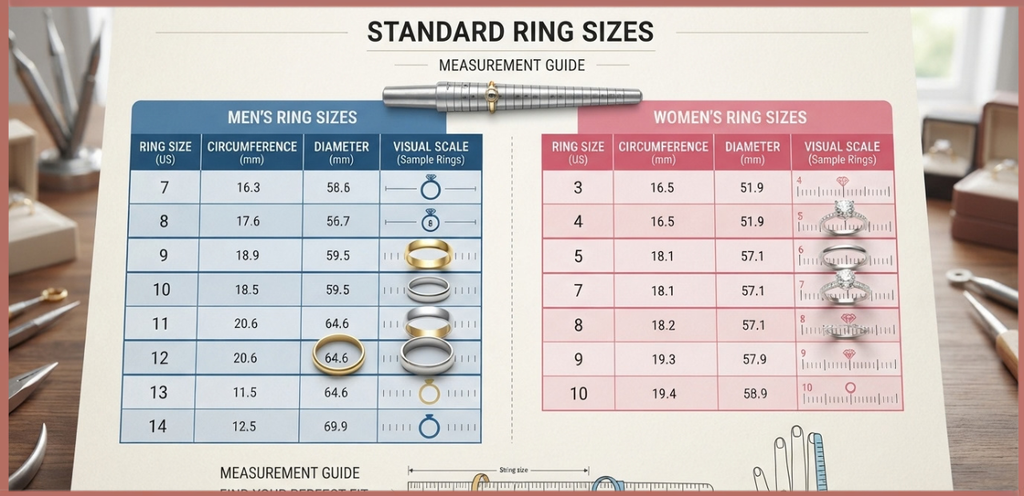
Although everyone’s hands are unique, average sizes often differ.
Typical references include:
- Men’s ring size chart
- Women’s ring size chart
Average women’s sizes usually fall between US 5–7.
Average men’s sizes generally range between US 8–11.
Still, personal finger sizing always matters more than averages.
Professional Ring Sizing
Nothing beats visiting a trusted jewelry store.
A professional jeweler uses precision ring sizing tools designed for highly accurate physical measurement.
Professional sizing accounts for:
- Finger shape
- Knuckle size
- Ring style
- Band width
- Comfort preferences
This remains the gold standard for accurate ring sizing.
Ring Resizing Options
Sometimes even careful measuring isn’t enough.
Fortunately, many rings can be adjusted through ring resizing services.
Common ring resizing options include:
- Making the ring larger
- Making it smaller
- Reinforcing weakened areas
- Refinishing the surface
However, not every ring can safely undergo ring resizing.
Some eternity bands, tension settings, and certain gemstone designs have limited adjustment possibilities.
Ring Size Calculator vs Conversion Table
People often ask which tool is better.
A ring size calculator estimates measurements based on your input.
A ring size conversion table compares existing measurements across countries.
Both are valuable.
Many shoppers actually use both together for maximum confidence.
Helpful Ring Sizing Tips Before Buying Online
Following a few simple habits greatly improves your chances of getting the correct ring size.
- Measure twice.
- Avoid measuring cold fingers.
- Check measurements in millimeters (mm).
- Compare with a ring size comparison chart.
- Use multiple measuring methods.
- Read the retailer’s jewelry sizing guide.
- Review return policies.
These small steps make accurate ring measurement much easier.
Frequently Asked Questions
How to measure ring size with string?
Wrap the string comfortably around your finger, mark where it overlaps, measure with a ruler, then compare the result with a ring measurement chart.
How to measure ring size with paper?
Use a narrow strip of paper, wrap it around the finger, create an overlap mark, measure the length, then compare it against a ring size chart in mm.
How to use a printable ring sizer?
Print at 100% scale, verify calibration, then either wrap the measuring strip or compare an existing ring to printed circles.
How to find your ring size online?
Use a properly calibrated online ring sizer, confirm screen calibration, and compare with an international ring size conversion guide.
Does ring size change throughout the day?
Yes. Temperature, hydration, activity level, and natural swelling all affect finger size.
What if my ring doesn’t fit?
Consult a professional jeweler regarding ring adjustment or available ring resizing services.
Frequently Asked Question
Ring Sizes in mm
Ring sizes in mm are based on the inside circumference or diameter of a ring. Measuring your finger accurately in millimeters helps you choose the correct ring size.
Ring Size mm
A ring size in mm refers to the ring’s inner diameter or finger circumference measured in millimeters. Use a ring size chart to match the measurement with your correct size.
Ring Size Conversion
A ring size conversion chart makes it easy to compare ring sizes between US, UK, Europe, Japan, and other international sizing systems. It helps you find the equivalent size when shopping worldwide.
mm to Ring Size
To convert mm to ring size, measure your finger’s circumference or the ring’s inside diameter in millimeters and compare it with a standard ring size conversion chart.
How to Know My Ring Size
To know your ring size, measure your finger with a measuring tape, string, or an existing ring, then compare the measurement with a ring size chart to find the best fit..
Read this blog https://avenzorixy.com/60-mm-ring-size/
Final Thoughts
Finding the right ring size isn’t about luck, even though it sometimes feels that way after trying five different methods in one afternoon. A dependable Ring Size Conversion Chart, careful ring measurement, and a little patience make all the difference.
Whether you’re searching for the ideal engagement jewelry, choosing wedding jewelry, or simply treating yourself to something beautiful, taking time to measure correctly saves frustration later.
Remember that fingers naturally change with temperature, time of day, and even seasons. That’s perfectly normal, and it’s why experienced jewelers recommend measuring more than once before making an important purchase. Use a ring fitting guide, compare an international ring size chart, and don’t hesitate to ask a trusted jeweler if you’re unsure.
In the end, the best ring isn’t only the one that shines the brightest. It’s the one that feels so comfortable you almost forget you’re wearing it, until someone notices it and smiles. That’s a tiny little detail, maybe, but sometimes tiny details are exactly where lasting memories quietly begin.